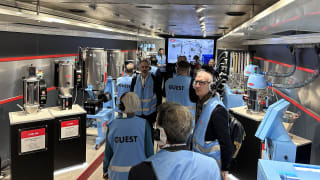
SABIC, a global chemical producer, presented new specialty materials for the automotive industry at PIAE 2026 in Baden-Baden. The portfolio includes LNP Elcrin SLX compounds with post-consumer recycled content, the new thermally conductive LNP Konduit WTF2C compound for use in advanced driver assistance systems (ADAS), and material solutions for vehicle lighting and structural components in electric vehicles. The company states that these solutions are intended to support automotive part design and aesthetics, improve functionality and performance, and contribute to circularity and emission reduction targets.
Sergi Monros, vice president SABIC Polymers, Specialties BU, comments: "To remain competitive, the automotive industry must continuously innovate in many areas, from styling to sustainability. SABIC keeps pace with these changes by proactively developing new materials based on a deep knowledge of customer requirements and market trends. The solutions we are presenting here confirm our understanding of the industry and build on decades of collaboration with OEMs and tier suppliers."
LNP Elcrin SLX compounds with post-consumer recyclate
The new LNP Elcrin SLX2373RCC and SLX2375RCC compounds are produced with 30 and 45 percent post-consumer recycled content respectively. These materials offer high weatherability and good impact resistance, which helps extend the service life of high-gloss, molded-in-color parts. The use of molded-in color eliminates the need for painting and thus reduces emissions of volatile organic compounds associated with coating processes. In addition, material homogeneity facilitates recycling and recovery at the end of the product life cycle.
Among the exhibits at the SABIC stand are a shark fin antenna and a heated ADAS radome manufactured from the new LNP Elcrin SLX compounds. These applications illustrate the ability to achieve high-gloss surfaces while maintaining resistance to outdoor conditions and functional requirements typical for exterior vehicle components.

New LNP Elcrin SLX compounds with post-consumer recycled content used in shark fin antennas; offering high weatherability and impact resistance for high-gloss, molded-in-color parts.
Specialty materials for ADAS systems
In the ADAS field, SABIC's portfolio of specialty materials is intended to address requirements for EMI shielding, mechanical strength, thermal conductivity and chemical resistance in radar, lidar and other sensor systems. The new thermally conductive LNP Konduit WTF2C compound has been developed as an alternative to die-cast aluminum in housings for ADAS radar units and electronic control units (ECUs). Use of this material is expected to enable greater design freedom, weight reduction, lower system costs and reduced emissions associated with vehicle production and operation.
The LNP Konduit WTF2C compound is compatible with existing manufacturing methods used in the automotive industry, including laser welding and heat staking. This can facilitate the introduction of the material into existing production lines and designs for vehicle electronic components.
SABIC's offering of materials for optical applications also includes the new Extem RH1017UCL resin. This is a transparent thermoplastic that withstands lead-free reflow soldering. Its properties make it suitable for use in lenses for optical sensors in driver monitoring and gesture control systems, as well as in solutions enabling optical multigigabit connectivity in next-generation vehicle architectures.
Solutions for automotive lighting
In the vehicle lighting segment, SABIC is showcasing applications of Ultem resins, which meet high temperature requirements up to 230°C. This is important for complex modules such as matrix LED headlamps with adjustable micromirrors. Compared with metal solutions, the use of Ultem resins can help reduce component weight, decrease outgassing and enable direct metallization of parts such as lens barrels, spacers, brackets and reflectors.
Among the lighting applications on display is an illuminated front grille from a leading OEM. In this case, the LNP Elcres SLX1271D copolymer is used to support part design and aesthetics. The material provides a UV-resistant, high-gloss surface and allows molded-in color without the need for painting, including diffusive colors that optimize backlighting.

In automotive lighting applications, Ultem resins meet high temperature requirements up to 230°C for complex modules such as matrix LED headlamps.
Structural components for electric vehicles
SABIC is also exhibiting an energy absorber for electric vehicle batteries made from Noryl GTX resin. The honeycomb demonstrator is intended for installation inside the rocker panel, where it can provide lightweight yet robust side impact protection over a wide temperature range. The part is produced by injection molding, which enables complex geometries and simplifies assembly compared with metal solutions.
The use of Noryl GTX resin in this application is intended to allow the replacement of both metal and polyamide. Compared with polyamide, this material is reported to offer better low-temperature ductility and higher modulus at elevated temperatures. The combination of these properties can be important when designing lightweight energy-absorbing structures in electric vehicles.
PIAE 2026 as a platform for new material launches
SABIC's new material solutions were presented at PIAE 2026, an event focused on plastics applications in the automotive industry, held in Baden-Baden, Germany, on 18–19 March 2026. The company is using this platform to showcase its current range of specialty materials for vehicle structures, electronic and lighting systems, as well as components related to electromobility and to requirements for sustainability and the circular economy.