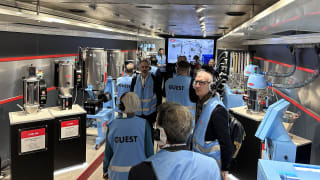
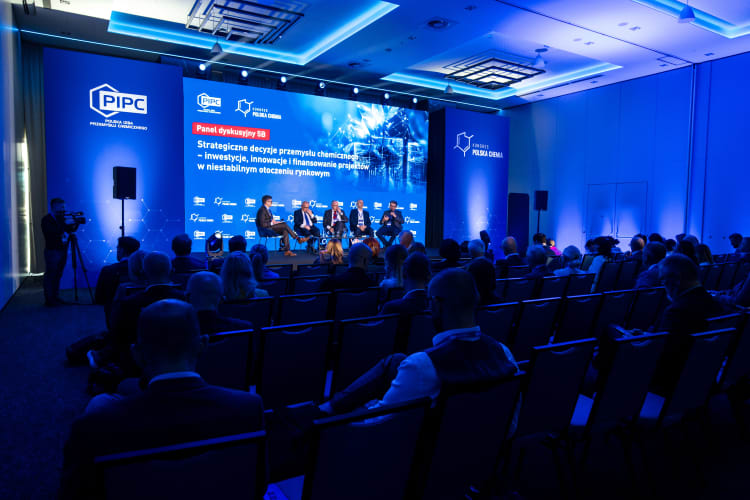
The 13th Polska Chemia Congress, held on 11 and 12 June 2026 at the Arche Krakowska Hotel in Warsaw, brought together nearly 500 representatives of public administration, the chemical industry, financial institutions, science and industry organisations. The debates focused on the question of how to maintain industry in Europe amid rising cost pressure, geopolitical tensions and an increasingly complex regulatory environment. Opening the event, Tomasz Zieliński, PhD Eng., president of the management board of the Polish Chamber of Chemical Industry, stressed that the discussion on industrial decarbonisation is now giving way to a more fundamental issue, the ability to maintain industrial production in Europe. As he noted, the return of geopolitics to the economy and the growing importance of economic security mean that chemistry has once again moved to the centre of the debate on the future of states and economies. Participants repeatedly emphasised that the chemical sector remains the foundation for many other industries, from energy and agriculture to defence, technology and modern value chains.
The opening statements of the congress focused on economic resilience and the strategic role of industry. Tomasz Zieliński said: "Just a few years ago, we were asking how to decarbonise industry. Today we must answer a much more important question: how to keep industry in Europe." He also added: "We are meeting at a moment when the global economic order is being rebuilt before our eyes. For the last three decades, we lived in the conviction that globalisation would be an irreversible process. That trade would become increasingly free. That the economy would become increasingly integrated. That security and development were self-evident. Today we know that this is not the case." In his view, war, geopolitical pressure and economic rivalry have brought industry back to the centre of the strategic debate, and chemistry is one of the key links in this system.
Chemistry at the centre of industrial policy
One of the main items on the programme was the special round table "Chemical industry at a turning point, strategy for security and the future". The discussion involved representatives of government administration, European institutions, major industrial companies and the financial sector. Participants included Andrzej Domański, Krzysztof Bolesta, Grzegorz Wrona, Dariusz Joński, Dorota Jeziorowska, Ireneusz Fąfara, Remigiusz Paszkiewicz, Katarzyna Byczkowska, Kamil Majczak and Ilona Wołyniec, among others. The moderator was Tomasz Zieliński, PhD Eng.
Experts assessed that the chemical industry has reached a turning point at which decisions on energy, regulation and investment will determine the retention of production, jobs and strategic industrial capabilities in Europe. They pointed out that chemistry is the "industry of industries", and that its condition directly affects energy, defence, agriculture, climate transformation and technological development. At the same time, the sector operates under high energy prices, costs resulting from EU ETS, regulatory uncertainty, strong global competition and difficult conditions for new investment.
EU ETS, energy and transformation financing
The topic of the EU ETS repeatedly returned in the debates. Participants pointed to the need to revise the system so that it supports industrial modernisation and decarbonisation without weakening the competitiveness of European producers. They called for maintaining free allowances, limiting cost growth, revising benchmarks and ensuring that funds generated by the system are returned to industry in the form of transformation financing.
At the same time, they highlighted the importance of energy as a basic competitiveness factor for the chemical industry. According to participants, the energy transition should lead to predictable, accessible and competitive energy prices for industrial consumers. In this context, transformation technologies such as hydrogen, CCUS, low-emission solutions, integration of renewable energy sources, gas, district heating, energy recovery, biomethane, nuclear power and SMR were widely discussed. It was pointed out that decarbonisation must take into account technological feasibility, implementation costs, the maturity of solutions and the possibility of scaling them in existing plants.
A separate area was financing. Speakers stressed that banks and investors are ready to engage in industrial, modernisation and energy projects, but expect regulatory predictability, stable business models and risk mitigation instruments. It was noted that support should cover not only projects already classified as green, but also the entire transition period, during which companies must simultaneously maintain operations, reduce emissions, modernise assets and compete with producers from outside the EU. In this context, the importance of instruments supporting CAPEX and OPEX, guarantees, modernisation funds and predictable state aid rules was highlighted.
Local content, CBAM and market protection
An important topic of the congress was the local content approach, understood as a tool for strengthening domestic and European production capabilities. Participants pointed to the need to develop local suppliers, shorten supply chains, make better use of the potential of companies operating in Poland and direct investment in such a way that a larger share of its effects remains in the domestic and European economy.
At the same time, the issue of protecting the European market from unfair import competition was discussed. Considerable attention was paid to the CBAM mechanism and its relation to the specifics of the chemical industry. Experts noted that Europe cannot impose increasingly costly requirements on its own industry without effective tools to protect it against imports of products manufactured under lower regulatory, environmental and cost standards. At the same time, it was stressed that CBAM in its current form, or if extended too quickly, may not reflect the specifics of chemistry, as the sector is based on complex and multi-stage value chains.
Critical chemicals and regulations
At the close of the event, a round table entitled "The fight for critical chemicals in Europe, can we still preserve strategic production?" was organised and moderated by Szymon Domagalski of the Polish Chamber of Chemical Industry. Participants included Otto Linher, Marcin Celejewski, Daria Frączak, PhD Eng., Adam Gniazdowski, George Kapantaidakis, Aleksandra Karpińska, Piotr Majdański and Kinga Świerad.
One of the main conclusions was that the identification of critical chemicals, molecules and installations is of fundamental importance for future EU industrial policy. Participants pointed out that the methodology for assessing criticality should not be limited to formal tables, as this may lead to overlooking substances that are crucial for industry and entire value chains. Ammonia was cited as an example, as its strategic importance for fertiliser production and supply security may not be properly reflected by the proposed criteria. In this context, participants called for refinement of the assessment model and for taking account of entire value chains rather than only individual substances or production stages.
In this part of the debate, the issue of hidden regulatory costs also returned, including the effects of restrictions concerning PFAS. Experts stressed that when designing regulations, it is necessary to consider not only environmental objectives, but also the impact on process safety, component durability, installation maintenance costs and continuity of production. The need for proportional regulation and for basing it on an analysis of effects on industry was emphasised.
Innovation, circularity and security
The congress programme also covered circularity, innovation, digitalisation and automation. Discussions concerned the circular economy, chemical recycling, bioplastics, new materials technologies, plant cleaning and the practical use of artificial intelligence and automation in production facilities. Participants pointed out that effective implementation of innovation requires the right competences, a stable regulatory environment, access to data, cybersecurity and cooperation between industry, science, technology suppliers and the financial sector.
Many panels also highlighted the role of the chemical industry in the national security and defence system. Participants pointed to the importance of a domestic industrial base, access to strategic materials, dual-use technologies and protection of critical infrastructure, including pipelines, terminals, storage facilities and networks. The discussions showed that the future of the sector requires a more coherent approach combining industrial, energy, raw materials, climate, trade and defence policy.
The international character of the 13th Polska Chemia Congress was confirmed by the participation of nearly 90 experts representing national and EU administration, business, science and industry organisations. Strategic partners of the event were BASF Polska, KGHM Polska Miedź, ORLEN, PKO Bank Polski and Qemetica. The technology partner was Maire. The main partners included ABB, Anwil, Getec Polska, Gloria Corporation, Pern and Rafineria Gdańska. Other partners included, among others, Alleima, ASE Group, Biprotech, Drager, DZP Law Firm, Epichem, Fluor, Gemsur, Go Logis, Honeywell, Łukasiewicz Research Network, NTT Data, ORLEN Południe, Plasticon Poland, Polska Spółka Gazownictwa, Polimex Mostostal, Prozon, Responsible Care, SAP, Siemens, SK&S Law Firm and Veolia.