The Plastic Packaging Manufacturers Association PAGEV, acting as an umbrella organization for the Turkish plastics industry, has signed a strategic cooperation protocol with the EU-recognized conformity assessment body Certiloop. The agreement aims to strengthen regulatory compliance in plastic packaging exports and increase the competitiveness of Turkish producers and recyclers in European markets. The cooperation responds to new requirements arising from the EU Packaging and Packaging Waste Regulation PPWR, where credible verification of recycled content and packaging recyclability is becoming crucial. In practice, without independent certification, declarations on the share of secondary raw materials lose their commercial and tax relevance, which translates into higher product costs and restrictions on market access.
Scope of cooperation between PAGEV and Certiloop
Under the signed protocol, Certiloop will provide PAGEV members with a range of services related to conformity assessment for the EU market. These include certification of recycled content in plastic packaging recognized in EU member states, as well as recyclability assessments carried out in accordance with PPWR requirements. The agreed scope of cooperation also covers verification of recycling processes, as well as technical training and regulatory guidance related to the implementation of European packaging legislation.
The introduction of the PPWR means that statements regarding recycled content are considered valid only if they have been confirmed by independent and authorized bodies. Recycled content that is not confirmed by certification is not recognized as recycled within the meaning of the PPWR, which results in the loss of benefits related to the plastic tax and in higher product costs. The cooperation between PAGEV and Certiloop is intended to reverse this negative effect by providing a measurable, verifiable and practical solution for Turkish plastic packaging manufacturers and recycling companies.
Cost advantages and strengthening exporters’ position
The parties to the protocol expect that the use of certified recycled content will allow a reduction of burdens related to the plastic tax and other costs arising from the PPWR. At the same time, obtaining the relevant certificates is expected to help overcome documentation barriers in European markets, where evidence of compliance with environmental regulations is gaining importance.
As a result, packaging producers from Turkey are expected to gain a stronger negotiating position in export price discussions, while certified secondary raw materials produced by recycling companies will become a more valuable and preferred feedstock for packaging manufacturers. Shifting the focus from regulatory risk to verified compliance is intended to act as a form of commercial assurance, important in long term relationships with customers in the European Union.
The importance of reliable certification for the EU market
Commenting on the significance of the agreement, Certiloop General Manager Yağmur Cengiz Eroğlu underlined the role of documented data in international trade: "In European markets, documented facts, not goodwill declarations, are now decisive. Through this cooperation with PAGEV, Turkish plastics manufacturers will be able to substantiate their recycled content claims with internationally recognized certifications. This certification is a strategic tool that both reduces export costs and opens doors to new markets."
According to PAGEV Vice Chairman Ahmet Meriç, maintaining competitiveness in the European Union market requires the Turkish plastics industry not only to deliver high production quality, but also to have advanced systems for traceability and verification of environmental parameters: "To maintain competitiveness in European Union markets, the Turkish plastics industry must now be strong not only in production quality, but also in traceability, recycled content and the verification of environmental claims. This protocol signed with Certiloop provides PAGEV members with a reliable and technically robust roadmap for compliance with EU regulations."
PAGEV Vice Chairman Ali Zeki Karadeniz highlighted the long term dimension of the cooperation: "Recycled content and recyclability are no longer optional, they have become mandatory criteria for exports. Through our cooperation with Certiloop, we aim to establish an internationally recognized, transparent and reliable certification framework for our industry."
Support mechanism for a broad base of companies
Certiloop is one of only two officially operating programs worldwide in the field of plastic recycling under European Union accreditation. Under the current agreement, this body will provide PAGEV members with EU-recognized certification services, PPWR-compliant technical assessments, process verification, as well as training and regulatory guidance.
PAGEV represents the broadest segment of the Turkish plastics processing sector, bringing together approximately 1,500 trustees and nearly 2,500 affiliated companies. Thanks to the cooperation, the services offered by Certiloop are to become directly accessible to manufacturers, including companies specializing in the production of plastic packaging and entities engaged in recycling.
The parties indicate that the protocol is an important step towards building a structure that is fully compliant with European regulations, competitive in exports and transparent in terms of sustainability. In the longer term, the cooperation between PAGEV and Certiloop may contribute to the wider adoption of certified recycled content in Turkish plastic packaging and to the increased role of recycling in the value chain of this sector.
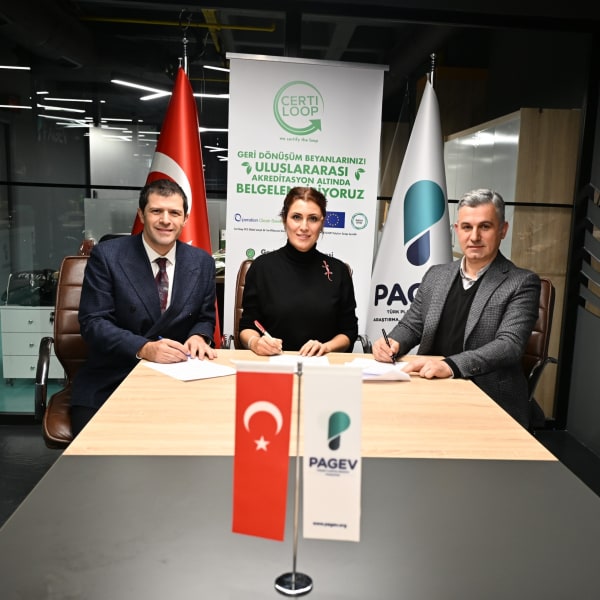
Representatives of PAGEV and Certiloop after signing the cooperation protocol