AMI Market Intelligence has published a new report on the polyethylene market in the Middle East and Africa region. The study provides an analysis of PE demand dynamics by processing technologies and end-use segments, as well as the competitive environment that is shaping future consumption of this polymer in the region. The report covers the period 2019–2029 and refers to the underlying economic and demographic fundamentals behind the observed and forecast expansion, including societies’ efforts to raise living standards. It highlights both historical trends and expected development directions for individual processing segments, such as film extrusion, blow moulding, injection moulding, pipe extrusion, cable and wire extrusion, and rotational moulding.
Scope and methodology of the PE market study
The AMI report was prepared using a bottom-up approach based on an extensive series of interviews with market participants. The team of analysts conducted hundreds of interviews with plastics processors and suppliers of raw materials and products across the Middle East and Africa region. The objective was to build as accurate a picture as possible of actual polyethylene consumption in all main processing technologies, including film extrusion, blow moulding, injection moulding, pipe extrusion, cable and wire extrusion, rotational moulding and other processes.
The time frame of the analysis covers ten years, from 2019 to 2029, allowing comparison of historical data, the current market situation and forecasts for the coming years. The report considers the specific features of the Middle East and Africa as a whole, and separately analyses the African and Middle Eastern subregions, where the drivers of structural change and PE demand growth differ significantly.
Dynamic growth in blow moulded products
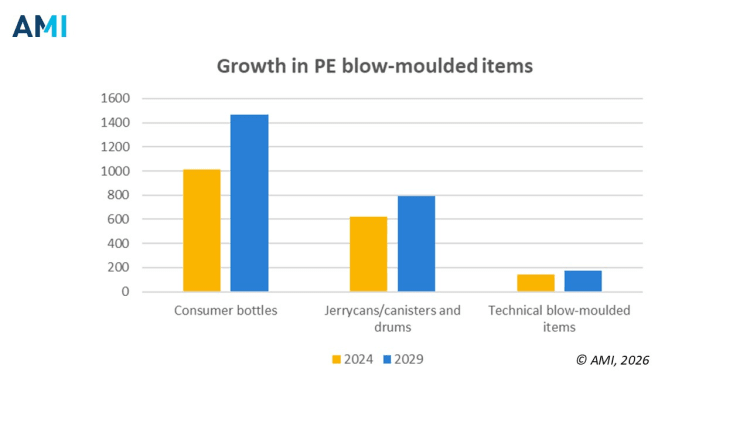
According to the report, demand for polyethylene used in blow moulding processes in the Middle East and Africa remains strong. This results from increasing consumption of packaged consumer products, in particular beverages, liquid food products, household cleaning agents and personal care products. This segment is directly linked to the development of consumer packaging and changing consumption patterns.
The fastest growth over the coming years is forecast in Africa, where in many countries current per capita consumption is very low and societies are striving to improve quality of life. Within blow moulding applications, small containers with volumes below 5 litres are seeing particularly robust growth. Due to their lower unit price, these products are accessible to a larger share of the population, which translates into steady growth in PE demand in this segment.
Role of polyethylene in cable applications
Across the Middle East and Africa region, a construction boom is driving strong demand for polyethylene used in cable production. This includes both infrastructure investment in Middle Eastern countries and significant rebuilding projects in states such as Syria and Iraq. In the report, the cable market is segmented into power cables, telecom cables and other cables and wires.
Key findings show that power cables dominate in volume terms, while telecom cables and niche cable applications also exhibit strong growth. The use of PVC in cable production remains important, but its volume is gradually being eroded by other polymers, including polyethylene. The report identifies local and regional enterprises as well as international manufacturers active in this segment, with a distinction between trends in Africa and the Middle East, where market conditions and the pace of infrastructure development differ significantly.
Film extrusion as the main outlet for PE
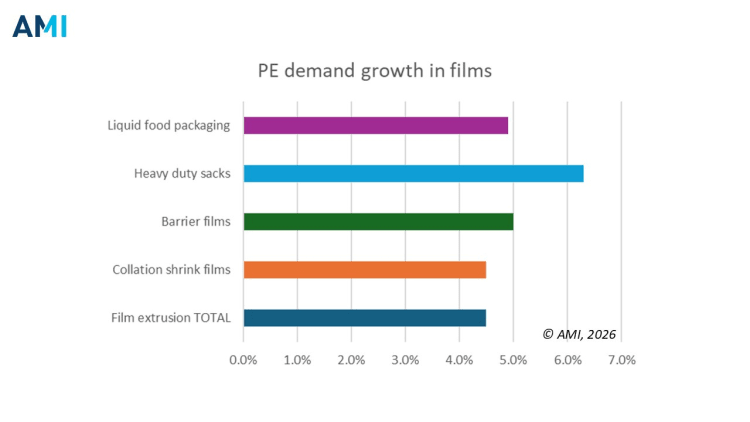
Film extrusion accounts for around 47 percent of polyethylene consumption in the analysed region. Within this process, the report notes steady growth in PE demand across many end-use segments. Collation shrink film remains an area of expected stable growth, associated with rising consumption of packaged beverages and food. This trend is supported by the development of modern retail formats and improving logistics in Africa, as well as increased on-the-go consumption in Middle Eastern countries.
Barrier films are an important segment for which solid volume growth is forecast. This results from growing demand for a wider range of food products in the Middle East and Africa and from the need for advanced film structures that can safely deliver these products under challenging logistical and climatic conditions to an expanding group of consumers.
Highest growth in heavy duty sacks and new opportunities in liquid food packaging
Among film extrusion applications, the fastest growth rate has been recorded in the heavy duty sacks segment. This trend is driven by a move towards smaller and more flexible order quantities for raw materials and building products. The shift in order structure, including a preference for smaller logistics units, supports the increase in demand for packaging solutions based on polyethylene.
The report also highlights future development opportunities in liquid food packaging, including pouches and bag-in-box systems. For this segment, PE demand in the Middle East and Africa region is forecast to grow at just under 5 percent. The development of this group of applications is linked to the evolution of food distribution models, changes in consumer preferences and the search for solutions that enable optimal use of logistics and storage space.
Characteristics of the "PE Markets in the Middle East & Africa 2025" report
The study "PE Markets in the Middle East & Africa 2025" combines the expert knowledge of AMI consultants, based on direct interaction with the industry, with quantitative data analysis for the main processing technologies consuming PE resin. The objective of the report is to provide a comprehensive picture of a market that is gaining importance in the global plastics value chain.
The research, released in December 2025, is intended to help market participants and investors better understand competitive challenges, demand dynamics and industry development paths in the Middle East and Africa region. The data and analyses it contains can form the basis for assessing market position and planning strategic actions. Interested companies can request a free proposal containing a more detailed description of the report structure and its key findings by visiting the AMI website.