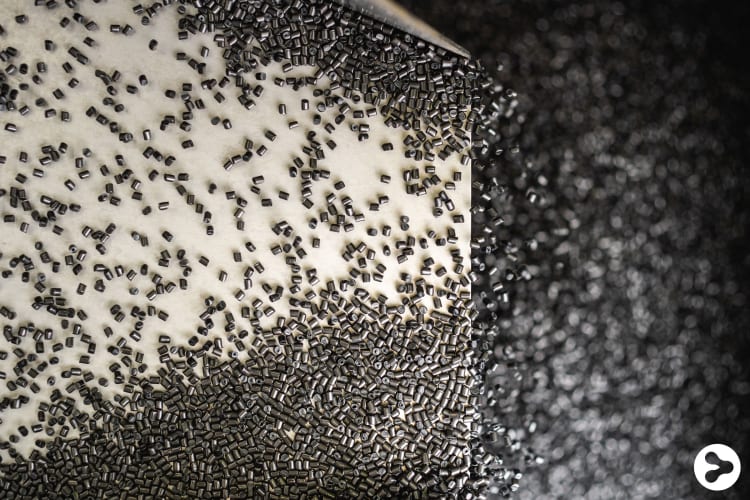
Xenia Materials, a global supplier in the design and production of reinforced thermoplastic composites, has announced the introduction of the new HM Upgrade (High Modulus) technology. This solution has been developed to increase the stiffness and structural response of materials reinforced with carbon fibres by using high modulus fibres. The company indicates that the technology is targeted at applications where high mechanical strength, structural stability and weight reduction are required while maintaining long-term performance properties.
Fibre-reinforced thermoplastic composites are widely used in structural applications where stiffness, low weight and dimensional stability are crucial. HM Upgrade has been designed to raise the performance of these materials and provide compounds that meet increasingly demanding design criteria. This applies in particular to areas where it is necessary to combine low mass, high modulus of elasticity and predictable structural response under load.
Increase in modulus of elasticity without raising material density
According to information provided by Xenia Materials, the HM technology enables a significant increase in material stiffness. The average increase in tensile modulus is around 15 percent compared to traditional formulations, while not affecting compound density. This means that the characteristic low specific weight of thermoplastic composites is preserved, which is important, among others, in transport and aerospace applications.
At the same time, key mechanical properties are improved. The manufacturer indicates an average increase of around 15 percent both in tensile strength at break and in flexural modulus. This translates into higher structural stability of parts, especially under high mechanical loads where deflection and deformation must be limited.

Improved impact resistance and structural response
In addition to the increase in modulus and static strength, the HM Upgrade technology also improves impact resistance. Depending on the polymer matrix used, average increases in impact strength of up to 20 percent have been recorded. This combination of properties, including stiffness, strength and impact resistance, is important in lightweight structures exposed to dynamic loads and repeated duty cycles.
The manufacturer emphasises that due to these properties, materials with HM Upgrade can be a solution for applications where structural reliability and retention of mechanical properties over an extended service life are critical. This applies both to load-bearing components and to parts providing stiffness in complex structural systems.
Scope of application of the HM Upgrade technology
The HM Upgrade technology can be applied to the Xecarb material family offered by Xenia Materials. It is already available for a range of polymer matrices, including PA66, PA6, PP, PPA, PEBA, PA11, PA12, PA4.10, PA6.10 and PA10.10. The use of high modulus fibres in different polymer systems allows the properties of the composite to be tailored to the specific requirements of a given project, taking into account operating temperature, service environment and mass requirements.
The solution is aimed at a wide range of industrial sectors. Xenia Materials points to applications in aerospace and motorsport, where low weight, high stiffness and dimensional stability under varying load and temperature conditions are priorities. At the same time, the technology has potential uses in demanding industrial applications and in the sports equipment segment, where impact resistance, structural reliability and consistency of properties during service life are important.
More information on the HM Upgrade technology and available materials can be found on the manufacturer's website at: https://www.xeniamaterials.com/en/high-modulus-upgrade/.