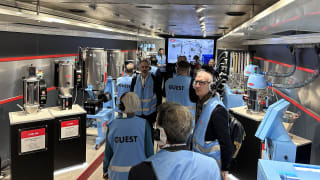
At Battery Show Europe 2026 in Stuttgart, Envalior will present material solutions for high-voltage batteries used in electric vehicles. The materials on display are intended to improve battery performance, operational safety and service life, while also supporting weight reduction. The presentation will cover solutions for both currently used technologies, such as lithium-ion batteries, and emerging systems, including sodium-ion and solid-state batteries. As Jürgen Selig, Advanced Development Expert for Battery Systems at Envalior, explains, the company supports automotive manufacturers at every stage of battery component development, from material selection and part design to finished part testing and mass production optimization.
The display will focus on materials for busbars, battery junction boxes and solutions aimed at limiting the initiation and spread of thermal runaway. According to the company, the new developments address requirements associated with increasing thermal and electrical loads in high-voltage systems. Jürgen Selig emphasizes: "As a leading global manufacturer of sustainable and high-performance engineering thermoplastics, we want to shape the future of electric mobility through our next generation of material innovations. We support our customers in the automotive industry at every stage of battery component development with our services, whether this involves material selection, component design, finished part testing, or the optimization of mass production."
Materials for busbars and junction boxes
One of the new products will be Xytron M5080ET, a new polyphenylene sulfide, PPS, intended for overmolding and functionalization of busbars. The material was developed for rising operating temperatures in high-voltage batteries and electric vehicle powertrain systems. According to Envalior, the material withstands temperatures above 150°C and at the same time offers increased resistance to stress cracking during thermal shock. Tests conducted in the range from -50°C to 180°C are said to confirm that its resistance to stress cracking is more than 70% higher than that of comparable PPS compounds. The material is also flame-retardant and achieves a V-0 classification in UL 94 flammability testing. The company states that these properties are intended to ensure electrical safety and the mechanical functionality of busbars throughout their service life.
Xytron M5080ET is part of Envalior's broader thermoplastics portfolio for busbar applications, which also includes Durethan PA6, Akulon PA66, Pocan PBT and ForTii PPA. These materials are intended to meet requirements including high tracking resistance, very good electrical and insulating properties, and toughness.
In the area of junction boxes for electric vehicle batteries, the company will present the PBT compounds Pocan XHR and Pocan BFN Z. Such housings must meet stringent thermal shock resistance requirements because they are usually large parts, contain numerous metal inserts and often integrated metal busbars. Pocan XHR grades, such as Pocan B3233XHR, are said to offer increased elongation at break, enhanced hydrolysis resistance and good heat ageing resistance. This property profile is intended to significantly improve housing stability under thermal shock.
For applications additionally requiring high flame retardancy, Envalior recommends the impact-modified Pocan BFN Z grades. Unlike conventional flame-retardant PBT grades, they are said to exhibit high elongation at break, which translates into favorable behavior under thermal shock conditions. In this context, the company highlights Pocan BFN4221Z, for which it states an elongation at break of 2.9%. This grade achieves UL 94 V-0 classification in all colors at a thickness of 0.4 mm and a maximum Comparative Tracking Index of 600, CTI A, according to IEC 60112, which is intended to confirm high electrical reliability under high-voltage conditions.
Solutions to limit thermal runaway
A separate part of the presentation will be a technology toolbox based on Stanyl and Tepex, developed to prevent thermal runaway in batteries. According to Envalior, these solutions are intended to limit the initiation of such an event at cell level, delay or stop its propagation from cell to cell, and counteract its further spread through the entire battery system if it has already begun.
Stanyl SN-PURE is designed to form a thin protective layer on the cell cathode surface, reducing heat generation during thermal abuse by around one-third and interrupting self-accelerating reactions. As a result, this additive is intended to reduce the severity of single-cell events. In turn, the continuous-fiber-reinforced thermoplastic Tepex acts as a thermal barrier between cells and delays the transfer of critical temperatures to neighboring cells. Positioned on top of cells or modules at battery pack level, it is also intended to help contain thermal runaway already in progress, thanks to high heat resistance and resistance to particle bombardment.
The company emphasizes that because the developed set of solutions acts on several levels, it can support compliance with new "zero propagation" standards such as China's GB 38031-2025 requirement of "no thermal propagation".

At Battery Show 2026 in Stuttgart, Envalior will present material innovations that improve the performance, safety and service life of high-voltage batteries for electric vehicles, while also supporting lightweight design.
Envalior experts will be available at booth 5-C41 during Battery Show Europe 2026, which will take place on June 9, 10 and 11 at Messe Stuttgart in Germany.