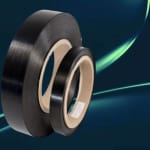
Envalior is expanding its portfolio of materials for hydrogen pressure vessels with a new high-performance thermoplastic UD tape for use in all-thermoplastic high-pressure tanks. The UDea EcoPaXX Q20HTC60 tape, reinforced with continuous carbon fibers, is designed for wrapping and mechanically reinforcing polyamide liners. The use of the tape enables the tanks to withstand the high pressure loads occurring during hydrogen filling and storage, while reducing the mass and cost of the system and improving recyclability of the entire structure.
Material characteristics of UDea EcoPaXX Q20HTC60
The new UDea EcoPaXX grade is based on polyamide 4.10 and is reinforced with 60 percent by weight of unidirectional continuous carbon fibers. The alternative carbon fibers used in the composite increase the tensile strength of the tape in fiber direction by more than 15 percent, to around 2.2 gigapascals, compared to materials with a similar composition but with lower-strength carbon fibers.
According to Giacomo Perfetti, Sales & Business Development Manager for UDea, the tape ensures high strength and stiffness of the tank wrapping and high structural integrity of the entire tank. The mechanical properties result from the combination of the bio-based polyamide 4.10 matrix and the high content of unidirectional carbon fibers, which is crucial when designing thin-walled structures operating at high pressure.
Tape application technology and cost reduction potential
One method of applying the thermoplastic tape is laser assisted tape placement. This process can be carried out in start-stop mode, which allows local reinforcement of the liner only in those areas that are critical for carrying high pressure loads. In this way, the designer can precisely tailor the composite architecture to the stress distribution in the tank.
In contrast to conventional wet winding processes using thermoset resins, in a structure made from thermoplastic tape it is possible to remove carbon fibers from areas that do not carry loads. This enables weight and cost savings of up to 20 percent while maintaining the required strength parameters of the pressure system.
Environmental advantages over epoxy systems
An important advantage of the thermoplastic-based composite is its environmental profile. The polyamide 4.10 used in UDea EcoPaXX Q20HTC60 is partially bio-based, which reduces dependence on fossil resources. As a thermoplastic composite, the material is also easier to recycle compared to epoxy systems currently used for pressure vessel winding.
For conventional thermoset systems, tanks typically end up in landfills or incineration plants after the end of their service life, which creates additional environmental burdens. In contrast, wrapping the liner with a thermoplastic tape does not require curing processes or handling thermoset chemicals, for which special occupational safety and cleaning procedures are necessary. This simplifies production organization, reduces the consumption of auxiliary materials and can contribute to lower operating costs.
Comprehensive Envalior material offering for hydrogen tanks
The new tape complements Envalior's broad portfolio of thermoplastic materials for manufacturing hydrogen pressure vessels. This portfolio includes, among others, impact-modified polyamide 6 compounds from the Durethan and Akulon product lines, used in blow molding, injection molding and rotational molding of tank liners. As a result, Envalior can supply a complete set of materials required to produce tank systems made entirely from thermoplastic materials, which significantly facilitates recycling of the tanks at the end of their service life.
As emphasized by Bert Keestra, Advanced Engineering Manager at Envalior, the company acts as a one-stop-shop supplier of thermoplastic materials for hydrogen tanks, which is important for manufacturers of hydrogen storage systems seeking consistent material solutions for the entire system.
Compatibility of polyamides 6 and 4.10 and structural integrity
A key aspect in the design of all-thermoplastic pressure vessels is the mechanical connection between the liner and the composite overwrap. The use of a polyamide 4.10-based tape on a liner made of a polyamide 6 compound results in a melt-melt contact between the two polyamides at the interface under laser heating.
As a result, a monolithic structure with strong material bonding is formed. Giacomo Perfetti notes that with such a connection the liner is not able to deform independently from the composite structure when exposed to mechanical or thermal loads. This reduces the risk of buckling and facilitates cleaning and maintenance of the pressure vessels in service, because the internal geometry is more stable and deformations are more predictable.
Detailed information on the UDea EcoPaXX Q20HTC60 tape, including material data and application guidelines, is available in the Envalior MaterialAdvisor tool.