The SKZ Plastics Center, together with industrial partners, is working on the development of a continuous recycling process for silicone elastomer waste. In this project, silicones are depolymerized to monomers in a planetary roller extruder and can then be reused for the synthesis of new silicones. This makes it possible to avoid the energy-intensive production of virgin monomers and contributes to improving resource efficiency.
The project is aligned with the objectives of the European Green Deal announced in 2019, under which the European Union aims to achieve climate neutrality by 2050. One of the key areas for implementing environmental targets is the transition towards a circular economy, in which resource savings through recycling play an important role. For silicones, both reducing energy demand and cutting CO2 emissions associated with the production of raw materials for monomer synthesis are relevant.
Energy-intensive silicone production and the need for circularity
The production of silicones is a highly energy-intensive process and generates chemically unavoidable CO2 emissions. The manufacture of metallurgical silicon, which is subsequently used for the synthesis of silicone monomers, accounts for around 66% of the greenhouse gases generated in this production chain. At the same time, silicones, due to their properties, are key materials for a range of applications in strategically important sectors.
Silicones are characterized by high biocompatibility, temperature resistance, chemical resistance and weather resistance. For this reason, they play an important role in applications in medicine, energy technology, the automotive industry and the electrical industry. SKZ and its industrial partners are seeking solutions that will enable the recycling of this group of materials without compromising their key performance characteristics.
Challenges in recycling cross-linked silicone elastomers
Silicones belong to the group of cross-linked materials. Chemical cross-linking underpins their high resistance and many advantageous service properties, but at the same time significantly complicates recycling. In contrast to typical thermoplastics, reprocessing cross-linked materials requires breaking the chemical bonds that form the network, which places high demands on process conditions and on the design of the processing line.
In the project carried out by SKZ, a key factor is the combination of the chemical aspects of depolymerization with the capability to conduct the process continuously on a technical scale. This requires suitable configuration of the planetary roller extruder, appropriate process parameters and the development of a method for controlling the depolymerization reaction so that the recovered monomers are directly suitable for further silicone synthesis.
As emphasized by Dominik Uhl, scientist in the cross-linked materials department at SKZ: "Another important aspect of this project for us is to develop a continuous process that can also be implemented economically in industrial quantities." This statement reflects one of the main assumptions of the project, namely that the solution is designed from the outset with technical and economic feasibility in industrial conditions in mind.

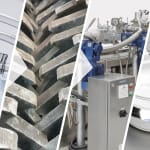
The silicone elastomer recycling project combines the partners' expertise in silicone production and chemistry, material comminution, chemical process design, and compounding in planetary roller extruders. (Photo: Wacker, Mercodor, Entex, SKZ)
Depolymerization in a planetary roller extruder and monomer recovery
The aim of the new research project is to develop a continuous depolymerization process for silicone waste in a planetary roller extruder. Such a process is not currently available on a technical scale and is to be implemented for the first time in a laboratory setting at SKZ. The depolymerization is expected to enable the recovery of monomers that are directly processable and suitable for use in the synthesis of new silicones.
Applying this approach could reduce the demand for new material and for virgin raw materials for monomer production, and thus lower the energy demand of the entire silicone production chain. The development of a continuous depolymerization process represents a first step towards significant energy savings in silicone manufacturing and towards establishing a circular economy for this class of materials.
Project partners and research funding
The recycling project for silicone elastomers through depolymerization in a planetary roller extruder has been officially launched. SKZ is implementing it in cooperation with Entex Rust & Mitschke GmbH, Mercodor GmbH Sondermaschinenbau KG and Wacker Chemie AG. Within the project, the partners combine their expertise in silicone production and chemistry, material comminution, chemical process design and compounding in planetary roller extruders.
The project is funded under the German government's 8th Energy Research Program from 1 August 2025 to 31 July 2028. During this period, the partners plan to develop and validate the concept of a continuous depolymerization process, which in the longer term may form the basis for industrial solutions that increase resource and energy efficiency along the silicone value chain.