Sustainable food packaging must combine a high level of product protection with reduced material consumption, recyclability, regulatory compliance and economic viability. Interpack, as the world's leading trade fair for the packaging industry, addresses these needs by providing a platform for solutions to the key challenges of the food sector. In the food industry, well-designed packaging determines shelf life, product safety and transportability, and thus has a significant impact on reducing food losses along the entire value chain.
According to the UN Environment Programme's (UNEP) "Food Waste Index Report 2024", around 1.05 billion tonnes of food are wasted worldwide every year. This results not only in considerable economic losses, but also in a serious environmental burden, estimated at eight to ten percent of global greenhouse gas emissions attributable to food that is never consumed. Initiatives such as SAVE FOOD, launched by interpack together with partners from industry and institutions, have helped to raise awareness of these interrelationships. Today, the focus is on concrete technological responses: sustainable materials, intelligent packaging concepts and automated, resource-efficient processes for tomorrow's food packaging.
Recycling in food-safe applications
The new EU packaging regulation PPWR provides for a significant reduction in packaging waste, mandatory recycling quotas and increased use of recyclates. However, the use of recyclates in direct contact with food remains one of the major technical and regulatory challenges. Nevertheless, the first plastics recycling facility in Europe was recently awarded RecyClass certification for sorting plastics intended for food contact.
Its operator, Swedish Plastic Recycling, currently sorts PET bottles, PET trays and PS packaging from separate household collection. The process is fully traceable, from collection through sorting to processing. In parallel, the CRISP research project is working on achieving food-safe quality in the recycling of PE and PP.
Material manufacturers are simultaneously investing in certified recyclates. Interpack exhibitor WIS Kunststoffe offers rPE and rPP materials with FDA approval for direct food contact. These materials already meet the PPWR requirements for 2030, providing packaging manufacturers with greater planning certainty.
Mopack uses a different technological approach. The polyolefin fine-shrink films in the eco+35 series contain 35 percent chemically recycled PCR. The material is purified and re-polymerised at the molecular level, which enables a high degree of homogeneity, a clear appearance, neutral odour and stable processability on packaging lines. Since March 2025, the films have had DEKRA approval for direct contact with food.
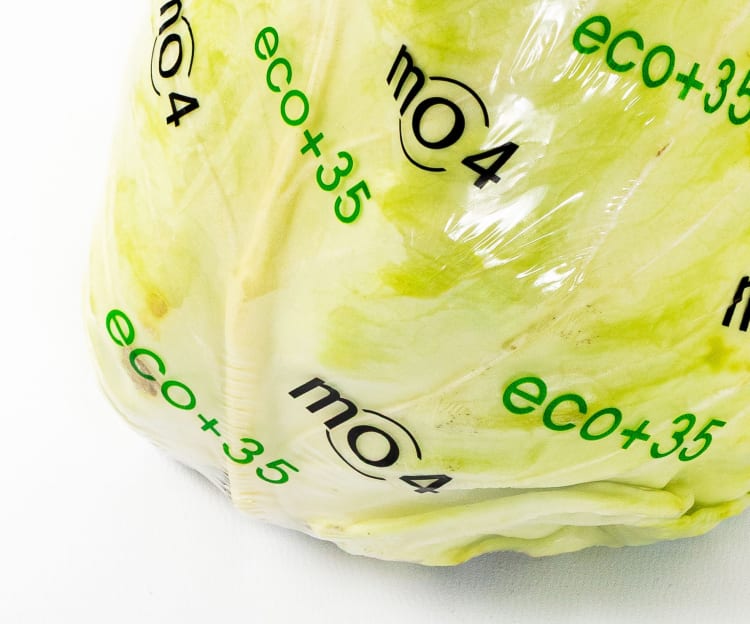
Mopack shrink films contain a share of chemically recycled PCR. Image: Mopack
New approaches to value creation in packaging
Sustainability is not limited to material selection, but also includes the design of the packaging itself. GEA presents a newly developed multi-chamber pack for sliced cold cuts. Two separately sealed freshness chambers enable portion-wise opening of the pack and reduce plastic consumption by more than 70 percent compared to classic blister packs. This is made possible by the stabilising chamber structure and the use of film with a thickness of only 50 µm. The packaging is produced on a fully automatic line comprising a GEA PowerPak thermoformer, a MegaSlicer and a ShingleLoader.
At the upcoming interpack in the exhibition halls in Düsseldorf, machine manufacturers will demonstrate how they are adapting their systems to process recyclable materials. Ulma Packaging is developing flowpack and traysealer solutions for monomaterials, as well as paper and board-based trays. The vertical high-performance VTC 800 machine enables fully automatic packaging of cut salads and vegetable mixes at high output, using recyclable monomaterials.
Multivac combines sustainable packaging solutions with a high level of automation. A new traysealer line for ready meals seals cardboard trays with thin, recyclable film under a modified atmosphere. The line is complemented by AI-based inspection systems, label checking and cobots for automatic stacking.
The role of robotics and automation in food processing
Growing product diversity and increasingly stringent hygiene requirements are raising the importance of automation in packaging and processing. Stäubli Robotics offers a broad portfolio of HE (Humid Environment) robots designed to operate reliably in demanding environmental conditions. In meat processing, TX2 robots carry out product cutting using a water jet. The use of vision systems enables gentle yet high-speed handling of sensitive food products.
Through its acquisition of Swedish company RobotGrader AB, Ishida has expanded its portfolio to include robotic weighing, sorting and packaging systems. These solutions are particularly beneficial for processors of meat, poultry and fish, as well as manufacturers of protein products, who can use intelligent, automated systems to precisely pack fresh products in trays.
Development of fibre-based solutions
In parallel with innovations in plastics, the development of paper and fibre-based solutions is progressing. Sappi Europe has developed two recyclable high-barrier papers with barriers against oxygen, grease and water vapour, suitable for direct contact with food. The heat-sealable Guard Pro OHS is designed for flow wraps, sachets, pillow bags and doypacks, while Guard Pro OMH has been developed for cold-seal applications.

Paper packaging for food requires effective barrier functions. Image: Sappi
UPM Specialty Papers and Royal Vaassen are replacing aluminium laminates with a fibre-based barrier paper for packaging coffee, broth or chocolate. UPM Solide Lucent packaging paper serves as the backing material for Barryrwrap. It has a smooth, dense and at the same time stable structure, which allows the use of low coating weights. UPM is also testing its barrier paper solutions in new applications, including fibre-based tub formats for crisps, tea or powdered drinks.
In cooperation with Solenis, Heidelberg has developed a process for applying barrier coatings to flexible paper packaging that is also suitable for food contact. The printing press manufacturer has integrated Solenis technology into roll-to-roll flexographic printing processes in the Boardmaster press. During the process, barrier coatings are applied to the paper web only at the areas that require protection and with register accuracy.

A new process enables industrial and selective application of barrier coatings to paper packaging. Image: Heidelberg
Sustainable bonding in food packaging
Apparently secondary components of packaging systems are also gaining in importance as sustainability factors. Jowat uses energy-efficient hot-melt adhesives to reduce energy consumption during carton sealing in the food and frozen food industries. Thanks to its low melting temperature, one of the new Jowatherm adhesives is suitable for packaging temperature-sensitive products such as chocolate. Another formulation has been developed for use in the frozen food segment, for example for pizza, ready meals or ice cream packaging.
For customers seeking raw materials with an enhanced sustainability profile, a bio-based Jowatherm alternative is available, produced from by-products of paper manufacturing and not competing with food production.
Interpack as a platform for the future of food packaging
Numerous exhibitors will demonstrate at interpack in Düsseldorf from 7 to 13 May 2026 how food products can already be manufactured and packaged safely and sustainably with a view to the future. Detailed information about the trade fair is available at https://www.interpack.com/.