SKZ Plastics Center has developed a new test method intended to significantly accelerate the determination of the permeability of plastic pipes. Compared with conventional tests, which take several weeks or even several months, the new approach makes it possible to obtain reliable results within a few hours. For pipe manufacturers, this means potential benefits in quality assurance, testing costs, and shorter times needed for development, approvals, and complaint analysis.
Plastic pipes are used for the safe transport of gases and liquids. Under ideal conditions, the transported medium should reach its destination completely and unchanged. In practice, however, even slight material permeability can be a significant challenge. Permeability, that is, a material's ability to allow specific media to pass through, is therefore regarded as one of the key quality criteria in pipe manufacturing and is tested in accordance with relevant standards.
Until now, testing the permeability of pipes in accordance with DIN 53380-3 has been a time-consuming process. Due to product geometry, material thickness, and the need to perform measurements under steady-state conditions, these tests often took several weeks to several months. This created a significant time and cost burden, especially in development, approval, and complaint handling processes.
Rohr-Perm project and the new test approach
The alternative test concept was developed within the IGF project "Rohr-Perm", project number 01IF22636N, funded by the Federal Ministry for Economic Affairs and Energy. The objective of the work carried out by SKZ in Würzburg was to significantly shorten the time required to determine the permeation properties of plastic pipes without reducing the reliability of the results.
The new method is based on testing a flat specimen cut from the pipe. Its permeability is determined using established measurement methods for flat specimens in accordance with DIN 53380-2, which allow for much shorter measurement times. Then, using correlation factors determined and validated in the project, the permeability of the entire pipe can be reliably calculated.
The correlation factors were determined systematically by comparing measurement results obtained on pipes and cut specimens in accordance with different standards, as well as by using a rapid helium test developed at SKZ.
Results for PE, PP and PVC pipes
Tests carried out on pipes made of polyethylene, polypropylene and polyvinyl chloride showed a high degree of agreement between the results obtained in pipe tests and flat specimen tests. According to SKZ, the "Rohr-Perm" project therefore makes a significant contribution to faster and more practical determination of the barrier properties of plastic pipes.
Franziska Eichhorn, senior engineer at SKZ, explains: "Especially for PP and PVC, we were able to demonstrate a significant correlation of results when using identical measurement gases. The developed method enables the pipe industry, for example, to reduce measurement time from several weeks to a few hours when testing oxygen permeability."
The new method may increase testing efficiency and broaden the use of permeation tests in future quality assurance activities. According to SKZ, the industrial benefits stem primarily from the significant reduction in testing time and costs, as well as from the possibility of wider use of such tests in industrial practice.
As Dr Linda Mittelberg, Head of the Quality and Lifecycle Division at SKZ, emphasises: "The project highlights the value of methodological transfer. Established measurement methods from other product areas can, with appropriate validation, be successfully transferred to new applications. This often results in significant potential for efficiency gains and cost savings."
The "Rohr-Perm" project, grant number 01IF22636N, is funded by the Federal Ministry for Economic Affairs and Energy pursuant to a resolution of the German Bundestag.
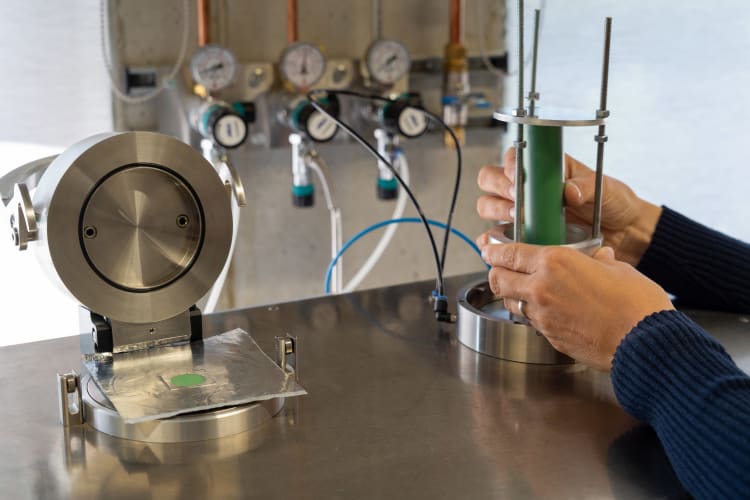
Measuring system for the rapid helium test, which can be used to determine gas permeability using helium on both flat samples (left) and pipe sections (right). (Photo: Luca Hoffmannbeck, SKZ)