Interpack 2026, described as the world’s largest event for the processing and packaging industry, will open its doors in Düsseldorf from 7 to 13 May 2026. The organisers announce the participation of around 2,800 exhibitors from 67 countries, who will present the latest solutions for the globally interconnected packaging value chain. The key focus will be on issues related to artificial intelligence, automation, new packaging materials and changes in workforce skills. For many companies, the event is intended to be a platform to compare concrete technologies, discuss regulatory trends and make investment decisions.
According to the trade fair director Thomas Dohse, interpack 2026 has special significance in a demanding market environment. As he points out, the industry needs a place for dialogue and orientation, and the task of the exhibition is to create a space for reviewing and comparing solutions and for making well-founded decisions. The market context is defined by population growth, progressing urbanisation and changing consumer behaviour, which increase the demand for efficient processing systems and packaging. At the same time, companies are facing raw material shortages, growing regulatory requirements, supply chain risks and a lack of qualified personnel.
In response to these challenges, the technical programme of interpack 2026 has been structured around three so-called Hot Topics: Smart Manufacturing, Innovative Materials and Future Skills. These concepts are intended to organise the presented solutions and expert discussions, covering both processing technologies and materials as well as organisational issues related to work in increasingly automated plants.
Three main thematic areas: Smart Manufacturing, Innovative Materials, Future Skills
Under the heading Smart Manufacturing, data-based solutions aimed at increasing the resource efficiency of production will be presented. This includes systems using artificial intelligence, advanced data analytics, robotics, integrated control systems and industrial automation to monitor and optimise packaging and processing operations. Exhibitors plan to show how line digitisation, automation of auxiliary operations and integration of production systems can support process stability, reduction of material losses and energy savings.
The Innovative Materials area will focus on new packaging materials, their functionalities and design-for-recycling concepts. The spotlight will be on solutions enabling more efficient sorting and recovery of raw materials, as well as packaging structures adapted to the requirements of the circular economy. Materials with modified barrier properties, lightweight solutions and designs supporting the reduction of material consumption while maintaining functional requirements will also be presented.
The third pillar, Future Skills, concerns the changing world of work and the competencies required in an increasingly digitalised and automated production environment. Discussions and presentations in this area will focus on the qualifications needed by employees to operate, supervise and maintain complex technological systems, as well as on work organisation and methods of attracting and retaining specialists in a context of skills shortages.
Exhibitor profile and exhibition layout
Among the approximately 2,800 companies present at interpack 2026, there will be many key suppliers of solutions for various market segments. The confectionery and bakery sector will be represented in halls 1, 3 and 4 by, among others, Aasted, Sollich, Theegarten-Pactec and Sacmi Packaging & Chocolate. These companies will present integrated lines for forming, packaging and handling confectionery and bakery products, as well as automation and quality control systems specific to this sector.
The pharmaceutical and cosmetics industries will find their main points of reference in halls 15–17. There, IMA Industria Macchine, Marchesini Group and Optima will present their portfolios. The displays will include packaging lines for medicinal and cosmetic products, solutions for filling, closing and labelling, as well as inspection and track & trace systems in line with the regulatory requirements of these sectors.
The extensive exhibition area for food, beverages, consumer and industrial goods will occupy six halls (11–14 and 5 and 6). In this area, companies such as Coesia Group, Duravant, Gerhard Schubert, Ishida, KHS, Krones, Multivac, Syntegon Technology and Ulma Packaging will present solutions focused on automation, increasing line efficiency, optimising packaging processes and reducing resource consumption. The exhibits will include complete packaging lines, weighing and inspection systems, machines for vacuum and modified atmosphere packaging, as well as technologies integrating different stages of the process.
Halls 7–10 will also play an important role for the market, with more than 1,000 exhibitors presenting packaging materials and finished packaging products. The organisers emphasise that this segment of the exhibition makes interpack one of the world’s most important trade fairs for packaging materials. Exhibitors will include Bericap, Jokey, Metsa, Sappi Europe and Schutz, presenting solutions ranging from plastic packaging to paper and board packaging, as well as reusable container systems and components for industrial packaging.
Labelling and marking technologies will be concentrated in halls 8a and 8b. Companies such as Bluhm Systeme, Domino Printing Sciences and Totani will present their portfolios there, including systems for printing information on packaging, solutions for label application, as well as technologies enabling the integration of coding and marking with the packaging process.
International dimension and country pavilions
Interpack 2026 highlights its global dimension through numerous country pavilions. Within these pavilions, exhibitors from a given country present together under one flag, grouping their expertise in clearly defined areas. Joint stands from India, China, Taiwan, Korea, Turkey, Malaysia and several European countries have been announced. This format is intended to make it easier for visitors to compare the offers of individual markets and to identify regional technological specialisations.
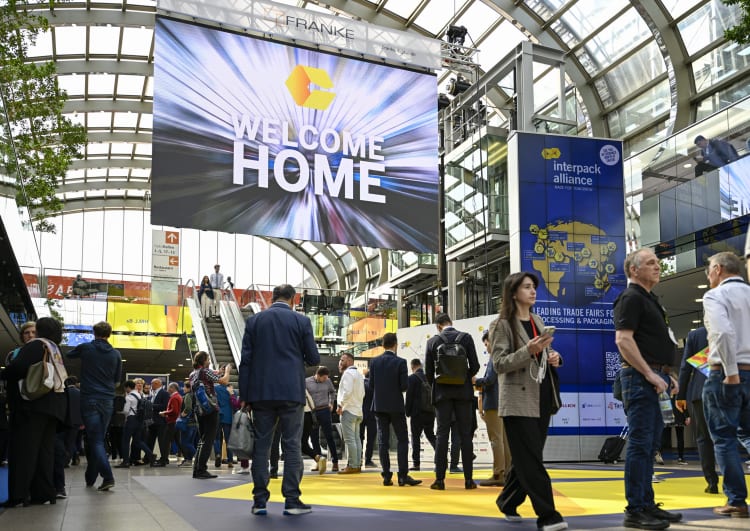
Photo: Messe Düsseldorf / ctillmann
Supporting programme and trade fair components
The event will be accompanied by an extensive supporting programme. At the North Entrance, the interpack Spotlight Forum is planned, where experts will discuss current industry developments and strategic issues such as regulations, consumer trends, sustainability requirements and process digitisation. A dedicated Start-up Zone is envisaged for young companies, providing a platform for new solutions and business models in processing and packaging.
One highlight of the programme will be the presentation of the WorldStar Global Packaging Awards on the exhibition grounds. This event aims to draw attention to outstanding packaging projects from different regions of the world, covering both material innovations and functional solutions as well as concepts geared towards the circular economy.
An important element of interpack is also the trade fair components dedicated to the supplier industry. In this section, companies will present solutions in the fields of drive technology, control systems, sensor technology, robotics, machine parts and industrial software. The aim is to demonstrate the technological basis of modern processing and packaging systems and the role of component integration in building flexible, scalable and digitally supported production lines.
The topic of reducing food loss and waste will also be strongly emphasised. As part of the Save Food initiative, the Save Food Expert Talks, Save Food Highlight Route, Save Food Awards and Save Food Project Competition are planned. These elements will focus on technological, organisational and material solutions for reducing losses at various stages of the food supply chain.
On 11 May, the Women in Packaging event will take place, focusing on the role of women in the packaging and processing industry. The programme will include presentations and discussions on the participation of women in decision-making processes, management, technology development and operational activities. Throughout the trade fair, interpack TV will broadcast from the exhibition grounds, reporting on new solutions, trends and views from representatives of the international industry community.
Services and tools for visitors
The organisers have provided a range of tools to facilitate preparation for the visit and navigation around the exhibition. In the exhibitor and product database, visitors can familiarise themselves with companies, their portfolios and planned innovations before coming to Düsseldorf, enabling preliminary planning of meetings and visiting routes. The Fair Match tool, a digital matchmaking system, is also available. Based on individual interests, it suggests potential business partners and helps to arrange appointments.
On the interpack website, information is available on preparing for the visit, travel and accommodation. A new feature is a hotel service that compiles accommodation offers related to the trade fair and facilitates comparison. The organisers recommend early booking due to the expected high occupancy during the event.
During the trade fair, the MyOrganizer tool and the interpack app are intended to support individual planning and orientation on site. They allow users to create their own schedules, mark interesting stands on the map and receive up-to-date information on the programme of events and changes in visitor guidance on the exhibition grounds.