
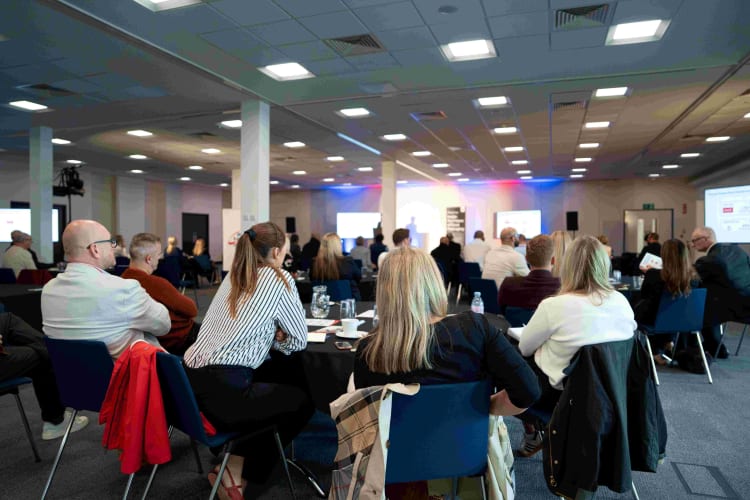
kp organised the "Inside the Future of Food Packaging" event, during which representatives of different parts of the value chain discussed the development directions of food packaging. The meeting took place at the Silverstone circuit and brought together retailers, recyclers, technology providers and manufacturers. The starting point was the observation that packaging sourcing decisions are no longer solely technical procurement choices, but increasingly strategic ones. This results from overlapping regulatory pressures, growing consumer scrutiny and rapid technological progress. The discussions covered extended producer responsibility, the PPWR regulation, consumer behaviour in sorting and recycling, soft plastics, as well as the use of artificial intelligence in packaging design and in the production environment. The common thread running through these conversations was the need for greater transparency, collaboration and data-driven decision-making across the packaging ecosystem.
Thomas Jakobsen, President of Food Packaging at kp, put it this way: "Packaging today is no longer simply about containment or protection. It is about balancing increasingly complex demands, performance, sustainability, compliance and cost, often under tighter timelines and greater scrutiny than ever before. In a world where volatility is increasingly the new constant, working in isolation is not an option."
Packaging as part of business decision-making
One of the main conclusions from the event was that food packaging is now assessed from multiple perspectives at the same time. Performance parameters, regulatory compliance, cost, recyclability, available recovery infrastructure and consumer trust all matter. Speakers indicated that the role of packaging has expanded and has become a tool that helps food businesses make decisions under greater pressure and within shorter response times.
In this context, kp presented its product solutions as a response to simultaneous market and regulatory requirements. These included kp Elite, mono-material MAP trays made from up to 100% rPET, as well as kp Infinity, a fully recyclable EPP-based alternative to phased-out single-serve EPS food packaging. The company also pointed to other solutions in its portfolio, designed not only for current market needs but also for future requirements.
Consumer trust and communication about recycling
A separate area of discussion was the growing role of packaging communication in building credibility. James Piper of the Talking Rubbish podcast noted that consumers are highly engaged with packaging and recycling, but at the same time remain sceptical, confused and quick to challenge manufacturers' claims. According to the data presented, the podcast has reached 250,000 downloads, built a 400-person Discord community, achieved an average episode completion rate of 91%, and generated 10 million social media views. This is intended to show that recycling and packaging issues can sustain audience attention if they are explained in an accessible way, both inside and outside the industry.
Among the problematic areas, James Piper mentioned confusion around QR codes, DRS deposit return schemes, and generic or misleading recycling claims. He pointed out that the industry often overcomplicates the message, while consumers primarily expect clarity. In his view, technical arguments and data must be presented in the right context and communicated effectively.
As an example, he cited the gap between recycling data and messages directed at end users. Campaigns that count individual plastic items instead of their weight can lead to misleading conclusions, because they treat a crisp packet and a plastic bottle in the same way, even though they represent very different amounts of material. In the speaker's view, market communication requires greater consistency in the way claims are formulated and data are applied.
kp related this issue to its own solutions, indicating that communicating the properties and data behind technologies such as kp Tray2Tray, which supports closed-loop recycling of PET trays back into trays, requires precision and reliability rather than generic slogans. According to the company, trust is built through specificity, verifiability and consistency of message.
PPWR, EPR and the impact of regulation on material choices
Considerable attention was devoted to legislative changes. In the week the event took place, a coalition of more than 200 companies signed a letter urging the European Union not to reopen the PPWR regulation and to implement it efficiently. This alone shows that regulation remains a dynamic and still evolving issue.
Denise Mathieson, Head of Packaging Innovation & Programme Delivery at Waitrose & Partners, assessed that the new set of compliance requirements creates a balancing act that many companies are not yet prepared for. In her view, the focus on EPR is needed, but a similar level of attention should also be given to PPWR because of its broad impact, including on PET recycling.
James Piper illustrated this issue using baked beans as an example of a staple product. He compared the cost of packaging one thousand beans in plastic snap pots, steel cans and glass jars. Under a weight-based EPR system, he estimated these costs at 3 pence for plastic, 5 pence for steel and 13 pence for glass. This is intended to show that weight-based legislation may favour lighter formats such as plastics, even where recycling infrastructure remains imperfect. At the same time, this may create tension with PPWR, which emphasises recyclability, recycled content and reuse. In the speakers' view, this tension cannot be resolved by classifying certain materials as inherently good or bad, but by focusing on actual end-of-life outcomes.
In this regulatory environment, kp pointed to SmartCycle technology, which enables the production of packaging with verifiable post-consumer recycled content, and kp Tray2Tray, which offers an operational and commercially viable closed-loop model. The company emphasises that these are not future concepts, but solutions already functioning on the market.
Soft plastics and the importance of collaboration
Soft plastics were also an important topic. It was noted that for food processors they remain a material with very high functionality, they are lightweight, easy to transport, durable and effective in reducing food waste. At the same time, their recycling still involves significant challenges which, under new regulations including PPWR, will become even more important.
Event participants stressed that responding to these challenges requires close cooperation between packaging manufacturers, retailers and other market participants. Change can be initiated individually, but its lasting implementation is primarily possible through joint action.
During the event, case studies were discussed showing the practical effects of such cooperation. These included Tesco's "Bring Back" programme, partnerships with Plastic Energy and Sabic, as well as the use of customer-returned soft plastics in cheese packaging. A subsequent move towards mono-material solutions was also highlighted where chemical recycling proved too costly and too complex. According to the organisers, the greatest value lies in examples focused on practice rather than theoretical assumptions.
In this context, kp pointed to its range of flexible films, including kp FlexiFlow and kp FlexiLam, designed with end-of-life considerations built in. The company believes that progress in soft plastics will not come from packaging designers working alone, but from jointly developing solutions with retailers and processors who understand what recovery infrastructure can realistically handle.
AI in packaging design and on the factory floor
A significant part of the programme was devoted to artificial intelligence. Yaseed Chaumoo, Managing Director of Greyparrot, discussed the use of AI to support packaging circularity. The Deepnest tool, based on Greyparrot's global AI waste analytics network, tracks billions of waste objects every year. As explained during the presentation, the system can break packaging items down into individual components and assess them against indicators such as sortability, contamination level, volume and fee exposure. This allows designers to model how changing a cap, label or sleeve affects recycling outcomes and costs in different markets.
The speaker stressed that this does not have to lead to radical design changes. Tools of this type make it possible to introduce targeted, incremental adjustments that balance consumer preferences with retailer and regulatory requirements. Full sleeves on PET bottles were given as an example. According to the data presented by Greyparrot, bottles with full sleeves are three times more likely to end up in landfill or incineration. Identifying such a problem makes it possible to consider switching to removable sleeves, smaller sleeves or eliminating this element altogether.
A second AI-related presentation was given by Sean Maley, Regional Sales Manager Europe at Infinite Uptime. The topic was operational efficiency on the factory floor. An approach based on prescriptive AI was presented, intended to detect equipment problems before failures occur and provide plant teams with a single recommendation explaining what is wrong, why it is happening and what action should be taken. In practice, this is meant to reduce downtime, lower the risk of failing to meet customer commitments, ease the burden on maintenance departments and improve the management of ageing machinery assets.
The presentation emphasised the difference between predictive AI and prescriptive AI. The former may indicate that a problem exists, while the latter is meant to indicate what the next steps should be. Sean Maley noted that Infinite Uptime's approach is based not only on dashboards, but also on the knowledge of reliability engineers, process experts, failure mode analysis, vibration data, PLC, DCS and SCADA signals, as well as customer-validated feedback loops. This model is intended to convert data into measurable operational action.
The conclusion from both presentations was that data alone are not enough. Their value depends on combining them with knowledge, competencies and the ability to implement change in practice.
A shared direction for the industry
Summing up the event, kp indicated that the future of food packaging will be shaped by collaboration, knowledge exchange and a willingness to verify established assumptions. The choice of participants, representing retail, recycling, technology, manufacturing and packaging design, was deliberate. According to the company, challenges related to EPR, PPWR, soft plastics, artificial intelligence and real-world recyclability cannot be solved in isolation.
Thomas Jakobsen concluded the event with the following words: "The biggest opportunity for us is that our customers don't know everything we can do for them, and it is very valuable that we have an opportunity, like today, to provide some insight and really interact with our customers on industry matters."
As pressure grows in terms of performance, compliance and adaptability, the role of packaging will continue to evolve. The best prepared companies will be those able to combine technical expertise with transparency, data use and cross-industry collaboration.
