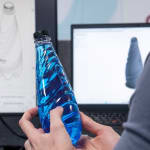
The growing pressure to bring packaging, including bottles for the FMCG and beverage sectors, to market quickly is forcing manufacturers to move away from traditional, high‑risk development paths based on early ordering of metal moulds. Acting as a strategic technology partner for the global packaging industry, BMT offers an alternative in the form of a smart prototyping approach. This platform makes it possible to produce production‑representative bottles under laboratory conditions and simultaneously acquire process data, enabling design validation before costly tooling decisions are made.
In practice, smart prototyping goes beyond standard rapid prototyping, which focuses mainly on the speed of creating physical models. BMT combines virtual simulations, 3D‑printed moulds and tests on a lab‑scale stretch blow moulding station to provide not only shape iteration but, above all, reliable information on material behaviour, wall thickness distribution and the process window. As a result, development teams can avoid six‑figure costs of mould rework, shorten the implementation cycle and decide on metal mould manufacture with greater confidence.
“Measure, digitise, execute” methodology
Smart prototyping is based on BMT’s established “measure, digitise, execute” methodology, the essence of which is generating high‑quality data instead of relying solely on time‑consuming trial‑and‑error testing. During trials on the BMT platform, real‑time parameters such as temperature, pressure and material response during blowing are recorded. On this basis, manufacturers can optimise preform geometry, material selection and process parameters at an early development stage, before series production starts.
The importance of such early visibility increases in line with trends in packaging lightweighting, growing recycled PET content and the search for more diverse, complex bottle shapes. Increasing design complexity reinforces risk when key decisions are taken only after target moulds have been manufactured. Smart prototyping makes it possible to validate designs, materials and process windows before ordering metal moulds, significantly reducing the likelihood of costly late‑stage modifications.
According to BMT data, Fortune 500 manufacturers using this platform have been able to validate bottle designs with weight reductions of up to 20 percent in as little as five days, while obtaining early, production‑representative confirmation of performance characteristics before ordering tooling. Data‑driven validation has enabled them to avoid up to £150,000 in tooling rework costs, significantly reduce late design changes and accelerate product launches by as much as 70 percent.
Integration of 3D‑printed moulds with the Blowscan platform
Conventional rapid prototyping based solely on 3D printing finished bottles often fails to reflect real production conditions. BMT reduces this gap by integrating additively manufactured moulds directly with its Blowscan lab‑scale stretch blow moulding platform. This allows bottles to be formed under tightly controlled conditions that are representative of an industrial blowing process.
The result is high‑quality printed moulds capable of producing bottles whose geometry and material distribution are close to production items, with a surface quality suitable for marketing samples, functional tests and early filling trials. Importantly, smart prototyping is not limited to visual assessment. By recording real‑time data on temperature, pressure and material behaviour, development teams gain greater confidence that the developed process settings can be transferred to industrial scale.
Validation of non‑standard formats and complex designs
The risk of committing to tooling too early increases particularly in the case of difficult formats, such as asymmetric bottles with thick walls or shapes that deviate from standard solutions. In such projects, innovative geometry, barrier requirements and process sensitivity to parameter deviations must be confirmed before production is scaled up.
Smart prototyping enables brands to test and refine innovative solutions under laboratory conditions using representative bottles that can be physically assessed, filled and tested without prior investment in production moulds. Combining data‑rich lab trials and 3D‑printed moulds allows teams to verify feasibility, performance and processability at an early stage, accelerating development while avoiding the risk of dead‑end projects.
Reducing risk as packaging complexity increases
As packaging innovation accelerates, the traditional “tool‑first” development approach is becoming increasingly risky and expensive. Decisions made with incomplete information often lead to hundreds of thousands of pounds spent on mould rework and design corrections. BMT indicates that smart prototyping allows manufacturers to explore and validate new concepts in a controlled environment, identifying potential performance or processing issues before ordering metal moulds or starting full‑scale production.
"In today’s market, manufacturers need more than speed, they need confidence" says Yannis Salomeia, CEO and co‑founder of BMT. "Smart prototyping empowers teams to replace guesswork with evidence. By testing assumptions early, visualising concepts before they are physically built, and aligning stakeholders around real data, manufacturers can reduce risk, eliminate costly rework, and accelerate their time to market. It is not just about moving faster, it is about moving forward with clarity and conviction."
"These enhancements reinforce our mission to deliver actionable insight, not just speed" adds Jude Cameron, project lead at BMT. "Smart prototyping allows manufacturers to ‘show, not tell’, turning ideas into testable models that expose feasibility and usability early in the process. By learning fast and iterating quickly, teams can move from concept to validated design in a matter of days, reducing uncertainty, focusing investment on what truly works, and building higher‑quality products from the outset."