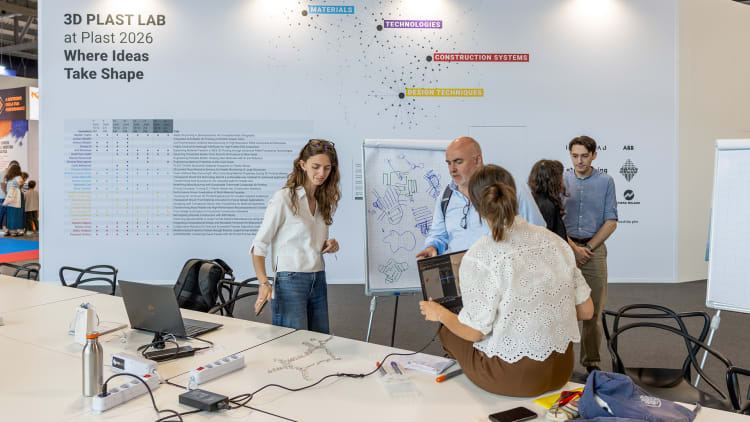
The first edition of 3DPlastLab, a format dedicated to innovation in additive manufacturing and organised within Plast 2026, has come to a close. For four days, the area brought together researchers, designers, start-ups, universities and companies from multiple countries, becoming one of the most visited spaces at the event. The format was intended to create dialogue between research, industry and design through the presentation of prototypes and direct exchange with the authors of the solutions. In practice, this meant shifting the focus from technologies alone to ideas, materials and applications. The renewed identity of 3DPlastLab was created through collaboration between the Plast organisational secretariat and Simone Maccagnan, Business Development Manager at Gimac and CEO and founder of eXgineering. Development, design and coordination were handled by Pierpaolo Ruttico, founder and managing director of Indexlab, the digital fabrication laboratory of Politecnico di Milano.
Simone Maccagnan emphasised: "The aim of 3DPlastLab was not simply to create a space dedicated to 3D printing, but to build a meeting point for people, skills and visions united by the desire to innovate. We believe that innovation grows when research, industry, design and universities come together. 3DPlastLab was created to foster these connections, accelerate the sector's technological development and generate new business opportunities for the entire additive manufacturing ecosystem."
Materials at the centre of the presentations
The common denominator of the projects presented at 3DPlastLab was an approach in which additive manufacturing is used not only to shape product geometry, but also to design the very nature of the material. In this approach, material becomes capable of having its properties programmed, while also becoming more sustainable and functional.
Marinella Levi from Politecnico di Milano and +Lab presented a new generation of 3D-printable composites entirely of plant origin. Among them was an alternative to leather, a plant-based "crocodile skin" made from agar and cork. At the same time, industrially advanced fibre-reinforced thermoset composites were presented, which gave rise to the spin-offs Moi Composites and Moi Dental.
Another project based on plant-derived materials was AI-TW, focused on transparent wood. Giulio Malucelli from Politecnico di Torino, DISAT, is responsible for its technical core. The process involves removing or modifying lignin and infiltrating the wood with transparent polymers, making it possible to obtain a material that transmits light and provides thermal insulation. According to the project description, this material could provide an alternative to glass, while the use of artificial intelligence is intended to support prediction of its behaviour and accelerate scaling of the solution. Beatrice Lerma and Doriana Dal Palù from Politecnico di Torino, DAD, are in turn analysing the perceptual and design aspects of applying this material in architecture, interiors and sustainable mobility, from bicycles to boats.
Another area focused on the use of waste as a raw material. Elena Casolari from Politecnico di Milano processes heterogeneous plastics from end-of-life vehicles, which usually go to downcycling, into products with predictable properties for the construction sector. Giulia Pelliccia from SDU Create, University of Southern Denmark, in the LAYGRADE project, is developing gradient biocomposites from sawdust, resin and beeswax. These materials can locally vary their optical and mechanical properties, opening the way to applications in architectural components that modulate light.
From material to function
An important part of the exhibition consisted of projects in which the material acquires programmed functionality. Kostas Grigoriadis from Bartlett School of Architecture, UCL, designs multi-material facades in which structural, solar and ventilation properties are embedded directly in the voxel distribution of the material. This model is intended to reduce the need for numerous mechanical systems.
Serena Graziosi from Politecnico di Milano develops printable bioactive composites made from food industry by-products. These are then formed into personalised wearable pads intended for non-invasive relief of breast pain. Jochen Mueller from Johns Hopkins University applies similar logic at the micro scale, printing elastic films only 18 microns thick inside complex devices, from origami structures to electro-active actuators for soft robotics. Across the presented work, the common idea is the simultaneous design of geometry, material, function and environmental aspects.
Hayden Taylor from UC Berkeley also presented an approach different from conventional layer-by-layer 3D printing. Computed Axial Lithography, CAL, applies the principles of computed tomography in an additive process. An optimised set of light patterns is projected through a rotating volume of photopolymer, and the absorbed dose accumulates volumetrically, creating a complete three-dimensional object within minutes, without support structures.

Call for Ideas and projects selected for implementation
The format also included a Call for Ideas addressed to students, researchers, designers and young innovators. Four winning concepts were selected, all linked by a bioinspired design approach. OsteoGyroid by William Solórzano-Requejo is a hip prosthesis with gradient porosity inspired by the human femur. Topo IV Disc, developed by Alejandro de Blas de Miguel together with William Solórzano-Requejo, Francisco Franco Martínez and Andrés Díaz Lantada, is a lattice-structure intervertebral disc intended for more biocompatible spinal implants.
The selected projects also included Nature Trace #00 by Payvand Azadmanesh and Milan Dragojlovic, a project translating growth processes observed in nature into lightweight and materially efficient structures, and Alpha EEG Headset by Chrystal Bryant, a next-generation device for monitoring brain activity. The projects were printed during the fair using additive manufacturing systems made available by X-Engineering and 3DHub Ferba. According to the organisers, this was intended to confirm 3DPlastLab's ambition to act as an open laboratory connecting young talent with industry.
Sound layer of the event
The exhibition was complemented by a special sound installation prepared by sound designer Marco Bordini. In an electroacoustic composition in a quadraphonic arrangement, the industrial and human identity of the organisations involved was transformed into an experience accompanying visitors throughout the event.
Machines, materials, production environments and voices were recorded and then analysed and processed using granular, spectral and sample-based synthesis. The result was an immersive soundtrack distributed across four independent channels. The organisers indicate that the first edition of 3DPlastLab demonstrated the importance of relationships and the cross-fertilisation of competences from different environments in the development of innovation related to additive manufacturing.