Polypropylene recyclates are gaining importance in long-life applications, which creates the need for a reliable assessment of their quality and service performance. The SKZ Plastics Institute in Würzburg has started work on a new testing method based on the strain hardening test (SHT), intended to support safe and predictable use of these materials. A quantitative approach to evaluating recyclate properties is crucial, with particular focus on failure mechanisms relevant for polyolefins, including resistance to slow crack growth. The planned project will last two years and is aimed at developing a method that is comparable with existing procedures for virgin materials and at the same time simple to implement in industrial practice.
Importance of resistance to slow crack growth
For polyolefins, including polypropylene, resistance to slow crack growth is one of the key design parameters in long-term applications. Proper specification of this parameter is linked to the safety in use of components exposed to long-term mechanical and environmental loads. This applies both to structural parts and to components used in installation technology or in utility items subjected to constant stresses. The introduction of recyclates into such applications therefore requires tools that allow precise assessment of their behaviour under service conditions, in particular their susceptibility to crack initiation and propagation over long time periods.
SKZ points out that quantitative assessment of material quality is becoming a necessary condition for the wider use of polypropylene recyclates in demanding applications. The researchers focus on developing a test procedure that will enable conclusions on resistance to slow crack growth to be drawn from strain hardening test results. This approach is intended to close the gap between classical test methods for virgin materials and the requirements resulting from the growing share of secondary raw materials in the stream of plastics used in industry.
Strain hardening test as the basis of the method
The starting point for SKZ's work is the strain hardening test described in ISO 18488. This method is already established for virgin polyethylene used in pipe applications, where it serves to assess material performance in the context of long-term reliability. The researchers in Würzburg intend to use experience from this area to develop a comparable procedure adapted to the specific characteristics of recycled polypropylene.
In the new research project the strain hardening test is to be adapted so that it enables a quantitative assessment of the quality of polypropylene recyclates. This includes both the selection of test parameters and the way the results are interpreted with regard to failure mechanisms typical for polyolefins. The project aims to develop a method that is easy to apply while being sufficiently sensitive to changes in properties resulting from differences in composition and processing history of the material.
Investigation of the influence of mixture composition
In the first phase of the project polypropylene recyclates will be simulated using mixtures of materials with known properties. This approach makes it possible to systematically analyse the relationships between composition and SHT results. As underlined by Britta Gerets, Senior Engineer at SKZ, the influence of the proportion of individual mixture components on the obtained characteristics is of fundamental importance in this context.
"Our main focus is on the dependence of the test results on mixture proportions and ratios," explains Britta Gerets. Targeted analysis of these relationships should make it possible to link parameters describing the strain hardening behaviour with specific material properties. On this basis, recommendations are planned for the interpretation of test results in relation to recyclate quality.
Validation on PIR and PCR recyclates
In the next step the method under development will be verified on post-industrial (PIR) and post-consumer (PCR) recyclates. This will make it possible to check its suitability under conditions close to market practice, where the material shows greater variability in composition and processing history than in the case of model mixtures. The validation is to include an assessment of the repeatability and sensitivity of the method to quality differences between batches of recyclate.
In addition, the influence of targeted addition of virgin material on the resistance of polypropylene recyclates to slow crack growth will be investigated. The aim is to determine to what extent and at what proportions of virgin polypropylene it is possible to improve the service properties of secondary material, as measured using the strain hardening test. The results of these investigations may in future provide the basis for more informed design of formulations for compounds containing recyclates.
The development of a simple, quantitative method for assessing the quality of polypropylene recyclates may support broader use of secondary raw materials in long-term applications while maintaining the required safety parameters. The project being carried out at SKZ aims to bring testing practice for recyclates closer to the standards already in place for virgin materials, which may facilitate the integration of recycled plastics into more demanding value chains.
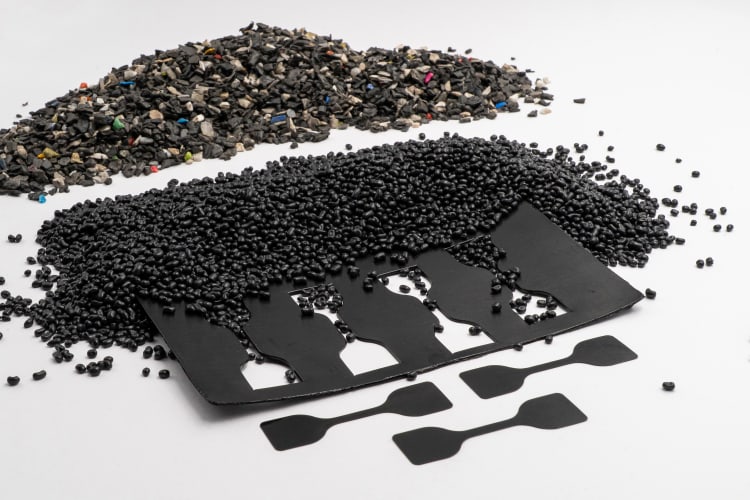
Milled material, recycled compound, film, and test specimens for the strain hardening test. (Photo: Luca Hoffmannbeck, SKZ)