Packaging for non-food products is becoming an increasingly complex field of application for the plastics packaging industry. At interpack 2026 in Düsseldorf, manufacturers of machines, materials and systems will show how diverse the requirements of this segment are and how technology, material selection and system integration impact process and environmental performance. The range of products from screws, batteries, office and gardening supplies to electronic accessories, DIY and household items translates into a wide spectrum of packaging formats. Folding cartons, trays, pouches, blisters and various plastic packaging formats must provide product protection, user functionality, shelf appeal and suitability for e-commerce. At the same time, requirements regarding sustainability, material reduction and recyclability of the entire packaging system are increasing.
In contrast to food, many non-food products are not consumed at once but remain in their packaging for a longer period. This requires higher structural durability, reclosability and simple opening systems. It applies to office supplies packed in folding cartons or plastic boxes, batteries in blisters and screws in transparent plastic bags. Product presentation plays a key role, for example through euro holes for hanging display and windows in the packaging or transparent plastics that allow the contents to be viewed. Against this background, solutions that enable the replacement of conventional plastics with alternative materials, the reduction of grammage and the improvement of recyclability of the entire packaging system are particularly important.
Replacing conventional plastics and reducing materials
Sustainability issues are currently one of the main topics in non-food packaging. Environmentally friendly materials, recyclability of the entire pack and the reduction of primary raw materials are in focus. This also requires appropriate machinery solutions that can process new materials without compromising process stability.
An example of this approach is the fully automatic JET A50 S tying machine from Siebeck. Instead of conventional plastic strapping, the system uses a compostable cord made of 100 percent cotton. The machine automatically adapts to different package heights, and lacing patterns can be freely programmed. The technology can be used not only for classic parcel strapping but also for securing products inside shipping cartons, which reduces the need for air cushions made of film or stretch wrapping.
In mail order business, product protection, material efficiency and minimisation of environmental impact are particularly important. Flöter Verpackungs-Service addresses these requirements with AirWave systems, where cushioning is generated mainly by air trapped in the cushion structure and the material share is very low.
AirWave Bio-Film is based on renewable raw materials and is biodegradable, while AirWave ClimaFilm is produced from post-consumer recyclate. These are complemented by AquaWave paper air cushions with a PVA coating that completely dissolves in the recycling process, enabling a clean return of the material to the paper cycle. The different film types are processed on Flöter AirWave1 and AirBoy nano4 air cushioning machines.
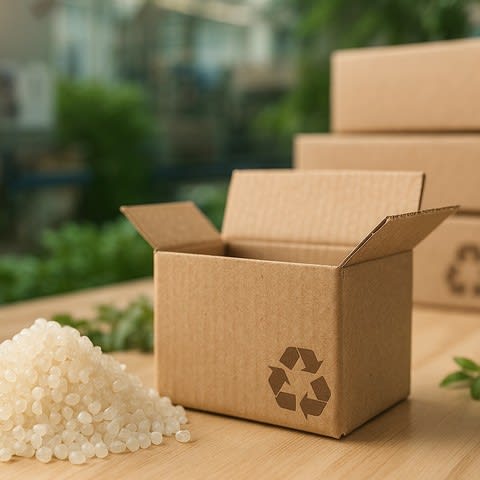
Adhesive manufacturer Follmann reduces fossil resources with renewable raw materials. Image: Follmann
Adhesives, printing inks and flexible packaging for the non-food sector
An important, often underestimated lever for improving the environmental profile of non-food packaging is auxiliary and operating materials, including adhesives and printing inks. Follmann, an interpack exhibitor, addresses the packaging industry with bio-based dispersions, hot-melt adhesives and PSA adhesives designed to reduce the share of fossil raw materials.
By targeted use of renewable raw materials and certified mass-balance methods, the use of fossil resources can be reduced without deteriorating process stability on existing production lines. Water-based printing inks for flexographic, gravure and screen printing provide a VOC-free alternative to solvent-based systems. This is particularly important in the non-food segment, where packaging is often heavily printed and serves as a carrier of marketing and technical information.
New concepts are also emerging in primary packaging for liquid products. AeroFlexx combines flexible LDPE film with an integrated air chamber structure to create packaging of the same name. According to the producer, this solution enables a reduction in plastic consumption of around 50 to 70 percent compared with conventional bottles. The design is based on self-sealing valve technology, which allows the pack to be almost completely emptied. Enhanced mechanical resistance protects the product against external influences, and the material can be recycled after use. The AeroFlexx solution has been recognised with the German Packaging Award (Deutscher Verpackungspreis).
Tubular packaging and reusable solutions for technical applications
Poly-clip System is increasingly transferring its experience from the food and pet food sector to technical and industrial non-food applications. At interpack, the manufacturer will present the FCA 80 automatic double clipper, a robust entry-level solution for closing collagen, fibre and plastic casings. The machine is primarily intended for pasty or viscous products such as sealants or construction chemicals. The double clipper is mechanically and electrically coupled with a filling machine; portions are dosed to the exact gram and closed in the form of individual sausage-shaped packs or linked chains of portions.
The portfolio is complemented by the TSCA 120 sealing and clipping machine, which processes flat film from the roll into a ready-to-fill tube and then closes it in an integrated clipping unit. The machine is designed for technical products such as sealants and civil explosives. A wide range of composite films can be used, and an integrated printing unit enables direct product marking during the process.
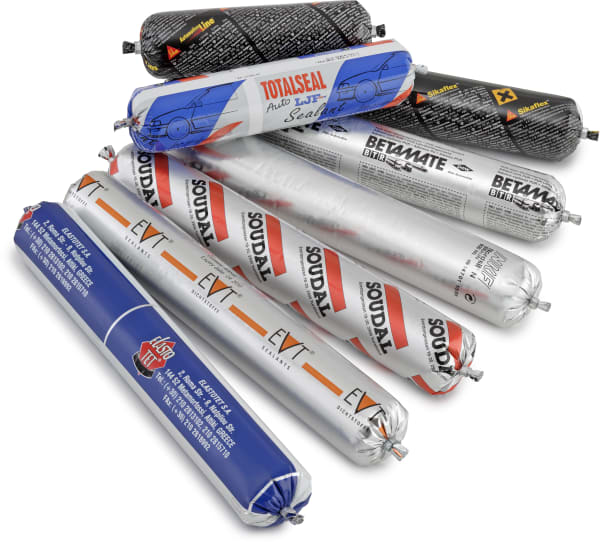
Tubular packaging is suitable for a wide range of non-food applications. Image: Poly-clip System
For non-food manufacturers, this means a combination of high process reliability with flexible selection of packaging materials. Tubular solutions enable precise dosing of pastes and compounds, while allowing integration of requirements related to marking, safety and logistics.
An important complement in the supply chain is reusable packaging systems for transport and storage of industrial products. Auer Packaging presents Euro containers with Pro hinged lid at interpack, developed for applications that require splash water protection and dust-tightness. An integrated rubber seal and lever locks ensure secure closure of the contents, while stackability and optional lock integration increase system functionality.
For large-volume liquids and granulates, Auer offers the Bag-in-Box IBC solution, which combines a stable reusable container with replaceable liner bags. This design allows hygiene requirements to be met and reduces product contact with oxygen during emptying, which is important for sensitive chemicals or raw materials. At the same time, the construction supports circular economy concepts by limiting packaging waste to thin-walled liners.
The role of non-food packaging in the value chain
Modern non-food packaging fulfils far more functions than mere product protection. It serves as a brand communication tool, an instrument for optimising logistics processes and an important element of sustainability strategies. The solutions presented at interpack 2026 demonstrate how technical development, material substitution and system integration can result in packaging that simultaneously meets ecological and economic requirements.
In Düsseldorf from 7 to 13 May 2026, exhibitors will present complete solution chains for the non-food segment, covering innovative packaging constructions as well as plastics processing machinery, filling, closing and marking systems, and technologies for reducing raw material consumption and improving recyclability. Additional information about the trade fair is available on the organiser's website.
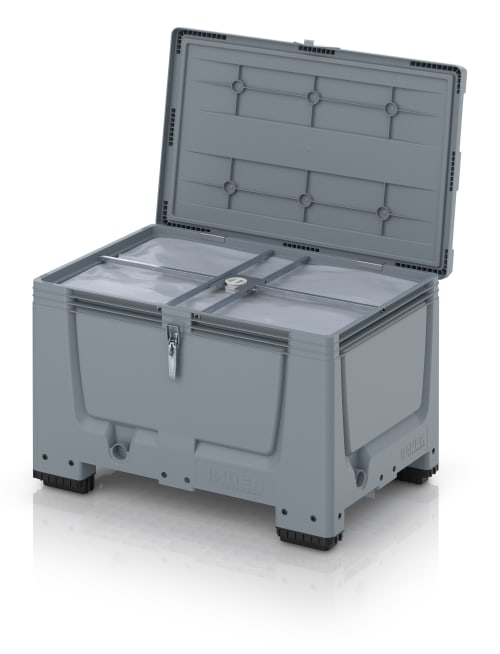
Auer combines a sturdy reusable container with replaceable inliner bags. Image: Auer Packaging