Hosokawa Alpine has developed a new granulate intake unit for extruders, intended for blown film extrusion lines. The solution has been designed as a compatible Alpine system component to provide clean and controlled feeding of granulate to the extruder throat. Integration of slide valves and a metal separator is intended to increase process reliability and reduce the formation of contaminants that can affect the quality of the film bubble. The design of the unit is aimed at preventing the build-up of dust and so-called angel hair and thus contributing to stable optical properties of the final product.
Function of the granulate intake unit and valve configuration
The granulate intake unit connects the dosing unit of the blown film line with the extruder throat. In the Hosokawa Alpine solution, this assembly comprises three fully integrated slide valves and a metal separator. The use of several independent slides makes it possible to separate the operations of emptying, cutting off the granulate supply and removing metallic contaminants without the need for additional adapters or transition pieces.
The first slide valve can, at the customer’s request, be installed in combination with a metal separator. It is located below the dosing unit and is responsible for emptying the metal separator. Once the slide has been closed, the remaining granulate flows into the extruder and the separator’s magnetic bar drawer can be pulled out to remove metal particles. The magnetic drawer consists of three encapsulated magnetic bars equipped with highly efficient neodymium magnets, enabling the capture of fine metallic contaminants present in the granulate.
The second slide valve serves as a resin drain, allowing residual granulate to be discharged from the system. Separating the functions of emptying the metal separator and emptying the intake unit itself enables more precise management of the material flow and facilitates maintenance activities and production changeovers.
The third slide valve is installed directly in front of the extruder throat and can be operated manually or optionally pneumatically via the ExVis process control system from Hosokawa Alpine. During emptying of the extruder screw, this valve is closed to interrupt the granulate supply. As a result, the screw can be emptied quickly and resin losses are reduced. According to the manufacturer, this translates into savings in time, energy and material for the user.
Operation of the unit and impact on film bubble quality
The new granulate intake unit has been adapted to the other components of Alpine blown film lines in order to simplify system integration and operation. The design provides for direct connection without the need for additional adapters through which the granulate would have to flow. The absence of such intermediate elements reduces the risk of forming so-called dead areas where dust or angel hair could accumulate.
According to the company, eliminating dead areas results in a lower risk of contamination of the film bubble. Reducing the amount of deposits in the material feeding system is particularly important in film production, where inclusions and contaminants can lead to surface defects, loss of transparency and deterioration of the optical properties of the finished product.
The matching of the intake unit to the other components of the line also has service and operational implications. As the company points out, the user has one coherent source of service support and spare parts. Centralisation of responsibility for line components can make it easier to manage maintenance and plan modernisation work.
New resin dedusting system
To further improve film quality, Hosokawa Alpine is developing a dedicated resin dedusting system. The need for such a solution arises from the fact that during storage and transport of the raw material, up to the point where it reaches the extruder, a significant amount of dust and angel hair is generated. The presence of these contaminants can cause specks and inclusions in the film and thus impair its optical quality.
The objective of the system is to remove dust from the granulate before it enters the dosing units of the extruders. Dedusting not only helps to reduce contamination inside the extruders but also clearly improves film quality. This approach is consistent with the trend to control raw material cleanliness at an early stage of the process chain, which is particularly important in applications requiring high quality standards for packaging films.
The new granulate deduster from Hosokawa Alpine is the result of cooperation with the company’s second business segment in Augsburg, which focuses on systems for powder and particle processing. By leveraging the experience of the company’s powder specialists, a product has been developed that is intended to provide high dedusting efficiency and be suitable for granulate dedusting in applications other than film extrusion as well.
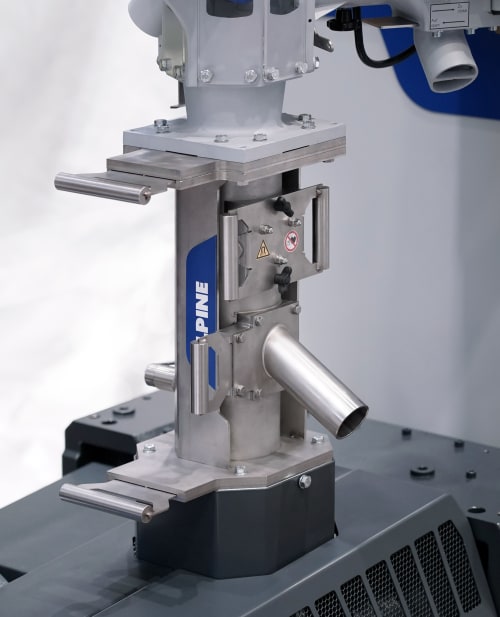
The granulate intake unit from Hosokawa Alpine is matched to the components of Alpine blown film lines and allows a clean feed of the granulate to the extruder.
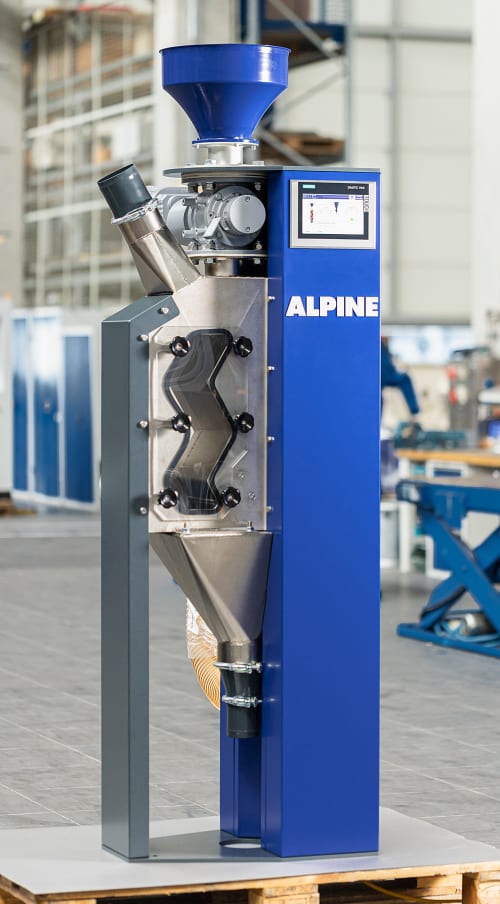
The resin dedusting system from Hosokawa Alpine removes dust from the granulate before it enters the dosing units of the extruder, thereby significantly improving film quality.