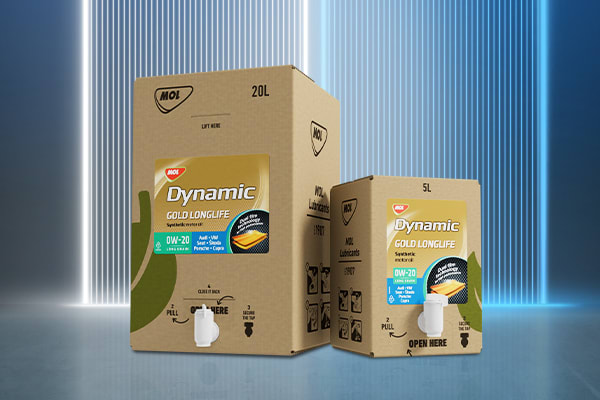
MOL Group’s lubricant subsidiary, MOL-LUB Ltd., has introduced a new Bag-in-Box packaging solution for its lubricant and engine oil portfolio, targeting a significant reduction in material use and logistics-related impacts. The development is positioned as part of MOL Group’s Shape Tomorrow strategy, which focuses on advancing circularity and lowering the environmental footprint of its operations and products. According to the company, the new solution cuts plastic consumption by up to 80 percent compared with the previously used 20-liter plastic containers, while the volume of post-use waste is reduced by a factor of twelve. At the same time, the packaging is designed to be compatible with existing industrial, commercial and service applications where lubricants are dispensed regularly.
Structure and recyclability of the Bag-in-Box system
The introduced Bag-in-Box system is based on a two-component construction. An inner plastic bag holds the lubricant or engine oil, while an outer cardboard box provides mechanical stability and protection. This combination is intended to balance lightweight design with robustness and functionality. The cardboard component is fully recyclable, which, as highlighted by the company, helps to lower the overall environmental impact over the entire life cycle of the packaging, from production and logistics through to end-of-life handling.
Compared with the conventional 20-liter canister used previously by MOL-LUB, the Bag-in-Box design enables an 80 percent reduction in plastic use for the same nominal filling volume. In addition, the company reports that the volume of packaging waste generated at the end of life can be reduced twelvefold, which is relevant both for users managing on-site waste streams and for downstream recycling and disposal systems.
Operational and logistical benefits
The new packaging is being introduced in 5-liter and 20-liter variants, targeting different user groups and application profiles. Beyond the material savings, MOL-LUB emphasizes several operational and logistical advantages. Owing to its compact geometry and stackable design, the Bag-in-Box format occupies less space in storage and during transport than rigid canisters with comparable fill volumes.
For the 20-liter format, MOL-LUB indicates that up to 88 percent more units can be loaded onto a single pallet compared with the earlier packaging solution. Depending on delivery conditions, this increase in pallet utilization can translate into transportation cost savings of up to 40 percent. Better pallet density also has the potential to reduce transport-related emissions per unit of product moved, in line with the company’s broader efforts to optimize its logistics footprint.
The handling concept of the Bag-in-Box is tailored to industrial, commercial and service environments where lubricants are often dispensed in confined spaces or directly at the point of use. A smart tap integrated into the inner bag enables controlled, clean dispensing, with the aim of minimizing dripping and spillage. This can be relevant both from an occupational safety perspective and for reducing product losses during handling.
Sustainability context and company strategy
The launch of the Bag-in-Box solution is presented by MOL Group as part of a broader program of innovation and sustainability initiatives. The company links the development directly to its Shape Tomorrow strategy, which includes objectives related to circular solutions and the reduction of environmental impacts in product value chains.
Commenting on the introduction, Szabolcs Kozma, Managing Director at MOL-LUB Ltd., stated: "This new packaging solution demonstrates how MOL Group is integrating sustainability principles into every level of its operations. By significantly reducing plastic use and enabling easy recycling, we are offering our customers and end-users a sustainable solution while maintaining the same high product quality that MOL lubricants are known for."
Within this framework, the Bag-in-Box format is intended to contribute to lowering the carbon footprint associated with the company’s lubricant portfolio. At the same time, MOL Group positions the solution as a tool to support its partners and customers in meeting their own sustainability objectives, particularly in relation to resource efficiency and waste management in lubricant use.