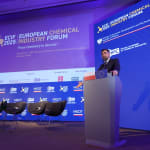
On 11 December 2025, the first edition of the European Chemical Industry Forum (ECIF 2025) was held at the headquarters of the Ministry of Economic Development and Technology. The event’s leading theme was “From Chemistry to Security”, highlighting the link between the condition of the chemical industry and Europe’s economic and strategic security. The forum was attended by Minister of Finance and Economy Andrzej Domański, representatives of public administration, and leaders of the European chemical sector and industry organisations. Discussions focused on challenges related to rising energy costs, the pressure of transformation, global competition and regulatory changes that affect the operation of the chemical industry in the European Union.
Economic security was identified as equally important as military security, particularly in the context of the current geopolitical crisis and disruptions in global supply chains. Participants stressed that Europe’s economic resilience is closely linked to the condition of its basic sectors, first and foremost the chemical industry.
The chemical industry as the foundation of value chains
In his opening speech, Minister Andrzej Domański drew attention to the role of chemistry as the starting point for modern value chains in the economy.
“Today we must state this clearly and responsibly: Europe’s economic resilience begins with the resilience of its basic sectors. Every modern value chain starts with the chemical industry. Without it, there is no modern energy sector, modern construction, modern agriculture, pharmaceuticals or defence industry. Poland wants to be a co-creator of a new European model of economic growth – a model in which industry is treated as a pillar of security, stability and prosperity. We want the chemical industry to be strong, competitive and safe, not only in Poland but across Europe,” said Minister of Finance and Economy Andrzej Domański.
In 2025, the European chemical industry faced growing developmental and competitive barriers. Attention was drawn to raw material pressure from third countries, supply chain disruptions, high energy prices and the relocation of production outside the European Union. These factors weakened the competitive position of the chemical sector and forced the search for solutions supporting the energy transition, restoring competitiveness and achieving ambitious regulatory objectives.

Photo: Teodor Klepczyński for PIPC
A new compact linking climate policy, industry and security
The importance of the chemical industry for the European economy was also emphasised by representatives of industry organisations. As pointed out by Dr. Eng. Tomasz Zieliński, President of the Management Board of the Polish Chamber of Chemical Industry, the chemical sector provides critical support for many other branches of industry.
“The chemical industry is not just ‘another sector’ – it is, as the European Commission itself underlines, the mother of all industries and the foundation of Europe’s economic strength. If chemistry loses competitiveness, all of Europe loses it, which is reflected in data from the last 20 years, when Europe’s share in the global chemicals market fell from 27% to 13%. Therefore, Europe now needs a new, realistic compact linking climate policy, industry and security. We cannot talk about economic security, a modern defence industry and a competitive Europe without a strong chemical industry, but also without efficient supply chains and maintaining production on our continent. That is why, together with the Ministry of Economic Development and Technology, as the Polish Chamber of Chemical Industry, we have created a space for shaping concrete solutions for the future of the European chemical industry – the European Chemical Industry Forum 2025,” said Dr. Eng. Tomasz Zieliński.
This statement fits into a broader discussion on the need to develop an approach that consistently takes into account climate objectives, industrial needs and security requirements. It was emphasised that the chemical industry, as a supplier of key raw materials and materials, has a direct impact on the functioning of modern energy, construction, agriculture, pharmaceuticals and the defence sector.

Photo: Teodor Klepczyński for PIPC
Security as a priority and Poland’s role in Europe
Since the beginning of 2025, security issues in all their dimensions have become one of the key priorities of public administration. This was also reflected in the slogan of the Polish Presidency of the Council of the European Union – “Security, Europe!”. In this way, Poland’s special role was underlined, as one of the world’s twenty largest economies, in shaping a new approach to resilience and the development of European industry.
During the first edition of the European Chemical Industry Forum 2025, representatives and leaders of the European chemical sector, industry organisations and public administration consistently indicated that the climate transition must be implemented in a realistic and feasible way that reinforces the economy. In the context of mounting geopolitical tensions, military, energy and economic security were recognised as inextricably linked, and the chemical industry was identified as one of the key elements in this system of interdependencies.
Maintaining industrial production in Europe
Forum participants stressed that the future of Europe’s security and competitiveness depends to a large extent on maintaining industrial production on the continent and ensuring stable and predictable conditions for investment, particularly in strategic sectors such as the chemical industry. It was pointed out that without an appropriate regulatory and economic environment, maintaining the long-term competitiveness of European chemical producers may be difficult.
The European Chemical Industry Forum 2025 was organised jointly by the Ministry of Economic Development and Technology and the Polish Chamber of Chemical Industry. It was also supported by the European Chemical Industry Council (Cefic), the European Chemical Regions Network (ECRN) and the Chemical Industry Association of the Czech Republic (SCHP CR). The event created a platform for the exchange of views between industry, trade associations and public administration, as well as for formulating proposals for actions to support the development and resilience of the European chemical industry.