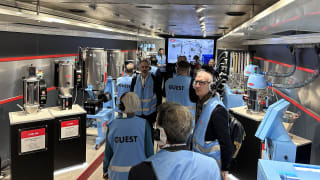
Clariant reported that in 2025 its catalysts enabled the avoidance of greenhouse gas emissions amounting to 45 million tonnes of CO2 equivalent, 5 million tonnes more than a year earlier. According to the company, this increase resulted from the use of catalytic technologies applied in processes of major importance for emission reduction in heavy industry and the chemical sector. The company points in particular to reforming catalysts for direct reduced iron production, catalysts for nitrous oxide abatement in nitric acid plants, and syngas catalysts for green methanol production, both from electrolytic hydrogen obtained from renewable electricity and from bio-based feedstocks. Catalysts for refinery off-gas purification also contributed to the declared effect, supporting refineries and crude-to-chemical complexes in reducing their environmental footprint. The company also emphasises that the DRI process has half the CO2 intensity of conventional steel production.
Jens Cuntze, President of Clariant Catalysts, said: "Enabling a cleaner and more sustainable future remains one of our main focus areas as we support industries where emission reduction is particularly difficult through continuous innovation. Our sustainability efforts cover the entire value chain, from reducing our own direct and indirect emissions to creating solutions that help our customers lower theirs."
Richard Haldimann, Chief Strategy & Technology Officer at Clariant, added: "The achievement of ambitious climate goals can be significantly accelerated through collaboration with producers and industrial partners. The success of these low-carbon processes is based on advanced technology that makes economically attractive CO2 savings possible."
The growing role of green methanol
Clariant notes that most emission savings still come from already established industrial processes, but new and unconventional applications are also gaining importance. The company states that last year marked an important stage in the development of green methanol with the startup of two projects described as lighthouse projects. These are European Energy's e-methanol plant, where biogenic CO2 and green hydrogen are processed using MegaMax catalysts, and Shanghai Electric's bio-methanol facility, which uses agricultural waste to produce methanol. According to the company, both projects confirm the commercial viability of sustainable methanol production on an industrial scale.
The company states that green methanol is one of many carbon-neutral technologies it supports. The release also indicates that Clariant is continuing the transformation of its product portfolio and operations in order to accelerate the energy transition and the decarbonisation of the chemical and fuel industries.

Clariant enabled customers to avoid 45 million tonnes of CO2e greenhouse gas emissions in 2025. (Image created using MidJourney - Clariant)