Borealis has announced the global rollout of the Borstar Digital Twin program, based on virtual replication of production processes and the use of artificial intelligence tools. The solution has been developed for plants operating with the Borstar technology for polyethylene and polypropylene production, with the objective to increase operational efficiency, process stability and product quality across all facilities using this platform.
The Borstar Digital Twin solution package combines process models, real-time data analytics and advanced optimization algorithms. On this basis, a virtual production twin is created that reflects the actual operation of the plant. The platform enables continuous monitoring of parameters, generation of predictions and execution of simulations, supporting decision-making at the operational level. The use of digital tools is also intended to accelerate product grade changes, reduce the number of unplanned shutdowns and improve the consistency of quality of the materials produced.
According to the program assumptions, Borstar Digital Twin is intended to support Borealis plants in several areas. First, it allows efficiency optimization through data-driven decisions and process simulations. Second, by enabling prediction of potential irregularities before they occur, it is expected to contribute to higher operational safety. Third, the tool is designed to support sustainability efforts by reducing waste volumes, energy consumption and environmental impact. In addition, the platform is to help accelerate product development and support operator training in a virtual environment.
Expansion of the program to all Borstar units
The Borstar Digital Twin program was launched in 2023 with a focus on the proprietary Borealis technology for polyethylene and polypropylene production. It was designed to ensure that plants operate at the highest possible efficiency. In 2025, after the implementation phase and the build-up of digital maturity, the company initiated the global scale-up of this solution. It covers all Borstar units, including plants operated by licensees Baystar and Borouge. This marks a transition to a phase in which digital ways of working become the standard in Borealis core production processes.
As emphasized by Wolfram Krenn, Executive Vice President Operations at Borealis, the role of the digital twin goes beyond deployment of a single technology.
"By embracing the Borstar Digital Twin, Borealis is not just adopting a new technology, it is transforming plant operations. By combining AI-driven predictions with rigorous process models, the Borstar Digital Twin enables plants to run at higher efficiency, achieve faster and more controlled grade transitions, and deliver consistently prime product quality. Additionally, real-time monitoring allows early detection, prediction and mitigation of process and equipment anomalies, resulting in fewer unplanned shutdowns and greater reliability," says Wolfram Krenn.
Importance for customers and the company strategy
The broader relevance of the Borstar Digital Twin program for the company activities is commented on by Stefan Doboczky, CEO of Borealis.
"Borstar Digital Twin turns technology into a customer advantage. It delivers speed, reliability and quality, helping our customers succeed. That is how we put our We4Customers strategy into action," says Stefan Doboczky.
The implementation of Borstar Digital Twin forms part of the Borealis digital transformation process, in which virtual process models, data analytics and artificial intelligence are becoming tools of day-to-day production management. As the program evolves, the company plans to publish further information on its functionalities and the results achieved at individual plants, as well as on the next steps in the development of this platform.
Current information on the Borstar Digital Twin program is available on the dedicated website for this solution.

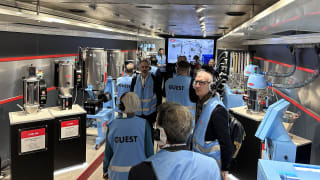
Borstar plant in Schwechat, Austria