Plastic packaging is one of the most basic and most widely used materials in the modern economy, playing a key role in such important consumer segments as food, personal care products and e-commerce. From retail shelves and cold chains to courier shipments, plastic packaging solutions permeate the entire consumption chain. According to a market analysis prepared by Mordor Intelligence, the global plastic packaging market reached a value of USD 493.42 billion in 2025 and is expected to grow to USD 579.95 billion by 2030. As demand increases, environmental requirements related to reducing plastic consumption, minimizing waste and improving recyclability are gaining importance. The modernization of plastic packaging is no longer limited to material selection; it has become a challenge that requires coordinated development in material choice, processing technologies and machinery capabilities. The three main application areas, namely food, personal care products and e-commerce, are becoming key drivers of technological progress in the packaging industry.
Food packaging: high barriers and bioplastics
Food safety has long been one of the main priorities for consumers. As health and environmental awareness increases, the focus is shifting from basic packaging functionality towards its ability to preserve freshness, ensure safety and offer a more sustainable profile.
Plastics dominate the food packaging segment, with modified atmosphere packaging (MAP) and high-barrier multilayer structures becoming standard solutions for shelf-life extension. MAP limits oxidation and microbial growth by adjusting the proportions of oxygen, carbon dioxide and nitrogen inside the pack, and is therefore widely used in meat, fresh fruit and vegetables and ready meals. In parallel, multilayer coextruded films using materials such as EVOH, polyamide and polyethylene provide additional barriers to oxygen and moisture, further extending the shelf life of food products.
Bioplastics are also gaining importance. BASF's ecovio bioplastic is a fully compostable polymer based on the biodegradable ecoflex polymer and PLA. It is used, among other things, to produce certified compostable coffee capsules and outer packaging with odour barrier properties.

BASF's ecovio bioplastic is used, among other things, for compostable coffee capsules and packaging with odour barrier properties.
In addition, PHA injection moulding materials developed by the Chinese biotechnology company Bluepha are intended for the production of environmentally friendly cutlery and food containers, addressing the growing market demand for bioplastics.
The high requirements regarding barrier performance and functionality mean that close interaction between material, processing technology and equipment is necessary. In the production of high-barrier films, coextrusion lines equipped with advanced automation systems enable stable multilayer coextrusion. The nine-layer blown film line from Corstar allows simultaneous processing of different materials and the production of multifunctional, high-performance composite films for premium food and pharmaceutical packaging.
In food packaging recycling, food-grade rPET produced on the Starlinger recoSTAR line plays an important role. This material has been approved by many international brands and industry organisations. These examples show that the synergy between material innovations and machinery upgrades translates directly into food packaging safety, freshness preservation and a more sustainable profile.
Personal care packaging: recyclates, aesthetics and personalization
In the personal care segment, the role of plastic packaging goes beyond protection. Under strong market competition, packaging has become an important tool for brand differentiation. The development of social media has reinforced the importance of visually appealing designs, while environmental regulations and requirements regarding the content of recycled material force companies to integrate sustainability aspects already at the packaging design stage.
The EU Packaging and Packaging Waste Regulation (PPWR) stipulates that from 2030 onwards plastic packaging must contain defined minimum levels of recycled plastics and must be fully recyclable or reusable. Large cosmetics groups such as Unilever and L'Oréal have set clear, phased targets for increasing the share of post-consumer recycled (PCR) feedstock in their packaging.
In the field of PCR applications, recycled polyolefins are attracting particular attention. The HDPE and PP recycling processes developed by Da Fon Environmental Technology have received FDA approval, and the resulting PCR-HDPE and PCR-PP recyclates meet the requirements for recycled content in packaging, including food-contact applications. PP recyclate offered by Re-mall is characterised by high purity, safety and transparency, as well as low odour and a traceable carbon footprint, which enables its use in packaging for food, personal care products and transparent containers with higher aesthetic requirements.
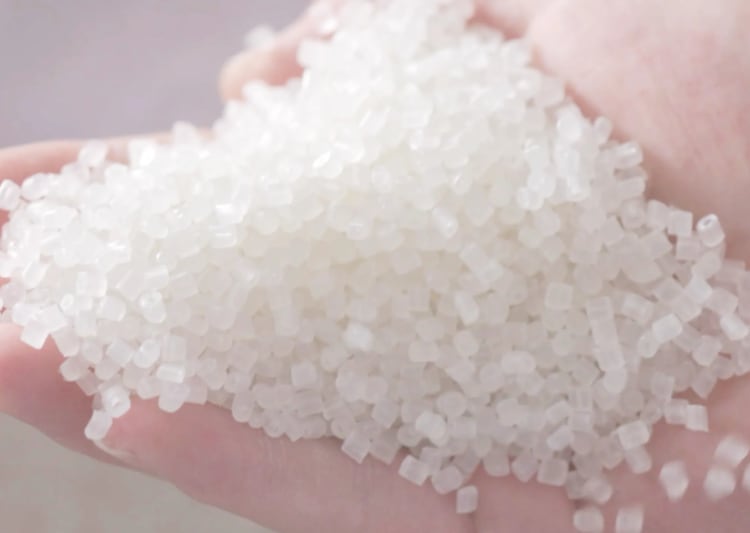
Re-mall's high-purity, transparent, low-odour PP recyclate is used, among other things, in personal care packaging.
In addition, LyondellBasell's CirculenRecover materials can contain up to 100% PCR content and are already used in personal care packaging. This demonstrates that the use of increasingly high-quality recyclates is becoming a standard in this segment.
In parallel, the personal care packaging sector is evolving towards smaller production batches and a higher number of variants, which stimulates innovation in printing and lamination. HP Indigo digital printing technology simplifies the printing workflow, enabling on-demand production and rapid implementation of personalised, limited-edition packaging designs. This reduces material consumption and waste volumes and shortens overall lead times.
At the converting stage of flexible packaging, modern lamination technologies are also important. Sinomech's intelligent solventless lamination machine, equipped with full-servo drives and advanced design features, enables very high operating speeds and rapid line speed adjustment. This provides flexible solutions for laminating films used in flexible packaging for cosmetics and hygiene products.
E-commerce: from downgauging to efficient recycling
As purchasing behaviour shifts from traditional retail to online platforms, packaging requirements are also changing. According to data from China's State Post Bureau, the number of courier parcels has exceeded 174.5 billion, which leads to increased packaging consumption and growing pressure on efficient recycling. To reduce costs and carbon emissions, the industry is optimising material structures and improving production efficiency.
The development directions for e-commerce packaging technologies are becoming increasingly clear. On the one hand, increasing the share of PCR feedstock supports the development of a circular economy. On the other hand, the use of mono-material solutions, reducing the number of layers and implementing lightweight moulding processes improve recycling efficiency and lower costs along the value chain. Logistics companies such as JD Logistics and Cainiao Network are actively working on mono-material designs and layer reduction, reflecting a growing industry consensus in this area.
Technologies such as downgauging of films, thin-wall injection moulding and microfoaming are coming to the fore. The latest developments in biaxially oriented films allow material modifications that reduce thickness while maintaining the required mechanical strength, enabling their use in high-performance e-commerce packaging.
High-speed injection moulding machines for thin-wall applications, offered by companies such as Sumitomo (SHI) Demag, Fu Chun Shin and Powerjet Plastic Machinery, reduce the material used per packaging unit while maintaining the necessary structural integrity.

Sumitomo (SHI) Demag high-speed injection moulding machine for the production of thin-walled containers and caps and closures.
Process requirements in the e-commerce packaging segment are also evolving. With the growth of live-streaming commerce, brands taking over logistics operations and the implementation of regional warehousing and distribution models, orders increasingly take the form of smaller batches, shorter lead times and greater product diversity. This places high demands on the flexibility of packaging lines.
The TS39-16c automatic bottle bagging machine from Guangdong Taisen Intelligent Equipment enables smooth changeovers between different bottle types, which is particularly important for small-batch production and the handling of multiple orders at the same time. The machine increases packaging efficiency and at the same time reduces costs associated with excessive packaging and frequent line adjustments.
Modernisation of e-commerce packaging is no longer limited to material innovation. In high-turnover, large-scale applications, both production efficiency and the sustainability profile of solutions have become integral elements of technical decision-making.
Synergy of materials, design and processes
Given the diverse requirements imposed on plastic packaging, a simple substitution of one material with another is no longer sufficient to meet the higher expectations of the market and regulators. Effective modernisation must be based on synergy between material properties, packaging design, processing technologies and the stability and flexibility of production equipment.
From high-barrier food packaging, through design- and recyclate-oriented cosmetics packaging, to fast-rotating solutions for e-commerce logistics, each segment has its own functional priorities. The common denominator, however, remains high reliability and efficiency of production processes. In the coming years, competitive advantage will be gained by companies that can consistently integrate material selection, structural design and processing technology, creating packaging solutions adapted both to market requirements and to recycling systems.