The global medical device market is in a phase of dynamic growth, driven by technological innovation and increasing demand for healthcare services. According to Fortune Business Insights, the value of the global medical device market is expected to reach USD 572.31 billion in 2025, and then increase from USD 604.99 billion in 2026 to USD 1,032.66 billion in 2034, corresponding to a compound annual growth rate (CAGR) of 6.9 percent. China is an important center of development, where a growing population, rising incidence of chronic diseases and significant public investment in healthcare make the country one of the key consumers of medical devices.
According to Frost & Sullivan, the Chinese medical device market increased from RMB 729.8 billion in 2020 to RMB 941.7 billion in 2024, with a CAGR of 6.6 percent, and is projected to grow to RMB 1,813.4 billion in 2035. Market development is influenced by policies such as centralized procurement and the implementation of Diagnosis Related Groups (DRG), which enforce cost efficiency, foster innovation and create new business opportunities. At the same time, several technological trends can be observed: integration of smart systems and artificial intelligence solutions, development of wearable devices, material and process innovations aimed at personalization and high precision, and the growing importance of sustainability in the design and manufacture of devices and their packaging.
Convergence of drug delivery systems and patient behavior
The drive to improve treatment efficacy and convenience of self-administration is stimulating the development of advanced drug delivery systems, such as connected injector pens and smart caps that monitor doses. In parallel, patient expectations are increasing with regard to ease of use, reduced pain and the possibility of less frequent dosing and home-based therapy.
One example is Savicred Biotechnology, a Chinese manufacturer of drug delivery systems, which has launched a new generation 2.25 ml auto-injector for the administration of high-volume biologics. The device uses Makrolon medical-grade polycarbonate from Covestro. The material provides high mechanical strength required for reliable administration of larger volumes, very good dimensional stability for precise component fit and favorable processability in precision molding of parts.
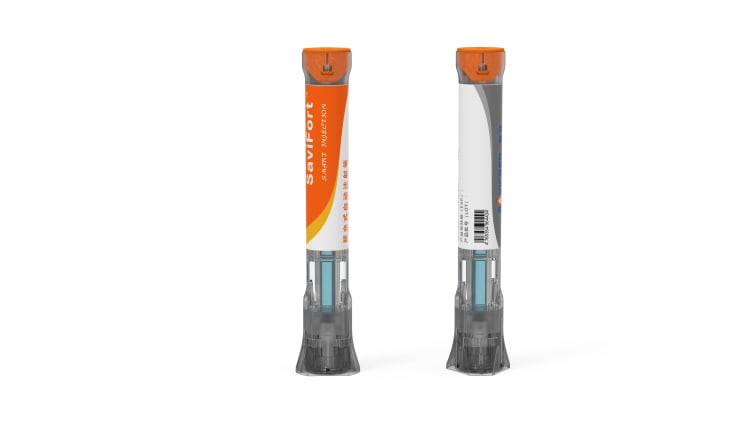
2.25 ml Savicred auto-injector with Makrolon medical-grade polycarbonate from Covestro (photo: Covestro)
Another example of specialized materials for drug delivery systems is the Victrex PC101 grade, based on polyetheretherketone (PEEK) and designed for use in delivery devices and components in contact with pharmaceuticals. PEEK materials perform well in environments requiring sterilization, high dimensional stability and chemical and thermal resistance. Due to their thermoplastic nature, they can be processed by injection molding, machining or additive manufacturing.
Towards more sustainable medical packaging
Environmental aspects are becoming a priority in the medical sector as well, particularly in the area of packaging. Manufacturers aim to reduce the environmental impact of packaging while maintaining the required level of product protection, safety and functionality.
The medical packaging market includes blister packs, bottles, vials, ampoules and other formats. Among these, blister packs are among the most widely used solutions and are expected to maintain a dominant position. From a material perspective, plastics play the most important role, combining barrier and mechanical properties with the ability to be formed into complex geometries.
Syensqo's Echo portfolio is designed for pharmaceutical blister packaging applications, providing a high level of barrier, mechanical and seal performance, which is critical for the safety of medical and food products. The portfolio is certified under ISCC PLUS based on a mass balance approach, enabling closed-loop raw material management and reducing environmental impact.
Kiefel offers the modular Solutionperformer KFS form-fill-seal machine, which forms, fills and seals polyolefin bags for parenteral nutrition or dialysis in a single production unit. The system is characterized by high energy efficiency. The use of servo motors instead of pneumatic drives at all key stations enables more precise process control, reduction of compressed air consumption and a lower specific energy consumption per article.

Kiefel Solutionperformer KFS machine for automatic forming, filling and sealing of medical bags (photo: Kiefel)
Material technologies for advanced medical applications
Advanced medical technologies, including devices for interventional vascular procedures and cardiovascular support, require specialized tools such as catheters, imaging systems and implants. Material selection is critical because mechanical properties and biocompatibility determine both device functionality and patient safety. Innovations in materials enable solutions with high strength, flexibility and durability while reducing the risk of adverse reactions, which is particularly important in minimally invasive procedures.
Evonik has developed the Vestakeep i4 3DF filament, the world's first implant-grade filament based on PEEK, intended for medical 3D printing of human surgical implants. The material offers high biocompatibility, biostability and X-ray transparency and meets the requirements of ASTM F2026, the standard defining criteria for PEEK polymers used in surgical implants.
Similarly, the Aksopeek series of implant materials from JiangSu JunHua, also based on medical-grade PEEK, has obtained ASTM F2026 approval. According to the manufacturer, this series is the result of 18 years of experience in PEEK applications in medicine. In the field of flexible components of medical devices, thermoplastic polyurethanes (TPU) and thermoplastic elastomers (TPE) play an important role.
Lubrizol offers, among others, the Pellethane and Tecothane medical-grade material families, which are thermoplastic polyurethanes for applications such as cardiac catheters, guidewires, heart pumps and imaging devices. Pellethane materials are characterized by high flexibility and are mainly used in tubing and catheters, while Tecothane stands out for its solvent resistance and biostability. Modified variants are also available, including grades with radiopaque fillers and pre-colorization tailored to specific application requirements.
Thermoplastic elastomers (TPE) are used in components requiring softness, elasticity and biocompatibility, such as seals for ostomy bags, which must maintain shape and tightness under pressure to prevent leakage. Materials from Kraiburg TPE provide very good adhesion to polypropylene and polyethylene, which simplifies assembly by eliminating the need for additional adhesives.
In the segment of high-temperature plastics for medical devices, polyphenylsulfone (PPSU) and polysulfone (PSU) are of particular importance. Medical-grade polyphenylsulfone is a high-performance amorphous thermoplastic polymer known for its high reliability and safety in medical applications. This material can withstand up to 1,000 cycles of steam sterilization without significant loss of properties.
Wanhua Chemical has developed the Wanafone Sulfone Polymer family, which includes both polysulfone and polyphenylsulfone. These materials offer high heat resistance, good mechanical strength, biocompatibility, resistance to hydrolysis and chemicals, and compatibility with various sterilization methods.
Precision and smart processing for quality and safety
Maximum precision is required at every stage of the medical device manufacturing cycle, since even a minor functional failure, such as in an insulin injector, can pose a life-threatening risk to the patient. Advanced precision processing technologies are essential to ensure that stringent quality and safety requirements are met. Production of such components typically takes place in cleanroom conditions, which places additional demands on machinery in terms of cleanliness and minimization of emissions.
Fresenius Medical Care, a global leader in kidney disease treatment, produces millions of hemodialysis cartridges every year. In this application, the processing shrinkage of polypropylene is a significant challenge, as it hinders achieving high dimensional accuracy of components. These requirements are met by the all-electric e-motion injection molding machine from Engel, equipped with a cleanroom package and dynamic electric servo drives. This solution ensures high precision and high production speeds. In addition, the intuitive CC300 control system increases process stability, resulting in consistent part quality.
Yizumi offers the FF-M series of all-electric injection molding machines for medical applications. The Tie-Bar Free clamping unit keeps the platen away from the tie bars, eliminating the need for lubricants in this area and reducing the risk of product contamination. The intelligent weight control function enables automatic monitoring and adjustment of process parameters in real time, limiting part weight variation and improving product consistency.

Yizumi FF-M all-electric injection molding machine for medical applications (photo: Yizumi)
Tools based on artificial intelligence are also gaining importance and are transforming quality assurance systems in medical device manufacturing. In injection molding, AI models use collected process data to determine critical quality parameters and detect deviations at an early stage.
One example is the solution from Kistler, which comprises a compact sensor combining cavity pressure and temperature measurement, installed directly in the mold. Data from the sensor is transmitted to the ComoNeo process monitoring system, which analyzes information in real time, compares it with reference curves and effectively detects deviations from set parameters.
In the field of technical films for medical and packaging applications, complex multilayer coextrusion solutions are being developed. Jctimes has developed a nine-layer pancake blown film die for use in the medical and packaging industries. The optimized flow channel design ensures uniform material distribution across all layers, reducing the formation of bubbles, defects and thickness variations. As a result, barrier properties, mechanical strength and film appearance are improved.
The outlook for the medical device industry remains closely linked to further progress in precision, smart technologies and sustainability. New materials will support the most demanding medical applications, and advanced, digitally supported manufacturing processes will strengthen quality assurance systems. Changes driven by patient needs and the growing importance of environmentally friendly solutions will foster further development of the global and Chinese medical device markets towards higher safety and a more sustainable profile.

Automated quality control during the production ensures traceability in medical technology. (Photo: Kistler)