DS Smith, KHS and Carlsberg produces a sustainable cardboard pack
Carlsberg, DS Smith and KHS have launched a cardboard multipack with rounded corners based on Arcwise technology. First introduced in Poland, the solution is intended to combine stronger shelf impact, lower material use and production on existing machines.
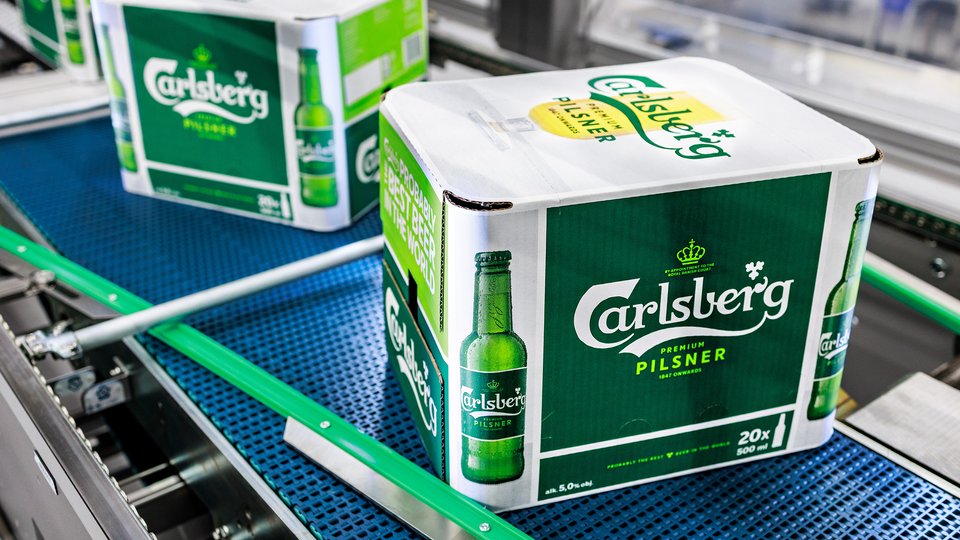
Carlsberg, in cooperation with DS Smith and KHS, is launching a cardboard multipack with rounded corners based on SCA's patented Arcwise technology. The new secondary packaging for bottles is intended to combine three goals that the company considers crucial when designing new formats, consumer experience, cost optimisation and solutions with a lower environmental impact. Poland has been selected as the first launch market, and further projects are in preparation. As Marine Andre, packaging innovation director at Carlsberg, explains, the success of packaging in retail is determined by a very short exposure time on the shelf. "For us, consumer experience has top priority. After all, in store our products have less than two seconds to be noticed on the shelf. If you are not conspicuous, it is as if you are not there." At the same time, the company points out that consumers expect sustainable packaging, but that this alone does not justify a higher price. For this reason, new solutions must simultaneously meet functional, cost and marketing requirements.
An example of this approach is DS Smith Round Wrap, a wrap-around cardboard multipack with curved edges intended for beer bottles. According to the project participants, the format improves brand visibility and shelf impact, while also reducing material use, lowering the carbon footprint and providing better protection during transport. An additional advantage is the possibility of production on packaging machines already in operation, without the need for major investment and without increasing the price for the end customer. In this context, Carlsberg refers to research indicating that objects with rounded shapes are perceived as more attractive than forms with sharp corners.
Long implementation process
Before the new packaging reached store shelves, the project went through a multi-year phase of trials and validation. Bogdan Volkotrub, senior packaging implementation and optimisation manager at Carlsberg headquarters, recalls that the first tests began in Sweden in 2020. "Before we started thinking about larger volumes, we first wanted to prove on a small scale that this solution could actually be implemented at all. At first, we were not successful because we could not achieve consistent quality."
The breakthrough came in 2022, when partners responsible for material and packaging technology joined the project. DS Smith, as the packaging manufacturer, provided the appropriate material and carried out intensive testing and validation. In parallel, KHS analysed which machines operating in Carlsberg plants could handle the new format without major modifications. Volkotrub describes the process as follows: "It is like playing with LEGO. One piece is the material, one is the machine and a third stands for teamwork. If even one element does not fit, you cannot build anything decent from it."
Poland as the launch market
Once the concept had been refined, it was necessary to identify a suitable test market. The choice fell on Poland, where large multipacks of bottles under the Carlsberg, Garage and Somersby brands are important in Carlsberg's portfolio, most often packed in formats of 20 or 24 units. In this segment, wrap-around cartons are used instead of plastic crates. Another important argument was that the plant already had a packer capable of handling the new format, the KHS Innopack Kisters WP Advanced. The first packs with rounded corners appeared on the shelves of Polish supermarkets in 2024.
Rounded corners place high demands both on the corrugated board itself and on processing parameters. Jonathan Carter, head of Innovation Product Management at DS Smith, explains that the outer liner must be strong enough to stabilise the curve, while the inner liner should be significantly lighter to allow the flute to form correctly. "This is the only way to achieve a smooth curve without creasing or tearing the material." To achieve the required quality, the company tested numerous combinations of paper, flute types, adhesive and machine parameters. Carter describes the final result as the "golden ratio" of material composition.
Work on packaging machines
In the final phase of the project, DS Smith delivered thirteen pallets with a limited number of material variants to the KHS site in Kleve, where they underwent machine testing. Tobias Kersten of KHS admits that initially the very idea of a wrap-around pack with rounded corners raised questions about practical feasibility. Ultimately, the solution proved technically relatively simple. "We simply had to use different guides and folding tools in the forming area." As he adds, in practical operation this means only minor adjustments. Thanks to precise machine setup, the new format can be integrated into modern wrap-around packers without any significant loss of process performance.
According to the project participants, the finished packaging has been well received by both retailers and consumers. The rounded corners are said to be less susceptible to damage in transport, warehousing and at the point of sale. DS Smith also cites the results of a consumer study showing that, on average, 77% of respondents would be more willing to purchase a product in the improved wrap-around pack with a rounded design than in another type of packaging. Additional communication space for the brand is also indicated. The top part of the box with the promotional print can be opened and set upright for the sale of single bottles, serving as a small display.
Material use and emissions
The new format is also intended to deliver benefits in terms of material efficiency and environmental performance. Thanks to a lighter inner liner and an optimised blank, material use can be reduced by up to 20%. Jonathan Carter states that, depending on the reference point, emissions can be reduced by up to around 24% CO2e. According to Carlsberg's estimates in Poland, this will translate into savings of around 224 tonnes per year. Additional effects are expected from logistics, including greater pallet stability and lower stretch film consumption.
DS Smith states that the Round Wrap solution is now fully developed and ready for rollout in further markets. The company reports that production trials have already been successfully carried out in many key locations across the EMEA region. Carlsberg also plans a selective expansion of the project where market volume, brand strategy, material availability and machine capability align. As Marine Andre concludes, "we cannot change anything in packaging on our own. Only by working together with strong partners can we develop systems and solutions that are better for our customers, the environment and our companies."
Read more: