At JEC World 2026, Syensqo plans to demonstrate how its advanced composite technologies accelerate high-rate manufacturing, deliver the performance required in mission-critical applications and support the development of circular solutions in aerospace and automotive. Key areas include fast-curing prepregs, advanced material modelling, support for high-volume production, sustainable resin systems and an expanding recycling ecosystem. Syensqo highlights that these solutions are aligned with its One Planet commitments, in which sustainability is a main driver of long-term value creation. The portfolio covers applications ranging from large commercial aircraft, space and defence, through hydrogen-powered aircraft and eVTOL platforms, to race cars and hydrogen endurance racing. The company emphasises the combination of lightweight design, structural integrity and environmental aspects in the engineering of modern composite structures.
Rodrigo Elizondo, President of Syensqo Composite Materials, comments: "By combining advanced material science, high-rate manufacturing technologies and circular innovation we are able to support our customers in meeting performance expectations while accelerating the transition toward more sustainable mobility." He also adds: "We look forward to engaging with our wide range of customers, partners and suppliers at JEC World 2026." Trade fair visitors will be able to meet the company at booth K58 in hall 5 and attend presentations at the Agora 5 stage, where selected projects from aerospace, automotive and sustainable composites will be presented.
Aerospace: high-rate manufacturing and mission-critical applications
In the aerospace segment, Syensqo focuses on solutions that enable high-rate production and meet the requirements of mission-critical components. One of the highlighted projects is cooperation with Bell Textron on the industrialisation of composite part manufacturing using Syensqo's patented DDF process in combination with the fast-cure aerospace prepreg Cycom EP 2750. A Bell component manufactured in this technology will be displayed at the show.
Syensqo also acts as main technology partner in the Climate Impulse project, a hydrogen-powered aircraft programme aiming to complete the first non-stop, nine-day flight around the world. In this programme, the benefits of lightweight construction and energy efficiency achieved through Syensqo's advanced composite materials are emphasised.
Another example is an eVTOL rotor blade developed for Vertical Aerospace. The component is manufactured using MTM 45-1 materials and one-shot compression moulding technology, which eliminates the need for secondary bonding. This approach is intended to provide a lightweight and strong structure in a single process step.
The company also announces further development of solutions in the field of localised production, high-rate aerospace manufacturing and materials for space and defence applications, where high mechanical performance and reliability are required under critical operating conditions.
At the show, Syensqo plans the official launch of the Cycom EP 1700 system. This product is optimised for takt times of 10 minutes or less, compatible with the DDF process and press cure technology. The material offers service temperature capability above 80°C and compatibility with automated deposition techniques, including pick and place, and features robust low-temperature VBO processing. It is intended both for early prototyping and for high-volume production in defence and aerospace applications.
An important element of the offer is also cooperation with AniForm. Syensqo's composite material datasets have been integrated into AniForm's software, enabling advanced forming simulation of thermoset and thermoplastic materials. The solution is compatible with the DDF process, and users can more accurately predict material behaviour during manufacturing, reduce the number of prototypes, accelerate qualification and shorten time to market for new components.
Automotive: developing sustainable composites
In the automotive field, Syensqo is expanding its ReGen portfolio of sustainable composite materials with two new grades: MTM 58 ReGen and SolvaLite 714 ReGen. The use of these materials is intended to reduce dependence on fossil-based feedstocks while maintaining identical mechanical properties and processing efficiency compared to conventional solutions.
One reference project is cooperation with the Mercedes-AMG Petronas Formula One Team. The team recently announced the use of MTM 49-3 ReGen resin on the rear wheel shield of the W16 race car at the 2025 Azerbaijan Grand Prix. After its debut in Baku, this component subsequently raced over 7,000 km. Syensqo received a Green Tech Award for this innovation. A similar composite part is planned to be showcased at JEC World 2026.
Another project involves the MissionH24 programme, focused on hydrogen-powered endurance racing. The goal of the initiative is to create a dedicated racing category at the 24 Hours of Le Mans by 2028. Syensqo materials, including MTM 49-3 ReGen, are used to provide lightweight construction and crash protection, which are essential in racing conditions.
Syensqo also highlights the use of its prepregs in high-performance road cars. An example is the active rear airbrake of the McLaren 750S, manufactured using MTM 58B and MTM 57VQ carbon fibre prepregs. This component is intended to illustrate the capabilities in lightweight construction and structural precision for high-performance road vehicles.
Sustainability: recycling and bio-based feedstocks
In the area of sustainability, Syensqo focuses on expanding the composite recycling ecosystem and developing bio-based feedstocks for carbon fibre production. In the Asia-Pacific region, the recycling network has been extended with Catack-H in Korea in order to strengthen regional composite recycling capabilities.
In the European market, Syensqo is expanding its partnership with Fairmat. The collaboration has been extended to include the Östringen site in Germany to further integrate circular solutions into Syensqo's composite manufacturing footprint. Including this site in the partnership is intended to support the management of composite waste and its reuse in secondary applications.
The company also reports achieving a milestone in cooperation with Trillium on bio-based carbon fibre. At its research centre in Piedmont, South Carolina, Syensqo has successfully completed the evaluation of bio-based acrylonitrile as a feedstock for carbon fibre production. Aerospace-grade carbon fibre was produced from a blend of Trillium's bio-based acrylonitrile and commercial acrylonitrile, representing an important step towards potential decarbonisation of the carbon fibre supply chain.
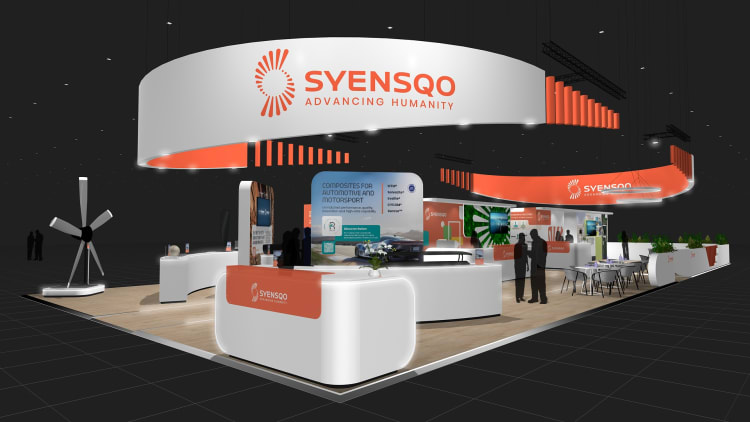
Syensqo to present high-performance sustainable composites at JEC World 2026. (Photo: Syensqo, PR112)
Syensqo presentations at JEC World 2026
During the trade fair, a series of talks by Syensqo experts is scheduled at the Agora 5 stage in hall 5. On Tuesday 10 March from 11:30 to 11:55, the presentation "Composite materials in a challenging world" will be given by Jonathan Meegan, Research Fellow at Syensqo. On the same day from 14:30 to 14:55, the talk "Validating automated DDF for aerospace applications" will take place, with contributions from Rob Blackburn, Global Customer Engineering Director at Syensqo, and Vincent d'Arienzo, Senior Technical Fellow at Bell.
On Wednesday 11 March from 11:30 to 11:55, the presentation "Portfolio advancements for a changing world" will be delivered by Edoardo Depase from Syensqo's global marketing team. On that day from 14:30 to 14:55, the session "Climate Impulse: pioneering sustainable aviation" is also scheduled, presented by Jef Delbroek, Customer Engineer at Syensqo.