The European plastics recycling sector is undergoing an intensive verification phase of available technologies. Increasing regulatory requirements concerning recycled content and material quality coincide with a clear separation between solutions operating at industrial scale and those remaining at pilot or early industrialisation stage. In this context, the latest Plastics Recyclers Europe report entitled Mapping of Plastics Recycling Processes&Technologies presents a structured overview of processes currently used in Europe, covering sorting, mechanical recycling as well as dissolution technologies and chemical recycling. The document also provides estimates of installed processing capacities and indicates the limitations of individual technological approaches in the light of circular economy requirements.
Sorting as the key stage of the recycling system
One of the most important conclusions of the report is the clear indication of sorting as the stage that determines the efficiency of the entire recycling process. Regardless of the downstream processing technology, the quality, homogeneity and cleanliness of the input material directly affect plant performance and the properties of the final recyclate. A substantial share of quality issues arises at early stages, when inadequately designed products or complex material compositions prevent effective separation of waste streams.
For packaging waste, mechanical and optical systems remain the standard in European sorting plants. The most commonly used operations include fraction screening, air separation, ballistic separation enabling the split of 2D and 3D fractions, and near-infrared (NIR) optical sorting. This set of technologies makes it possible to separate streams by shape, mass and polymer type, but the overall effectiveness of the system remains strongly dependent on packaging design and the combinations of materials used.
The report emphasises that multimaterial structures, metallised films, full-sleeve labels and colours that are not detectable by NIR sensors significantly reduce sorting efficiency. This leads to considerable material losses at an early stage of the process, when potentially valuable plastic fractions are directed to residual waste or downgraded applications. In practice, this means that even the most advanced sorting installation cannot compensate for design flaws on the product side, which reinforces the importance of design for recycling principles.
Streams originating from waste electrical and electronic equipment (WEEE) and end-of-life vehicles (ELV) are much more complex. Before plastics can reach proper sorting, hazardous substances must be removed and ferrous and non-ferrous metals recovered. Only then can polymer-rich fractions such as shredder light fraction (SLF) or automotive shredder residue (ASR) be further processed. Their heterogeneous character and the presence of components such as rubber, fibres, wood and residual metals mean that they require specialised lines and additional separation stages, which increases the complexity and costs of the overall process.
Mechanical recycling as the foundation of processing capacity
Mechanical recycling remains the backbone of the European plastics recycling system. According to data cited in the report, in 2024 the installed treatment capacity in EU27+3 amounted to around 13.5 million tonnes per year. Nearly 80% of this capacity is concentrated on several key streams: polyolefin films, PET, rigid HDPE and PP fractions. These figures show that despite growing interest in chemical solutions, classical mechanical processes currently provide the main scale of plastics waste processing in Europe.
The mechanical recycling process described in the report comprises a sequence of well-known and widely used stages: shredding, washing (in cold or hot mode), density and optical separation, drying and extrusion with filtration and degassing. Despite the technological maturity of this approach, differences between individual plants remain significant. They concern both line configuration and the level of sophistication of separation systems, as well as the quality of the resulting recyclate, its purity, property stability and applicability in final products.
Hot washing enables more effective removal of organic contaminants and label, adhesive and print residues, but is associated with higher energy and chemical consumption. This creates a need to balance quality benefits against additional operational and environmental costs. Advanced separation systems, such as electrostatic sorting or multi-stage density separation, make it possible to recover more challenging fractions and better separate similar materials, but require higher investment expenditure and precise process control.
The authors of the report also clearly indicate the limitations of mechanical recycling. Degradation of polymer properties in subsequent processing cycles, accumulation or presence of undesirable substances and specific application requirements mean that not every waste stream can be effectively kept in a closed loop. This is particularly relevant for high-specification applications, such as selected food-contact packaging or technical components with enhanced performance parameters.
Dissolution and chemical recycling at limited scale
Separate chapters of the report are devoted to dissolution technologies and chemical recycling. Dissolution processes, which use selective solvents to separate the polymer from additives and contaminants, allow the production of material of very high purity. This concept addresses the challenge of complex formulations and additives which, in classical mechanical recycling, hinder the achievement of high recyclate quality. As the report indicates, the application of dissolution technologies is currently focused on specific waste streams and in most cases remains at pilot plant or early industrialisation stage.
The scale of chemical recycling is currently even more limited. In 2024, the processing capacity of this segment in EU27+3 amounted to around 190,000 tonnes per year. The dominant technology was pyrolysis of polyolefin mixtures, while most projects are still in commissioning or testing phases. This means that actual, stable production of secondary raw materials from chemical recycling remains limited compared to the volumes processed in mechanical recycling.
The report points out that in the coming years chemical technologies will rather play a complementary role to mechanical recycling. This applies in particular to difficult or heavily contaminated streams for which classical mechanical approaches do not allow the required material quality to be achieved or are economically unjustified. At the same time, the authors of the document stress the need for a realistic assessment of the implementation level of these solutions and for distinguishing demonstrative pilot installations from fully operational industrial plants.
System conclusions and the importance of input quality
The key message of the Plastics Recyclers Europe report is a move away from the narrative of a single universal technology of the future towards a realistic picture of a multi-component recycling system. The authors introduce an assessment of the implementation level of individual technologies, from laboratory concepts to widely used industrial processes, clearly indicating which ones currently form the backbone of European processing capacity and which remain in the development and optimisation phase.
From an industry perspective, the conclusion is clear: the development of plastics recycling in Europe requires above all stable and predictable regulation, consistent design of products with recycling in mind and further investments in sorting infrastructure. Without systemic improvement of input quality, both in terms of material composition and contamination level, even the most advanced technologies will not be able to provide the scale and quality required by the circular economy.
The report emphasises that it is precisely the interface between product design, collection systems and efficient sorting that to the greatest extent determines the ultimate recycling potential. Mechanical recycling will remain the main carrier of processing capacity in the foreseeable future, while dissolution and chemical recycling technologies will be developed as complementary solutions targeted at specific, challenging waste streams.
The full Mapping of Plastics Recycling Processes&Technologies report is available on the Plastics Recyclers Europe website: https://www.plasticsrecyclers.eu/publications/.
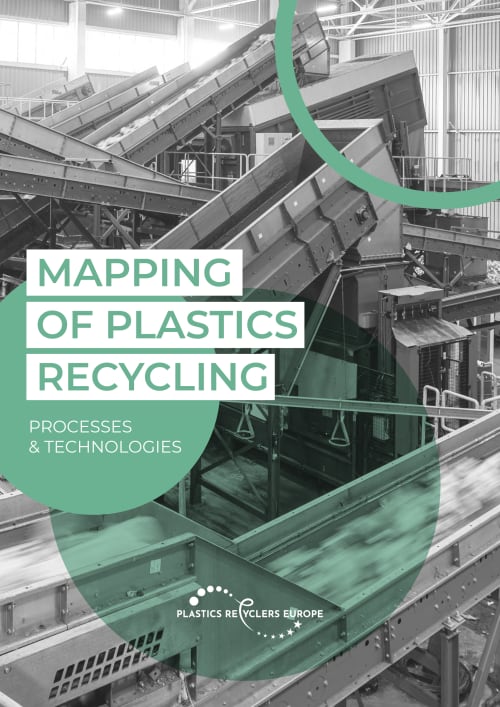
Mapping of Plastics Recycling Processes & Technologies, Plastics Recyclers Europe report