Envalior is introducing a new high-strength thermoplastic UD tape designed for reinforcing all-thermoplastic, high-pressure hydrogen pressure vessels. The UDea EcoPaXX Q20HTC60 tape is a composite based on polyamide 4.10 with continuous unidirectional carbon fiber reinforcement. This material is used to wrap and mechanically reinforce polyamide liners, enabling tank systems to withstand the high pressure loads that occur during hydrogen filling and storage. The use of a thermoplastic tape makes it possible to design fully thermoplastic tank structures, which, from an end-of-life and recycling perspective, distinguishes them from solutions based on thermosetting resins used in composite winding technology.
Material characteristics of UDea EcoPaXX Q20HTC60
The new UDea EcoPaXX grade is based on polyamide 4.10 and is reinforced with 60 percent by weight of unidirectional continuous carbon fibers. An alternative type of carbon fiber is used in the composite, increasing the tensile strength in the fiber direction by more than 15 percent, to around 2.2 gigapascals, compared to materials reinforced with lower strength carbon fibers.
"The tape therefore ensures high strength and stiffness of the tank wrapping and high structural integrity of the entire tank," explains Giacomo Perfetti, Sales & Business Development Manager for UDea.
The mechanical properties of the tape are critical for the safe operation of hydrogen tanks working at high pressures. The composite-reinforced shell limits deformation of the polyamide liners, stabilizes the structure under cyclic pressure loads and enables optimization of wall thickness and tank geometry in terms of mass and cost.
Wrapping process and weight reduction potential
One method to apply the UDea EcoPaXX Q20HTC60 thermoplastic tape is laser assisted tape placement. This process can be operated in a start-stop mode, which makes it possible to reinforce the liner only in those areas that are essential to withstand high pressure loads. In non-load-bearing zones, carbon fibers can be removed from the composite structure, which is not possible with conventional wet winding using thermoset systems.
Adapting the degree of reinforcement to local strength requirements reduces the consumption of both the reinforcing fibers and the polyamide matrix. According to the manufacturer, this enables weight and cost savings of up to 20 percent compared to constructions produced in typical winding technology with epoxy resins.
Sustainability and recycling aspects
An important advantage of the thermoplastic-based composite is its environmental profile compared with traditional epoxy systems. The polyamide 4.10 used as the matrix of the tape is partly bio-based, which reduces the share of fossil feedstock in the material formulation. As a thermoplastic composite, UDea EcoPaXX Q20HTC60 is also relatively easy to recycle in contrast to thermosetting epoxy systems used for pressure vessel winding.
Tanks reinforced with epoxy resins must be landfilled or incinerated at the end of their service life. In the case of fully thermoplastic systems, they can be processed in the plastics recycling stream, which reduces waste volume and potential disposal costs. In addition, wrapping liners with a thermoplastic tape does not require a curing step or the use of thermoset chemicals, for which specific occupational safety measures and cleaning protocols are necessary.
"The new tape completes our broad portfolio of thermoplastic materials for the manufacture of hydrogen pressure vessels, which also includes impact-modified polyamide 6 compounds from our Durethan and Akulon brands for blow molding, injection molding and rotational molding of tank liners. As a one-stop-shop supplier, Envalior offers all the materials needed to manufacture tank systems made entirely of thermoplastic materials, which significantly simplifies recycling of the tanks," explains Bert Keestra, Advanced Engineering Manager at Envalior.
Polyamide compatibility and structural integrity
The polyamide 4.10-based tape is designed to work with liners made from polyamide 6 compounds. During the wrapping process, under laser heating, the molten layers of both polyamides come into contact in the melt state, forming a monolithic structure with strong material bonding at the interface.
"Therefore, the liner is not able to deform independently from the composite structure when exposed to mechanical or thermal loads, which results in less risk of buckling and allows for easier cleaning and maintenance of the pressure vessels in service life," adds Perfetti.
Strong bonding between the liner and the composite shell is important for both safety and durability of the construction. Limiting relative movement of the layers supports dimensional stability and predictable tank behavior across the full range of operating conditions, from low to high temperatures and under multiple filling and emptying cycles.
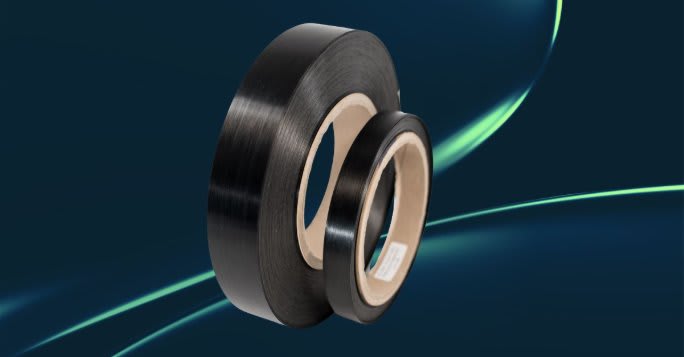
Envalior is launching a new high-performance thermoplastic UD tape UDea EcoPaXX Q20HTC60 for all-thermoplastic, high-pressure hydrogen pressure vessels. Thanks to this tape, the vessels can withstand high pressure loads that occur during filling and storage.