Dassault Systèmes and Nvidia have announced a long-term strategic partnership focused on building a joint industrial architecture for critical artificial intelligence applications across many sectors of the economy. The collaboration is based on combining Dassault Systèmes’ virtual twin technology with Nvidia’s AI infrastructure, open models, and software libraries. The expected outcome is the development of so-called “Industry World Models”, i.e., scientifically validated models of the physical world, supported by 3DExperience AI agents, which will provide specialists with a new level of expert support in the design, simulation and operation of complex systems.
"We are entering an era in which artificial intelligence not only predicts or generates, but understands the real world. When AI is grounded in science, physics and validated industrial knowledge, it can augment human ingenuity" said Pascal Daloz, CEO of Dassault Systèmes. "Together with Nvidia, we are building industry world models that combine virtual twins and accelerated computing to design, simulate and operate complex systems in biology, materials science, engineering and manufacturing with full confidence. This partnership creates a new foundation for industrial AI—by design trustworthy and able to scale innovation in the generative economy."
"Physical AI is the next stage of AI development, grounded in the laws of physics" said Jensen Huang, founder and CEO of Nvidia. "Together with Dassault Systèmes, we are combining decades of industrial leadership with Nvidia AI and Omniverse platforms to transform how millions of researchers, designers and engineers create the world’s largest industries."
Outscale AI factories and use of Nvidia infrastructure
Dassault Systèmes, through its Outscale brand, is deploying so-called AI factories as part of its sustainable and sovereign cloud strategy. Outscale AI factories will use the latest Nvidia AI infrastructure across three continents. This solution is intended to provide additional capabilities to run AI models on the 3DExperience platform while maintaining data privacy, intellectual property protection, and the sovereignty of Dassault Systèmes customers’ information.
Nvidia is implementing Dassault Systèmes’ model-based systems engineering (MBSE) approach to designing AI factories, starting with the Nvidia Rubin platform and integrating it with the Nvidia Omniverse DSX Blueprint for large-scale AI factory deployments. The joint architecture is intended to support both complex design and engineering processes as well as operations in a manufacturing environment.
Virtual twins and Industry World Models in industrial applications
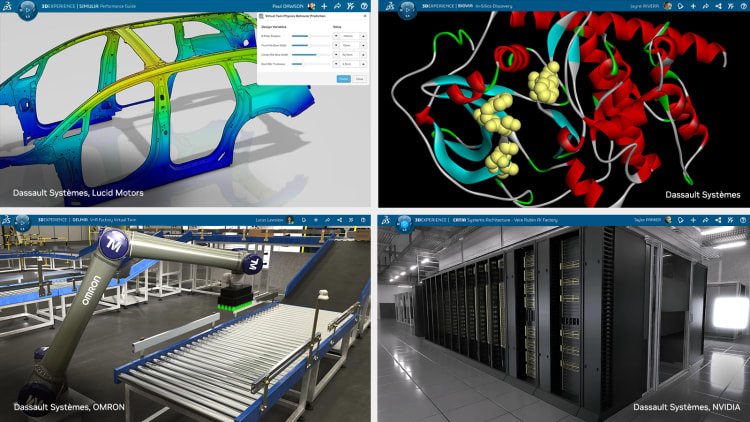
The infrastructure under development is intended to power Dassault Systèmes’ industrial virtual twins, leveraging Nvidia’s open models and libraries. The collaboration is expected to unlock new capabilities in areas such as biology, materials science, engineering and manufacturing. The anticipated range of applications includes both accelerating R&D and supporting operations at manufacturing plants.
In biological and materials research, the Nvidia BioNeMo platform, combined with Biovia’s scientifically validated world models, is intended to accelerate the discovery of new molecules and next-generation materials. Integrating specialized models and compute resources is expected to enable more complex analyses in less time.
In design and engineering, the use of AI-based Simulia virtual twins is planned. These models, using Nvidia Cuda-X libraries and “AI physics” libraries, are intended to enable designers and engineers to predict simulation results accurately and almost instantly. The goal is to reduce the number of physical prototypes and design iterations while increasing the precision of analyses.
In manufacturing, the Nvidia Omniverse Physical AI libraries, integrated with DELMIA virtual twins of global manufacturing systems, are intended to enable the creation of autonomous, software-defined production systems. The solution is expected to support companies in transitioning to more flexible, digitally validated production lines that can be optimized and reconfigured at the virtual model level.
An important element of the joint architecture is also Virtual Companions for Dassault Systèmes users. The agent-based 3DExperience platform, combining Nvidia AI technologies and open Nvidia Nemotron models with Dassault Systèmes industry World Models, is intended to power virtual companions that draw on deep industrial context. The goal is to provide reliable and practical information with the performance required at industrial scale, including in complex design and production environments.
The partnership elevates the existing cooperation between Dassault Systèmes and Nvidia to a joint, long-term vision for how industrial AI will be built, validated and deployed at scale. Key to this is combining Dassault Systèmes virtual factories and Nvidia AI technologies, addressing the needs of various industries—from life sciences to manufacturing.
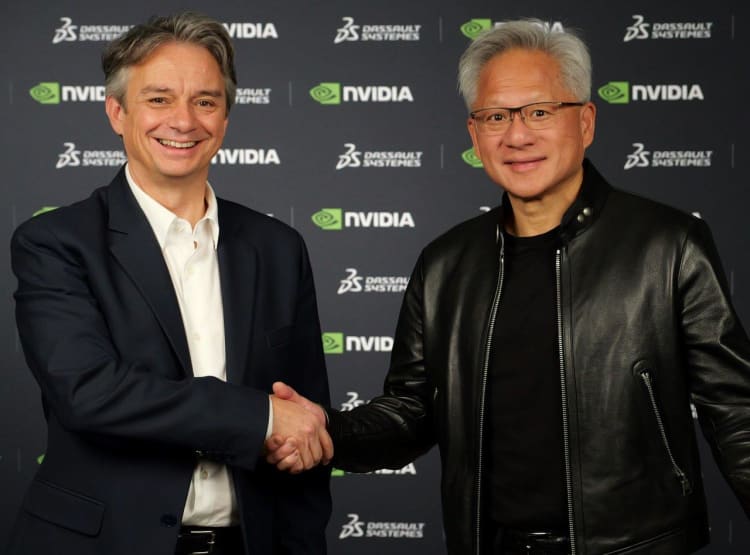
Pascal Daloz and Jensen Huang
User perspectives from various industrial sectors
The joint solutions from Dassault Systèmes and Nvidia are already attracting interest from global companies operating across different market segments. Representatives of these companies emphasize the importance of modeling, process optimization, and the transition to more autonomous, digitally validated production environments.
"Bel Group is building a sustainable future for food through responsible recipes and packaging. Thanks to the Nvidia–Dassault Systèmes collaboration, we gain computing power to model and optimize our products at scale, accelerating innovation while also delivering on our sustainability commitments" said Cécile Béliot, CEO of Bel Group.
"To meet the growing complexity of modern manufacturing, the industry must move toward fully autonomous and digitally validated production systems" said Motohiro Yamanishi, President, Industrial Automation at Omron. "By combining Nvidia Physical AI frameworks with Dassault Systèmes’ virtual twin factory and Omron’s automation technologies, manufacturers can move from design to deployment with greater confidence and speed."
"Lucid’s award-winning engineering and technology continue to set new standards in the automotive industry, and Dassault Systèmes remains our key partner, enabling us to maintain our leadership in vehicle and powertrain engineering" said Vivek Attaluri, Vice President of Vehicle Engineering at Lucid. "Agility, speed of innovation and rapid iterations are the foundation of our workflows, and our work using an AI Virtual Twin, supported by Nvidia’s AI models, can help our teams move faster from concept to production without sacrificing prediction accuracy. We look forward to continued collaboration and to leveraging these new tools in Lucid’s future innovations."
"NIAR supports the development of next-generation aircraft. From asset digitization, through design and production, to validation, Virtual Twin technology provides unmatched capabilities and performance. Dassault Systèmes’ Virtual Companions for engineering, using the agent-based 3DExperience platform with open Nvidia Nemotron models and Dassault Systèmes Industry World Models, accelerate design-compliant synthesis of aircraft virtual twins. Using the platform to link the virtual twin to compliance requirements reduces certification effort while maintaining information confidentiality" said Shawn Ehrstein, Director, Emerging Technologies and CAD/CAM, National Institute for Aviation Research, Wichita State University.
Partnership announced at 3DExperience World
The partnership was announced at 3DExperience World, Dassault Systèmes’ annual event dedicated to designer and engineer communities. Pascal Daloz and Jensen Huang appeared on stage on Tuesday, 3 February, at 9:00 a.m. CT to discuss the future of AI-driven industry.