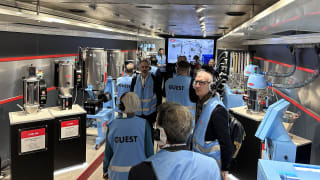
Chimei Corporation has joined the world’s first global supply chain focused on producing renewable plastics for Sony Corporation’s high-performance audio-visual products. The initiative covers fourteen companies across five countries and regions and is part of Sony and Mitsubishi Corporation’s "Creating NEW from reNEWable materials" project. Its goal is to implement a traceable and verifiable supply chain model that accelerates the shift away from virgin fossil-based plastics.
As a global producer of advanced materials, including bio-based plastics, Chimei plays a key role in this collaborative ecosystem by supplying renewable polycarbonate produced using a certified mass balance model. By using waste-derived resources converted into high-quality feedstock, this solution is intended to enable future CO₂ emission reductions while maintaining the optical clarity, mechanical strength and flame resistance required in the premium electronics segment. With material properties consistent with conventional polycarbonate, Chimei provides Sony with a stable basis for the gradual integration of renewable raw materials into successive product lines, without the need to compromise on performance.
Renewable polycarbonate and the mass balance model
The polycarbonate supplied by Chimei is based on a mass balance approach in which waste-derived feedstocks are incorporated into existing production streams and accounting-wise allocated to specific products. The use of a certified model of this type enables strict tracking of renewable raw material flows throughout the value chain and their reliable reporting to end users.
As part of the collaboration with Sony, the focus has been placed on ensuring that the use of renewable raw materials does not adversely affect the functionality of components used in audio-visual devices. The expected reduction of the carbon footprint is to be achieved while maintaining the characteristic properties of polycarbonate, such as high transparency, mechanical resistance and the required flame resistance.
Significance for ESG strategy and circular economy
Chimei’s involvement in this supply chain is in line with the company’s long-term activities in the ESG area. The company declares that it will continue to invest in initiatives related to decarbonizing production processes and developing life cycle transparency based on international certification systems. Cooperation with partners at different stages of the value chain is intended to help accelerate the implementation of solutions consistent with the principles of the circular economy.
The "Creating NEW from reNEWable materials" project, coordinated by Sony and Mitsubishi Corporation, serves as a platform for such cooperation, integrating companies from different countries and areas of expertise. The inclusion of Chimei in this initiative reflects both the company’s competence in advanced materials and its consistent focus on reducing environmental impact in plastics production.
Collaboration for high performance properties
According to Chimei, participation in this pioneering supply chain is intended to combine technological precision with measurable environmental outcomes. The company’s goal is to support broader sectoral transformation by incorporating renewable raw materials into applications that require high and stable performance parameters.
Maintaining equivalence of the properties of renewable polycarbonate compared with conventional material is crucial for consumer electronics applications, where constant material quality is required throughout the product’s service life. By introducing solutions based on waste-derived feedstock, Chimei aims to ensure that equipment manufacturers such as Sony can implement renewable materials without having to modify designs or operating parameters of final products.
The company emphasizes that a long-term approach combining material development, ESG investments and international cooperation is expected to support the construction of a more resilient and sustainable materials ecosystem.