In rotational moulding machines, the reliability of the production system depends not only on heating, cooling and control, but also on how cables and hoses are routed. These components operate in motion, at elevated temperatures and in dusty environments, and under long cycles and multi-shift operation they quickly reveal the quality of the design. Orex designs its rotomoulding machines with the objective of minimising installation failure risk and ensuring predictable servicing. A key component is the readychain pre-assembled system with the R4 closed cable carrier, which organises and protects the power and signal infrastructure.
Rotational moulding is a long-cycle process with repetitive technological phases, in which the machine often operates continuously. This imposes constant loads on motion subsystems such as rotation axes, traversing mechanisms, automation elements and power supply. Under these conditions, cabling is exposed to continuous and repetitive motion, material fatigue, elevated process-zone temperatures, dust, contamination and stresses resulting from changes in direction and motion dynamics. Any damage to control, servo or signal cables can lead to cycle stoppages and production downtime, which is why cable routing in rotomoulding becomes a critical factor for machine availability and operating costs.
Operating specifics of rotational moulding machines
Rotational moulding uses cycles in which the mould is heated, cooled and rotated around one or more axes. Maintaining stable process parameters requires not only precise automation but also reliable delivery of energy, media and signals to moving assemblies. Cables and hoses must withstand repeatedly occurring bends and twists while operating in zones with elevated temperatures and in the presence of process dust.
Under such conditions, standard cable routing solutions selected only at the level of individual components quickly show their limitations. Uncontrolled cable runs, lack of stable support, accidental kinks and abrasion increase the probability of failures. The consequences include production stops, the need for service intervention and the risk of damage to other system elements if the machine is brought to a sudden halt.
Automation and the role of reliable cable infrastructure
Orex is a producer of rotational moulding machines based in Poland, with a plant in Chybie. The company designs and builds installations based on process automation and an individual approach to each project, with machines operating at customer sites in various international markets. In such a business model, the reliability of moving installations directly affects the quality of finished products, commissioning schedules, warranty cost levels and how the brand is perceived by users.
Zones in which cables and hoses related to axis drives and control, sensor and encoder signals, pneumatic components and automation, monitoring and system integration hardware are routed are crucial for safety and stable operation. The use of a system-level approach, rather than selecting individual elements in isolation, is intended to reduce the risk of downtimes caused by failures of these installations.
Igus readychain system with R4 closed cable carrier
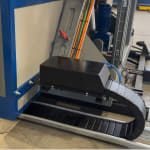
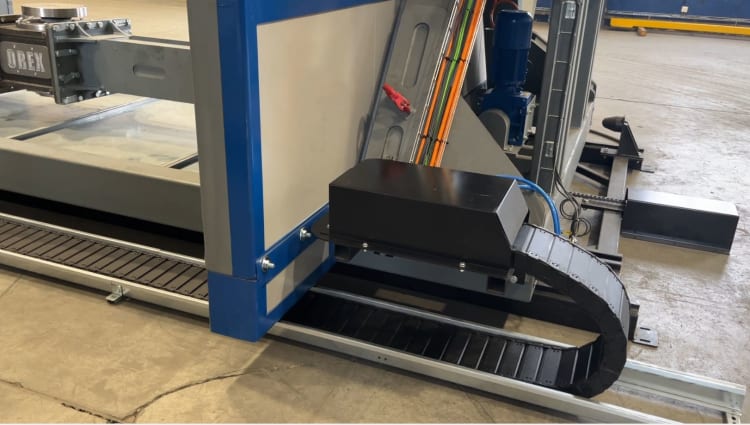
Orex machines use, among others, igus readychain systems, which integrate the cable carrier and motion-rated cables together with mounting accessories. A key element of this concept is the R4 closed cable carrier, the so-called e-tube, designed to protect cables in contaminated and dusty environments. This solution provides an orderly cable route, reduces the risk of cable tangling and accidental abrasion, and increases guidance stability during long operating cycles.
From a service perspective, the closed design of the carrier facilitates inspection of the installation, and the modular structure allows changes and upgrades without the need to rebuild the entire machine. Additional cables or hoses can be added when new functionalities are required, for example due to new process demands or integration of additional measurement and automation systems.
An important design premise is to treat the entire energy and signal chain as a single system. The carrier, servo cables, encoder cables and pneumatic components are selected according to the motion conditions and operating environment, in order to minimise mechanical stresses and the impact of temperature and contamination on installation durability.
Effects of using motion-optimised solutions
Using systems designed specifically for dynamic applications yields measurable results for both the machine manufacturer and the end user. For the equipment supplier, this means fewer installation failures during commissioning and operation, the ability to standardise solutions across different projects, reduced assembly and start-up times, and lower risk of complaints and warranty costs.
From the end user's perspective, the benefits include higher machine availability, lower probability of downtimes caused by cable damage, faster and simpler servicing, and more predictable maintenance costs. Stable routing of cables and hoses makes it easier to plan service work instead of reacting only after a failure occurs.
Prepared for expansion and digitalisation
Orex points to the further development of its solutions in the areas of remote monitoring, diagnostics, system integration and the use of analytical tools. This approach is associated with a growing number of signals, sensors and automation elements, which increases the importance of a properly designed cable management system. The modular structure of cable carriers and the use of pre-assembled cabling systems support such modernisations, enabling the addition of further cables with limited modification times and lower costs of adapting the installation.
In machines intended for automated processes, the cable and hose infrastructure becomes one of the elements determining the reliability of the entire system. The solutions applied by Orex show that the use of R4 closed carriers and readychain systems can stabilise installation operation, reduce the risk of unplanned downtimes and facilitate service planning.