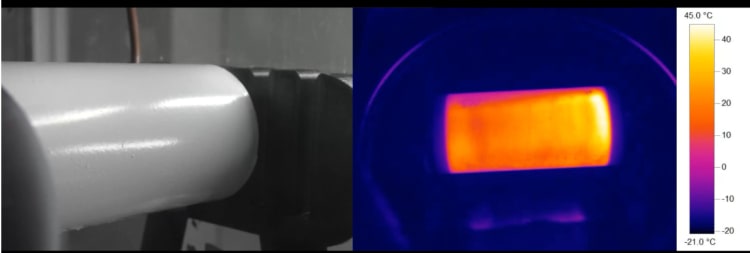
The Coat-Ips project focuses on the development of an energy-efficient heated coating intended to improve aviation safety under icing conditions. The solution is being developed by OMAR Coatings, the AIMPLAS Plastics Technology Centre and the National Institute of Aerospace Technology, INTA. The system takes the form of a coating applied like paint and can be repaired directly at the point of damage. The project addresses the problem of ice formation during flight, which remains one of the most serious challenges for the safety and operational efficiency of aircraft. According to the information provided, a thin layer of ice on the wings can reduce lift by up to 30% and increase aerodynamic drag by 40%, which degrades aircraft performance. In addition, aircraft are exposed to icing conditions for approximately 15% of their service life, which affects fuel consumption, stability and maintenance requirements.
In response to these limitations, the project partners have developed an anti-icing protection system based on a coating using Joule heating. It has been formulated as a technical paint with low energy consumption, capable of operating both in anti-icing and de-icing modes. This is intended to enable a rapid and efficient response to conditions conducive to ice formation. As explained by Blai López, a researcher in coatings, adhesives and converting at AIMPLAS, "in a sector moving towards more efficient and sustainable mobility, it is essential to develop solutions that reduce energy impact without compromising safety". According to the project participants, currently used anti-icing systems, such as hot air from the engine, pneumatic boots and electrothermal technologies, have significant limitations, including high energy consumption, added weight, control difficulties, overheating risk and limited effectiveness under certain conditions.

Coating applied directly to the surface
Project representatives indicate that the new coating can be applied directly to the aircraft surface and readily adapts to areas with complex geometry. Blai López emphasised that "the solution we are presenting represents a significant innovation in the aeronautical field, as it allows direct application onto the aircraft surface and adapts easily to areas with complex shapes".
In addition to energy efficiency, the coating is also expected to offer compatibility with commonly used aircraft paints. Another feature is low weight, because the solution does not require auxiliary systems or transformers. An important element is also reparability, which makes it possible to repair damage directly at the point where it occurs, without the need to remove and replace the entire system.
According to information provided by the project partners, the result of the work is intended to be an optimised formulation and a system designed specifically for aviation applications, validated for use on aircraft. The solution may be of particular interest to structural manufacturers, unmanned vehicle producers and companies operating in the coatings sector.

Division of responsibilities in the project
Three entities are involved in the development of Coat-Ips, each responsible for successive stages of the work, from formulation development to validation under conditions close to real use. AIMPLAS contributes the original development of the heatable formulation and expertise in advanced polymer technologies, which forms the basis of the entire system.
OMAR Coatings is responsible for transferring the formulation to the industrial development stage. The company’s work includes optimisation of the coating and its application process in order to ensure the scalability of the solution and the possibility of using it as an on-site repair system.
INTA contributes aviation expertise, defines the technical requirements for the product and conducts characterisation and validation testing in environments representative of end-use conditions. As stated, previous cooperation between AIMPLAS and INTA also facilitates optimal design of the heating system and assessment of its performance under real operating conditions.
Blai López concluded that "Coat-Ips provides a direct response to the aeronautical sector’s need for lighter, more efficient and sustainable technologies that enable reduced fuel consumption and improved flight safety".
The Coat-Ips project is funded by the Spanish Ministry of Science, Innovation and Universities under the 2024 Public-Private Partnership call managed by the State Research Agency, AEI, and is co-funded by the European Union through the European Regional Development Fund.