ENGEL has developed a new machine concept for clearmelt systems based on the duo combi M two-platen injection moulding machine in order to increase process efficiency and simplify implementation. The clearmelt technology itself has been used in series production for many years. It involves flooding plastic parts in the mould with a transparent or coloured polyurethane layer, allowing high-quality, scratch-resistant surfaces to be achieved directly in the injection moulding process. Functional films can also be integrated in the process. In many applications, this solution makes downstream painting or coating operations unnecessary. The new machine concept is designed to enable shorter PUR feed lines and thus reduce costs. At the same time, the system is intended to be more flexible in use, which from the processor's perspective reduces the effort associated with installation, operation and maintenance.
With clearmelt technology, decoration, protective function and part geometry are combined in a single highly integrated process. The importance of this technology is growing especially in the automotive industry, where new vehicle concepts require large, high-quality and at the same time durable interior and exterior components. In the new concept, the thermoplastic part is injected via an injection unit positioned on the moving side of the machine. The technical basis is the combi M design used in ENGEL duo two-platen injection moulding machines. In the new layout, the standard injection unit on the fixed platen side has been omitted, and the polyurethane equipment has been placed in its position. The thermoplastic part is therefore injected from the moving side, while the PUR mixing head is arranged on the fixed platen. As a result, the PUR technology is located closer to the mould, the feed lines are shorter, and the system periphery becomes more compact, easier to handle, faster to change over and more economical to operate.
Shorter PUR lines and lower investment outlay
For users, the new arrangement primarily means a considerable reduction in polyurethane flow paths. Since the PUR equipment is located directly at the fixed platen, the length of the lines and the line volume can be significantly reduced, which translates into a clear reduction in investment outlay. The amount of installation work also decreases because there is no need for expensive piping. This effect is particularly important for investments in multi-colour applications, where a separate line would otherwise be required for each colour produced. In the new concept, these lines can be made much shorter and moving hoses are not used. When changing the PUR equipment, hose connections only need to be disconnected for a short time.
The new system concept is also available in a mirrored version. This makes it possible to position the injection unit so that material supply remains on the standard side of the machine and matches the processor's existing in-plant logistics. According to the company, this does not require additional modifications in the production environment.
Colour change in less than 10 minutes
The new concept is also intended to increase flexibility in the use of colour units. In the previous configuration, they were permanently assigned to one machine. Unused colour lines previously had to circulate continuously to prevent pigment particles and additives from settling. In the new arrangement, this is no longer necessary. Line flushing processes required when disconnecting the colour units from the production cell have also been completely eliminated.
According to ENGEL, colour change can now take less than 10 minutes. This allows operators to allocate units between several systems according to demand, reduce downtime and use available resources more efficiently. Existing clearmelt moulds can continue to be used and only need to be turned around, without the need to keep modified mould variants for different system configurations.
Greater application flexibility
Despite a layout optimised for clearmelt technology, the systems are not limited exclusively to such applications. Thanks to the duo combi M design, which has been used for many years, they can also be used for standard injection moulding applications. This means greater flexibility in production planning and lower investment risk. The company also emphasises that subsequent retrofitting of the machine with an injection unit on the fixed side can be carried out easily.
In addition to the technical advantages and lower investment costs, the new system layout also reduces the required production space. According to ENGEL, the footprint is around 25% smaller.
The first systems based on the new concept are scheduled to go into operation in autumn. From November, a clearmelt solution for the production of large exterior parts will also be available for customer trials at ENGEL's technical centre in Shanghai.
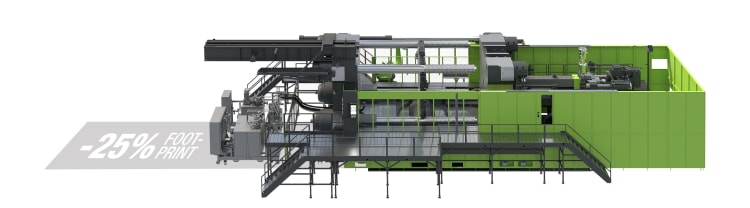
The new clearmelt system concept, shown here on an Engel duo 5500 combi M injection moulding machine, requires around 25% less floor space and operates with considerably shorter PUR feed lines. It reduces investment costs and enables faster colour change