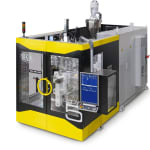
Bekum is expanding its portfolio with the fully electric SmartLine series for extrusion blow moulding, engineered from the ground up with a focus on efficiency and total life-cycle costs. According to the manufacturer, the solution is intended as a cost-optimized entry point into extrusion blow moulding technology while maintaining process performance relevant to consumer packaging production. The design approach includes new sourcing and manufacturing concepts, as well as optimization of drive systems and material utilization. Bekum states a 30% reduction in machine investment, up to 20% lower energy costs through optimized drive technology combined with energy-efficient HiPEx extruders, and material savings of up to 10% enabled by precise process control and efficient use of resin. The company notes that the world premiere of the series took place at K 2025.
"A strategic milestone is the world premiere of our fully electric SmartLine series, which we presented for the first time at K 2025. We clearly understand that our customers, particularly in consumer packaging, must calculate sharply. With the new SmartLine, we were able to reduce machine investment costs by 30%," emphasizes Michael Mehnert, managing partner.
Compact solution for consumer packaging
SmartLine is designed for small and medium-sized producers in the consumer packaging segment and for newcomers to extrusion blow moulding technology. The first two models are SBLOW 5S/D and SBLOW 15S/D, available as single-station (S) and double-station (D) versions. They feature 50 kN and 150 kN clamping force respectively, with opening strokes of 380 mm and 560 mm. Maximum mould width is 370 mm and 550 mm respectively, while mould height is 350 mm and 450 mm. The manufacturer indicates that these specifications are intended to support demanding packaging applications while keeping the machine footprint small.
Extrusion focused on process stability and energy consumption
The series uses HiPEx extruders and Bekum’s proprietary extrusion heads. According to the manufacturer, the configuration is intended to provide process stability, high output rates, and melt homogeneity. A key aspect is uniform wall thickness distribution around the entire circumference of the hollow part, which is intended to translate into reproducible production results and consistent part quality. Bekum highlights short flow paths and homogeneous temperature control as factors supporting stable and economical production.
Clamping unit with electromechanical rotary servo drive
The SmartLine clamping unit is driven by an electromechanical rotary servo motor. The manufacturer states that, unlike continuously rotating electric motors, the rotary motor moves precisely to a defined angle and stops exactly at the required position. This is intended to enable a compact machine design, a simplified control architecture, and high positioning accuracy while reducing energy consumption.
Bekum Control 8.0 and Industry 4.0 functions
SmartLine is equipped with the Bekum Control 8.0 control system. The operator panel is a 24-inch Full HD portrait touch display. The manufacturer reports that the interface supports intuitive operation and visualization of throughput and energy data via a dashboard. Integrated Industry 4.0 functionality is intended to enable integration into digital production environments.
Digital services and service support
The series is integrated into Bekum’s digital service environment. SmartConnect is intended to provide real-time remote support, while a digital spare parts catalog is intended to ensure permanent access to component information. The offering is complemented by worldwide Bekum Field Service and spare parts availability.
Design concept and ergonomics
Bekum states that SmartLine follows the company’s award-winning machine design concept, with an emphasis on functionality, service access, and visibility. The description highlights ergonomics relevant to day-to-day operation, maintenance work, and mould change processes.
According to Bekum, SmartLine is intended for companies entering extrusion blow moulding technology or expanding capacity under a cost-optimization approach, with a focus on energy efficiency and control functions.