BMT, a strategic partner to the global packaging industry, has developed a precise forming simulation method intended to support beverage producers seeking to accurately predict the wall thickness of PET and rPET bottles. The methodology combines a simulation-driven approach with advanced material characterisation, enabling reliable virtual performance testing of as-manufactured bottles under conditions corresponding to industrial practice.
As David McKelvey, Head of Product at BMT, explains, "BMT's technology supports accurate top load and burst pressure testing, helping manufacturers optimise bottle designs for strength and lightweighting. By improving how performance is predicted during development, our methodology significantly reduces the need for physical prototyping and accelerates development timelines."
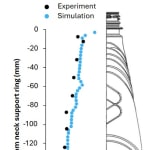
According to the company, the key element is the combination of real material data with a model reproducing the full bottle forming process. Instead of relying on the assumption of constant wall thickness or uniform stiffness, BMT's solution is intended to predict how the material stretches in both the hoop and axial directions, as well as how it is distributed throughout the bottle during blowing. As a result, a thickness and stiffness profile is produced that reflects what is observed in physical packaging.
Material characterisation as the basis for simulation
Material characterisation shows how the resin behaves during heating, stretching and shaping, providing the simulation with the input data needed to predict the bottle forming process. This includes biaxial tensile testing, which determines the material response when stretched in two directions under controlled conditions.
These tests make it possible to capture deformation patterns, stretch ratios, stiffness changes and the influence of processing history on mechanical properties. On this basis, the model can be supplied with data that better reflects the actual behaviour of PET during processing.
Modelling bottle behaviour under real conditions
Based on the measured material data, BMT simulates the full bottle forming process. Virtual top load and burst pressure assessments are then carried out to predict how the bottle is likely to perform in real-world testing.
In a recent validation study, models using variable properties resulting from the forming behaviour matched physical test results within about 1%. By comparison, models based on constant properties overpredicted results by 13% and by as much as 63%. According to BMT, this shows that simplified assumptions can lead to incorrect design decisions.
This level of accuracy is intended to help teams identify issues earlier, better understand how design changes affect performance parameters and make more confident decisions before tooling work begins.
An integrated process for PET and rPET bottles
BMT emphasises that material characterisation and the simulation-driven approach were designed as one coherent process. Material characterisation provides measured data on PET behaviour during stretching and heating. The simulation then uses these values to predict how the bottle takes its final shape and how it will behave under load.
According to the company, this integrated workflow supports manufacturers and brands in reducing material consumption, improving design efficiency and shortening product development time. Combining precise digital modelling with targeted physical assessment is intended to provide more reliable performance data while also supporting strength and environmental targets.