Alpla, a global supplier of plastic packaging and recycling solutions, closed the 2025 financial year with sales of EUR 5.2 billion, compared with EUR 4.9 billion in 2024. In an environment of high economic uncertainty, the company maintained its growth path, increasing both employment and the scale of its production activities. The number of employees rose to around 25,500, and the number of plants to 206. The company recorded particularly strong results in North and South America and in the extrusion blow moulding (EBM) segment. At the same time, Alpla is strengthening its position in recycling by setting new targets for 2030, including a significant increase in the share of post-consumer recycled feedstock and an expansion of recycling capacity.
Stable development in a demanding market environment
Alpla supplies global consumer goods brands and local customers with safe, cost-efficient and sustainability-oriented plastic packaging. Founded in 1955, the family-owned company maintains its position as a partner offering stable and predictable supply and the development of packaging solutions, despite difficult economic conditions.
Chief Commercial Officer (CCO) Nicolas Lehner attributes the company’s stable development in its seventieth year of operation to long-term strategic decisions, targeted investments and a cautious approach to risk management. "Growth markets can change, demand can fluctuate and costs can rise. We experienced this in 2025, particularly in the beverage market and in recycling, and the entire industry is feeling the impact. This makes it all the more important to have a clear plan and to focus on customer benefits. At Alpla, we are consistently pursuing both of these objectives."
Growth in the Americas and margin pressure in Western Europe
The company’s performance was positively influenced by market developments in North and South America and by the strong position of the EBM segment. "The market is growing again and we are well prepared. In recent years, we have taken the right steps: we have increased our efficiency, developed relationships with partners, diversified our product portfolio and built employee competences," Lehner emphasises. At the same time, margins across the industry are under pressure from rising costs and weaker demand, particularly in Western Europe.
Sustainable business development has been supported by investments in plants and technologies, the establishment of training programmes in the USA and the entry into the recycling sector in South America. Globally, the injection moulding division Alplainject 2025 was strengthened by the addition of six KM Packaging plants. The Alplapharma business unit has consolidated its position in the pharmaceutical packaging market, significantly increasing its presence in this segment.
The company also points to opportunities related to fibre-based packaging solutions developed by Paboco and Blue Ocean Closures. For Alpla, these are complementary directions for portfolio development, particularly in the context of customer expectations and regulations on sustainable packaging.
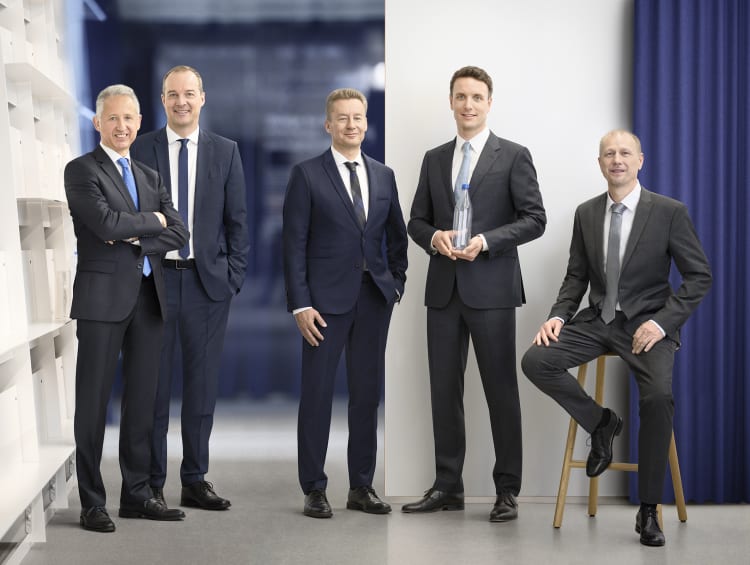
The Alpla Management Board (from left): Ricardo Rehm (CFO), Walter Ritzer (COO), Nicolas Lehner (CCO), Philipp Lehner (CEO) and Klaus Allgäuer (CTO).
Recycling under pressure from virgin material prices
The Alplarecycling division recorded mixed results in 2025, among other reasons due to regulatory processes in the European Union and ongoing price challenges on the secondary raw materials market. "New material is many times cheaper than recycled material. As demand falls and costs rise, the risk of low-quality imports from third countries increases. If the European Union does not take countermeasures, the PPWR will backfire," Lehner warns. Alpla is working with other industrial companies to promote a more level playing field.
New recycling targets for 2030
Despite the challenging conditions in the recycling market, Alpla intends to maintain its leading role in the circular economy. This is supported by new targets for 2030 and by projects developed in cooperation with industry partners. One example is the recently launched cooperation with NTCP in the Netherlands, aimed at the production of food-grade HDPE recyclate.
The company plans to increase the share of post-consumer recycled (PCR) materials in its packaging solutions to 30 per cent by 2030. To reach this level, Alpla is expanding its current and planned recycling capacities from 400,000 to 700,000 tonnes per year. From 2026, the company intends to invest EUR 15 million annually in recycling. These measures are intended to enable further growth in the importance of recyclates in the company’s portfolio while aligning with customer expectations and regulatory requirements in the plastic packaging market.

Packaging and recycling specialist Alpla looks back on a successful financial year 2025 in North and South America.