At the Wittmann Group stand at Plastindia, which will take place from 5 to 10 February in New Delhi, the central theme will be smart savings. The company focuses on four areas with particularly high cost reduction potential: energy, material, time and space. Using an example from medical technology, the production of vascular clamps, Wittmann Battelfeld India demonstrates that even highly demanding processes can be implemented with maximum efficiency. In addition to the micro injection molding cell, solutions in the field of mold temperature control, in-house recycling with granulators and automation will be presented, including the new Primus 118 linear robot and an IML application developed and manufactured locally for the Indian market.
Production of precise medical parts on MicroPower
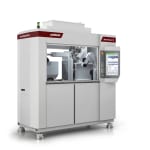
During Plastindia, the Wittmann Group addresses manufacturers of small, precise components for medical applications. For the demonstration of vascular clamp production, a MicroPower injection molding machine with a clamping force of 15 tons equipped with a two-cavity mold will be used.
The all-electric injection molding machine has been developed specifically for processing small and micro parts, which supports energy-efficient and material-saving high-volume production. The machine design allows the injection plunger to reach directly to the parting line of the mold. As a result, the melt cushion is reduced to a minimum and the size of the sprue is significantly decreased or can be eliminated entirely. This design solution improves both material efficiency and quality consistency of the parts, since the pressure is transferred to the melt over a very short flow path.
Another characteristic feature of the MicroPower is its very compact design. On an area of only about two square meters, a rotary table, auxiliary equipment, automation, temperature control unit, quality control systems and other process modules are integrated. For clean room applications, a laminar flow box can be easily integrated.

The MicroPower work cell combines all elements required for production on an area of about two square meters.
Mold temperature control: focus on simplicity and energy efficiency
In the part of the exhibition dedicated to auxiliary equipment, particular emphasis is placed on temperature control, since mold temperature has a decisive influence on both process efficiency and part quality. For this reason, Wittmann product developers pay special attention to temperature control solutions, focusing on robust design, ease of use and the lowest possible energy consumption.
During Plastindia, a Tempro C120 unit will be shown among other products. This temperature control unit is suitable for operating temperatures up to 120 °C and is characterized by an exceptionally high cooling capacity due to the direct feed of cooling water. It offers a favorable cost-to-function ratio and a wide range of configuration options, which makes it possible to adapt the unit to various plastics processing applications.
Material reduction and in-house recycling
In injection molded parts production, raw materials account for almost 80 percent of manufacturing costs. Reducing material losses is therefore of key importance from the perspective of the circular economy. Sprues are homogeneous, clean material that in many applications can be reintroduced into the material cycle in a cost-efficient manner. In addition to sprues, scrap parts can often be reused directly. In many applications, it is possible to use up to about 25 percent regrind.
In-house recycling with Wittmann granulators helps reduce the consumption of virgin material while lowering waste management and logistics costs. At Plastindia, both compact G-Max blade granulators and powerful screenless S-Max granulators will be on display.
G-Max granulators are designed for grinding soft to medium-hard plastics such as PP, PE, ABS, PU or PC. The optimized rotor design ensures clean, homogeneous regrind and high material throughput. The use of a massive flywheel that increases rotor inertia makes it possible to achieve significantly higher output with the same energy input.
S-Max granulators have been optimized for grinding engineering and reinforced plastics. Styrenic materials, acrylates and glass fiber reinforced materials are effectively ground in slow-speed mode at around 27 rpm at 50 Hz. S-Max granulators can also be installed in confined production areas and are compatible with various feeding systems, including robots and conveyor belts.
New Primus 118 robot with increased load capacity
The Wittmann Group is extending the application range of its Primus linear robots for injection molding machines with clamping forces of up to 250 tons by introducing the Primus 118 model. Previously, the maximum load capacity of Primus robots in this range was 5 kg, whereas the new Primus 118 allows configurations with load capacities of up to 8 kg.
The higher performance of the Primus 118 linear robot is based on a new design with reinforced demolding axes and vertical axes, as well as more powerful drive systems. The robot offers up to ten valve slots, enabling various combinations of grippers and vacuum circuits. Depending on the configuration, up to eight vacuum circuits are possible.
The new Primus 118 can be installed flexibly on different types and models of injection molding machines. Since the drilling pattern of the main beam remains unchanged compared to earlier series, the robot can also be easily mounted on existing production lines.
The Primus series of linear robots provides solutions for standard pick-and-place tasks and simple automation cells. All robots in this series are equipped as standard with the SmartRemoval function, which shortens part removal time and thus the overall cycle time.
The Primus 118 operates with the proven R9 robot control system. In its standard version, this system includes an OPC UA interface for data exchange with an MES and for editing and saving programs on a PC. The R9 controller supports users already at the programming stage, which translates into time savings.
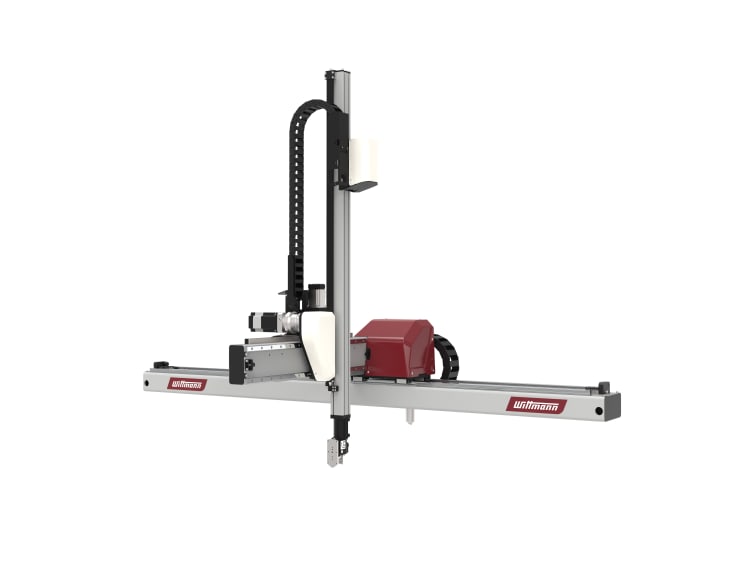
At Plastindia 2026, the new Primus 118 linear robot will be presented for the first time in India.
IML applications and local development in India
In the packaging segment, cycle time is a key process parameter. At Plastindia, the Wittmann Group will present an in-mold labeling (IML) application with a four-cavity mold and side-entry automation. The system operates with a cycle time of six seconds.
The Indian market has specific requirements in the field of automation, which is why Wittmann offers IML systems and automation solutions in India that are developed and produced locally. The company also carries out numerous in-house development projects in the area of auxiliary equipment in India, which complement the global product portfolio.
To meet the growing demand for locally manufactured auxiliary and automation equipment, Wittmann has recently commissioned a new, larger facility at its site in Chennai. Additional sales and service subsidiaries are located in New Delhi and Pune, and there are ten further offices in various strategically important industrial centers. This structure is intended to provide customers with extensive local support throughout India.
The Wittmann Group will be present at Plastindia 2026 in hall 5 at stand A1.