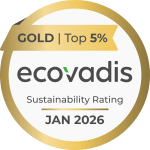
Südpack has further improved its rating in the global EcoVadis ranking for 2025, achieving 85 out of 100 possible points. As a result, the film manufacturer is now among the top 5% of highest-rated companies worldwide and has received the Gold distinction. The current score confirms the group’s continuous progress in the areas of sustainability and corporate responsibility, as well as the continuation of activities that in previous years led to an increase in the rating from 59 to 63 points, then to 84 points in 2024 and now to 85 points.
As an innovative family-owned company, Südpack consistently focuses on sustainable procurement practices across its entire supply chain and on the development of recyclable, material-efficient high-performance films and forward-looking packaging concepts. The latest rating is closely linked to the concrete sustainability targets defined in the Sustainability Leadership strategy. As the company’s management emphasizes, "the measurable progress made represents an outstanding achievement by our entire workforce. At the same time, it serves as motivation to keep improving, to continually set new standards for environmental and social responsibility, and ultimately to create long-term value for all our stakeholders."
EcoVadis assessment and areas of analysis
The EcoVadis rating platform has assessed around 150,000 companies worldwide, taking into account their performance in four main areas: environment, labor and human rights, ethics and sustainable procurement. In the 2025 ranking, Südpack was once again recognized for operating an advanced sustainability management system, which is reflected in the high scores in individual categories.
The company maintained consistently high results in the environment and labor and human rights areas. In the environment category, Südpack achieved 92 points, while in the labor and human rights category it received 84 points. These scores confirm that the company maintains developed procedures and actions that support the reduction of environmental impact and the assurance of labor standards and respect for human rights in its operations.
Clear improvement in the ethics area
Particularly notable progress was recorded in the ethics category, where Südpack’s score increased from 72 to 80 points compared with the previous year. According to the documentation accompanying the assessment, an important factor was the broad integration of ethics-related actions and certifications across various areas of the company’s operations. This included, among other measures, conducting risk assessments for information security and further expanding existing anti-corruption evaluations.
This approach aims to systematically identify and mitigate potential ethical risks, as well as to strengthen oversight and compliance mechanisms. The improved score in this category indicates that these activities have been embedded in management structures and documented in a manner that allows them to be evaluated by an independent rating platform.
Sustainable procurement and supply chain risk management
Südpack also improved its score in the sustainable procurement category, which rose by 3 points to 80 compared with the previous year. This result was primarily driven by activities focused on systematically assessing the risk of potential negative impacts on sustainability within the supply chain, covering suppliers, products and purchasing categories.
These assessments, supported by formalized documentation, serve as evidence of a structured CSR risk analysis process. As a consequence, when risks are identified, it becomes possible to develop targeted mitigation measures and to implement additional incentive programs for suppliers. Wherever possible, Südpack already prioritizes business partners that actively pursue their own ecological and social sustainability initiatives.
This approach to supply chain management is part of the broader context of the Sustainability Leadership strategy, in which procurement activities are one of the key tools for reducing environmental impact and strengthening social responsibility across the entire product life cycle. The combination of high scores in the environment, labor and human rights, ethics and sustainable procurement categories points to coordinated efforts across all analysed areas.