Bomat Energiesysteme GmbH has expanded its portfolio of corrosion-resistant heat recovery systems for combined heat and power (CHP) plants operating on biogas and sewage gas. The new heat exchanger models now cover an output range from 150 kW up to 1,500 kW and are based on tubes made from a high-performance polymer composite. Operators can deploy the systems in two main ways: as heat recovery units to monetize surplus thermal energy, or as retrofits to reduce fuel consumption and emissions in existing installations. According to the company, both configurations typically deliver around 10 percent gains in thermal performance. Depending on the fuel and operating strategy, the technology targets fuel savings of up to 15 percent for gas-fired systems and up to 10 percent for oil-fired systems, alongside reductions in CO2 and acid emissions.
Expanded range for small and medium CHP operators
The enlarged product range is designed to address both smaller and larger CHP plants using biogas and sewage gas. With outputs starting at 150 kW, the new units make corrosion-resistant heat recovery accessible to installations for which there were previously few suitable options. At the upper end, systems up to 1,500 kW are aimed at municipal operators and small and medium-sized industrial users, such as bakeries, breweries, paint shops and metalworking facilities.
By capturing surplus heat from exhaust gases, Bomat heat exchangers increase the usable output of each CHP unit and reduce reliance on additional fuel sources. Operators can use the recovered heat internally, for example to offset space heating or process heat, or feed it into external heating networks. This allows for an additional revenue stream where surplus energy can be sold, or for cost avoidance by reducing purchased heat.
For operators focused on fuel savings rather than additional heat supply, the systems can be installed as retrofits on existing CHP units. The company reports that, depending on the type of fuel, consumption can be reduced by up to 15 percent for gas and up to 10 percent for oil. Volker Wiersbitzki, sales engineer at Bomat Energiesysteme GmbH, states that these savings typically result in a return on investment within approximately four years. In parallel, the systems are designed to cut acid emissions by up to 60 percent and CO2 output by up to 15 percent, supporting compliance with environmental regulations and company-level sustainability targets.
Application examples in municipal and industrial sectors
In practical use, the recovered waste heat is applied across a range of municipal and industrial settings. In Germany, municipalities use heat from CHP exhaust to warm public swimming pools or feed into district heating systems. Food manufacturers, such as bakeries, use the captured energy for process water heating and space heating. Sewage treatment plants feed the recovered heat back into their existing heating circuits to improve overall energy efficiency and reduce external heat demand.
These applications demonstrate how waste heat can be converted into a usable resource. Operators can offset their own heating costs and reduce exposure to fuel price volatility while lowering their environmental footprint. The expanded output range is intended to make such high-efficiency heat recovery solutions technically and economically viable for a broader spectrum of plants, including smaller CHP units that previously lacked robust options for corrosive exhaust gas conditions.
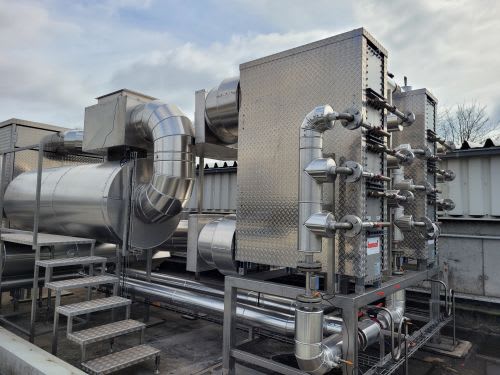
Polymer composite tubes for corrosive exhaust environments
Biogas and sewage gas-fired CHP plants generate exhaust gases that are both hot and chemically aggressive. High concentrations of corrosive components, combined with operation at elevated temperatures, present challenges for conventional metallic heat exchangers, particularly stainless steel, which can fail in such environments. To address this, Bomat's development team selected a tube material based on a high-performance composite consisting of polyphenylene sulfide (PPS) and graphite (GR).
The PPS-GR composite combines high chemical resistance with enhanced thermal conductivity. This combination allows the heat exchangers to operate reliably even below the acid and water dew point. Operating in this temperature regime is necessary to condense water vapor and acidic components from the flue gas but also exposes materials to concentrated corrosive media. According to the company, the selected composite material maintains performance in these conditions where conventional stainless steel designs are prone to corrosion damage and reduced service life.
The heat exchangers are engineered for exhaust temperatures up to 400°C when cooled. The PPS-GR tubes feature a dirt-repellent surface intended to minimize fouling from particulates and condensates. This surface characteristic supports stable heat transfer performance between cleaning intervals and reduces the risk of blockage or uneven cooling in continuous operation.
Modular design and operating principle
The Bomat systems use a modular slide-in register design. Individual heating elements can be removed independently for inspection, cleaning or replacement without dismantling the entire unit. This configuration is intended to simplify maintenance, reduce downtime and support long-term reliability under continuous load conditions typical of CHP operation.
In operation, the hot exhaust gases flow through PPS-GR modules within the heat exchanger. Heat is transferred from the exhaust side to a secondary medium, commonly water or a water-glycol mixture, circulating on the shell side or in separate circuits, depending on the design. The high thermal conductivity of the PPS-GR composite tubes enables efficient transfer of heat from the gas phase to the liquid medium.
As the exhaust gases are cooled in the exchanger, water vapor and acidic components present in the flue gas condense. This condensation process facilitates the recovery of latent heat that would otherwise be lost with the exhaust. At the same time, removal of condensable pollutants from the gas stream helps reduce acid emissions and overall air pollutant load. The modular configuration allows straightforward access for cleaning of the flow paths and for visual inspection, which is particularly relevant in applications involving dust-laden or condensate-rich exhaust.
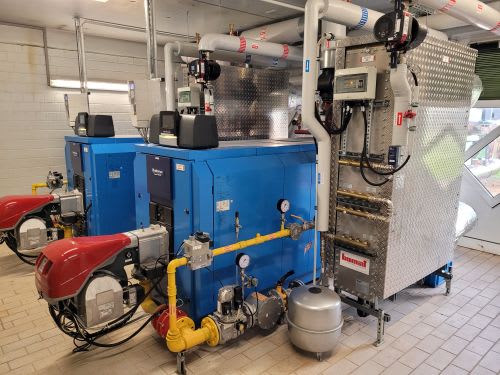
Integration, retrofit options and additional applications
The expanded heat exchanger range is designed for integration into new CHP projects as well as for retrofitting existing plants. The units are typically installed as the final component in the exhaust gas line, downstream of other flue gas treatment or handling systems. The thermal energy recovered in the exchanger is then fed into the existing heating infrastructure of the plant or used directly as process heat at the site.
According to Bomat, system prices start from 16,500 euros, depending on configuration and project requirements. The retrofit-oriented design is intended to minimize installation effort and associated costs, which is a key factor for existing CHP operators assessing the economic feasibility of upgrades. By enabling both heat recovery and direct fuel savings, the systems can be adapted to different operating strategies and energy demand profiles.
Beyond CHP plants, the company also supplies heat recovery systems for industrial furnaces, including melting and hardening furnaces, where hot exhaust gases are often underutilized. Many of these industrial furnace solutions are engineered for specific projects, reflecting the need to adapt heat exchanger sizing, materials and flow configurations to the furnace design and exhaust characteristics. In addition, Bomat manufactures condensing heat exchangers and neutralization systems for original equipment manufacturers.
The company's solutions are applied in municipal infrastructure, industrial processes and energy systems. In these contexts they are intended to combine corrosion resistance, heat recovery efficiency and operational reliability in line with the demands of continuous industrial and utility operation.
Presentation at Biogas Convention 2025
Bomat plans to present the new heat exchanger model range at the Biogas Convention in Nuremberg, taking place from 9 to 11 December 2025. The event will provide an opportunity for operators of biogas and sewage gas CHP installations, as well as industrial users, to evaluate the expanded output range and the polymer composite tube technology in the context of their own heat recovery and retrofit projects.