Photovoltaic and semiconductor specialists Antonia and Marko Omazić have launched Meliori Polymer Engineering in Europe to produce high quality, recyclable polymer wafer frames that ensure secure positioning of microchips during the precision dicing process. The entire production line, automation, know-how and raw materials are sourced from European suppliers. Even before the plant was commissioned, the company secured a letter of intent for deliveries of eight-inch frames from one of the largest European manufacturers of semiconductors for mobility, medical and renewable energy applications. The project aims to strengthen the self-sufficiency of the European supply chain and reduce dependence on imported frames from Asia.
Production, cleaning and refurbishment of frames in a single facility
To support the dynamic growth of the European chip market, the founders of Meliori decided to relocate from Austria to Croatia and site the plant in the Šibenik industrial zone. It is currently the only company in Europe that manufactures, cleans, packs and refurbishes polymer support frames for semiconductor production in one location. The 350 m² facility is designed to handle the full life cycle of the frames and to allow further expansion.
In addition to the injection moulding cell, the plant is equipped with a fully automated CNC machine for removing burrs from the eight-inch frames. The line also includes an automated washing and drying cell and a dedicated ISO Class 6 packaging cleanroom, which is crucial for maintaining the required cleanliness of semiconductor components. Provision has been made for installing two additional production lines as demand for frames in European chip manufacturing plants grows
IntElect injection moulding machine and complete cell with a European supply chain
Due to stringent requirements for process cleanliness and dimensional repeatability, an all-electric IntElect injection moulding machine from Sumitomo (SHI) Demag was selected to produce the frames. According to the founders, this choice was further confirmed by a German mould maker working with Meliori, who recommended this machine as an optimal solution for this type of application.
The complete production cell, comprising the injection moulding machine with auxiliaries, a six-axis Wemo Automation handling robot and the integrated cleaning cell, was selected, implemented and validated by Slovenian distributor Top Teh d.o.o. Company founder Marko Omazić notes that during the concept phase Meliori initially struggled to attract interest from some major machine manufacturers. He recalls: "The biggest motivation for us was working with a local supplier who was genuinely interested in bringing our idea to life. Matjaž Kos from Top Teh invested the time and energy, presenting us with options for a complete production line, including the all-electric injection moulding machine from Sumitomo (SHI) Demag."
Matjaž Kos underlines that using a standard IntElect machine provides all the required process functions and production repeatability. "It is a simple case of a quality machine delivering everything that Meliori needs to exceed the manufacturing precision, reliability and price per unit of the chip frames that are currently being imported into Europe from Asia. The team especially valued having direct access to our local machine validation, process optimisation and training support."
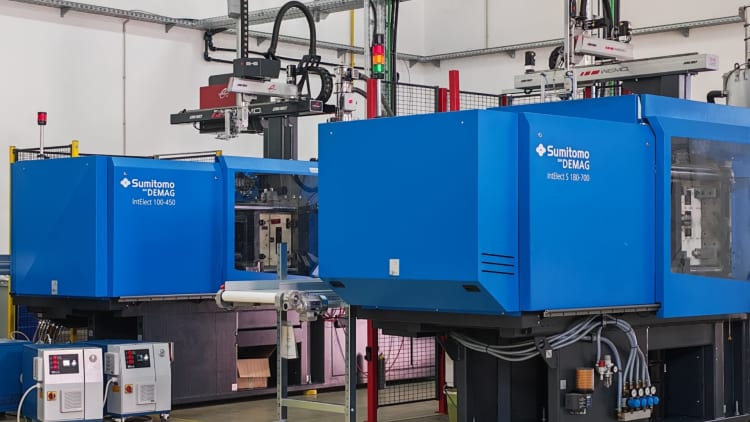
The IntElect injection moulding machine meets the high requirements for process cleanliness and repeatability.
Durable material and a reusable frame model
Antonia and Marko Omazić drew on their extensive materials and photovoltaic experience when selecting a raw material that would provide the required mechanical properties and tensile strength. The eight-inch wafer frame is produced from a glass fibre and mineral filled compound based on polyphenylene sulphide. This enables Meliori to offer a refurbishment service for the frames.
In contrast to single use solutions that generate additional waste, the Meliori concept is based on frames designed for multiple use. Omazić explains that the selected material allows the frames to be returned to the plant, where they undergo quality inspection, refurbishment, cleaning, repacking and dispatch back to customers. Antonia Omazić emphasises: "Rather than single use components that generates excess waste, we intentionally wanted to ensure that the frames were moulded from a robust material that could be returned to our facility, where they are quality checked, refurbished, cleaned, repacked and shipped back to customers. This service is central to our sustainability journey and aqua-friendly manufacturing and cleaning process. Combined with the energy and efficiency savings gained from using the Sumitomo (SHI) Demag IntElect machine, the CO2 and waste management savings are huge."
Frame stability and the chip dicing process
Frame stability has a direct impact on the semiconductor dicing process. Antonia Omazić notes that without a suitably stable support for the semiconductor wafer, the manufacture of integrated circuits would not be possible. The process involves bonding a polymer film to a single polymer support frame, onto which a disc with chips is then glued. Depending on the product type and technology used, a single disc may carry between 1,000 and 10,000 chips. Dicing requires very high stability, as the chips are mechanically hard yet each one is thinner than a single human hair.
Localising the entire value chain in Europe allows tight control over the quality of manufactured wafer frames and reduces risks associated with geopolitical developments and supply chain disruptions. As Antonia Omazić points out, with the advance of artificial intelligence and automation, European suppliers such as Meliori can now offer chip manufacturers in this fast growing segment a competitive alternative to frames imported from Asia.
Supporting EU objectives and developing local capabilities
Meliori's activities align with broader European Union initiatives, including the EU Chips Act and the Chips Joint Undertaking programme, which aim to strengthen digital capabilities and sustainability in national semiconductor ecosystems, including Ireland, the United Kingdom and continental Europe. By focusing exclusively on the European market and securing a large initial order from one of the region's largest semiconductor manufacturers, the company sets high quality standards for the frames it produces.
Antonia Omazić, a PhD-level specialist in polymers and semiconductors, points out that chip manufacturing is a resource intensive process. The measures implemented at Meliori support the sustainability strategies of European semiconductor manufacturers. She notes that by integrating renewable energy sources, using innovative materials and applying circular economy principles, the European semiconductor industry can significantly enhance its environmental profile.
The importance of local machinery and integrator ecosystems is also highlighted by Anatol Sattel, chief sales officer at Sumitomo (SHI) Demag. He comments: "The semiconductor market in Europe is evolving rapidly. Growing demand for advanced electronics, for example smartphones, laptops, electric vehicles, as well as AI, industrial robots, and healthcare is leading to a surge in demand for local infrastructures, R&D semiconductor hubs and manufacturing support. Enterprises like Meliori supported by local machinery manufacturers and integrators will play a critical role in building self-sufficiency and mobilising these opportunities."
According to Antonia Omazić, the confirmed letter of intent for a large order of wafer frames is one of the strongest validations of the quality of the solution offered. She concludes that the company's long term plans include further development work and the use of market knowledge to expand and diversify the product portfolio, as well as establishing its own R&D centre, which will further strengthen Meliori's position as a European supplier of components for the semiconductor industry.
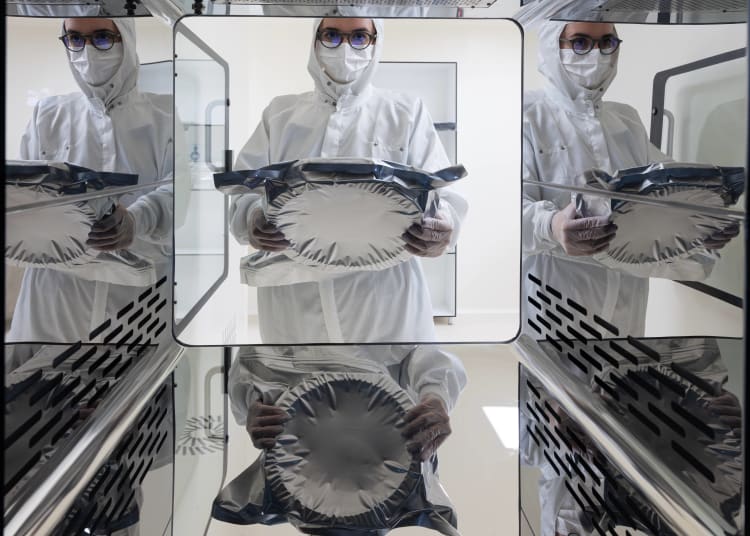
A wafer frame is cleaned after production and packaged in an ISO Class 6 cleanroom – a critical step to ensure maximum cleanliness and process reliability in semiconductor manufacturing.