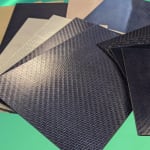
Envalior announces an extensive presentation of next-generation thermoplastic composites at JEC World 2026 in Paris, which will be held from 10 to 12 March. The company, describing itself as a global supplier of sustainable and high-performance engineering materials, is focusing its exhibit on Tepex and UDea solutions for aviation, drones and applications related to hydrogen storage and lightweight construction in the field of new mobility. A significant share of the showcased composites is biobased, enabling manufacturers to move from thermoset materials to structures based on thermoplastics.
Envalior highlights that lightweight thermoplastic composites can serve as a cost-efficient and recyclable alternative to conventional thermoset composites in the design of aircraft and unmanned aerial vehicles. These materials are adapted for high-volume processing using the hybrid molding process, which combines composite forming with injection molding. According to the company, this approach reduces time-consuming finishing operations, while the produced parts exhibit uniform properties and can be recycled at end of life into injection molding compounds.
As explained by Dr. Dirk Bonefeld, Head of Global Product Management and Marketing for Tepex at Envalior: "Our thermoplastic composites can be processed in large quantities using the hybrid molding process in a much more cost-efficient manner, directly in the mold and without the need for reworking. This results in high-performance components of consistently high quality which, unlike their thermoset counterparts, can be easily recycled into injection molding compounds and are therefore significantly more sustainable."
New Tepex dynalite composites for aviation and drones
At the Envalior booth at JEC World 2026, a range of thermoplastic composites for aerospace and drone applications will be presented. The focus will be on new Tepex dynalite grades based on polyphenylene sulfide (PPS) and polyetherimide (PEI), as well as high-performance composites based on EcoPaXX polyamide 4.10.
The new Tepex dynalite composites with PPS and PEI matrices are characterized by high temperature and chemical resistance and by high inherent flame retardancy. Due to these properties they are considered as materials for aircraft interior components such as seat shells, panels, partitions and flaps. Thermoplastic-based designs can facilitate the integration of multiple functions in a single part and enable the use of more automated production processes.
The second group consists of Tepex dynalite composites based on EcoPaXX, that is polyamide 4.10 (PA 4.10). This material family is biobased because castor oil is used as the primary raw material. Envalior emphasizes the excellent adhesion between continuous glass or carbon fibers and the PA 4.10 matrix, which results in high strength and stiffness at a low density. As a consequence, these composites are among the stiffest and strongest materials in the company's composite portfolio.
These properties make them suitable for lightweight structural components in drones, for example rods, beams or rotor elements. Weight reduction can translate into longer flight time, higher payload or the possibility to integrate additional functions while maintaining the required stiffness and dimensional stability.
Thermoplastic composites in high-pressure hydrogen vessels
Beyond aerospace applications, Envalior is presenting solutions for new mobility and lightweight construction at JEC World 2026, including components for hydrogen technologies. One example is a thermoplastic high-pressure vessel for hydrogen storage. The tank liner, manufactured by blow molding, is made from a Fuel Lock polyamide 6, while the reinforcing wrap is based on UDea tape made from EcoPaXX PA 4.10, both originating from Envalior's portfolio.
This type of tank is designed with recyclability in mind. According to the company, the strong chemical adhesion between the liner and the wrapping layer enables deep vacuum cleaning without the risk of liner collapse. The vessel is reported to exhibit high mechanical strength at low temperatures down to -40°C, also during rapid pressure changes that occur during hydrogen refueling. Potential applications for such tanks include fuel cell systems in buses and trucks as well as hydrogen storage in transport.
A second solution is a liner for high-pressure hydrogen vessels manufactured by rotational molding. The polyamide 6 liner exhibits a very good quality of the inner surface, with low porosity comparable to blow-molded or injection-molded liners that are subsequently welded. The PA 6 compound allows the integration of metallic boss parts that act as connection interfaces for the vessel.
Rotational molding as a single-stage process is described as an economical solution for producing liners without welded seams. The absence of welds can improve the uniformity of mechanical properties around the circumference of the vessel and reduce potential crack initiation sites. At the same time, the use of polyamide 6 as the base material ensures resistance to the stored medium and allows further reinforcement of the structure by an external composite wrap.
UDea composite tapes in electric motors and lightweight structures
Envalior will also showcase an ultra-light protective sleeve designed for electric motor rotors. This component is made of UDea composite tape, which encloses the high-speed rotor. The company notes that in high-volume production such a sleeve can be manufactured at lower cost than comparable metal or thermoset composite solutions while retaining the option of mechanical recycling.
Unlike thermoset composites, thermoplastic-based composite tapes can be reprocessed, which facilitates the management of production scrap and components at end of life. According to Envalior, these advantages are prompting more manufacturers of various types of electric motors to consider using housings made of UDea composite tapes as an alternative to metal and thermoset designs.
Biobased child seat made from Tepex composite
In the area of consumer applications, Envalior points to a prototype child seat that will be displayed at the Innovation Planets special exhibition at JEC. The design was developed by the Fraunhofer Institute for Microstructure of Materials and Systems (IMWS). The seat shell is made from a biobased Tepex composite based on polyamide 10.10 reinforced with flax fibers, and the component is overmolded with a biobased polyamide 11.
The combination of flax fibers with a polyamide 10.10 matrix yields a structure with a favorable stiffness-to-weight ratio while using raw materials of partially natural origin. The polyamide 11 overmolding layer enables the integration of functions such as mounting zones or fastening elements and improves the surface resistance to in-service damage.

Tepex is available with matrices made from polyetherimide, polyphenylene sulfide, polyamide 4.6 and 4.10 as well as thermoplastic copolyester elastomers.