In the Japanese market, there is a clear acceleration of the shift from conventional virgin plastics to recyclates and bioplastics. Around 2018–2019, the issue of marine plastic waste moved into the spotlight, and the term "de-plastic" became widely used. After the pandemic, awareness of the importance of packaging for ensuring the hygiene of food and other products further increased. At the same time, restaurant chains began to replace paper straws with bioplastic straws. Even in the automotive industry, known for its very strict technical requirements, the use of recycled materials is seen as inevitable. Work is underway to build a chain that covers the entire cycle from plastic waste collection to recycling and reuse.
Initiatives for a circular plastics economy
In 2024, the Sustainable Plastics Initiative (SusPla) was established in Japan with the aim of increasing the use of recyclates. SusPla brings together leading Japanese recycling companies, brand owners, manufacturers, trading companies, universities and research institutes, as well as governmental institutions from many sectors, including automotive, home electronics, chemicals, plastics processing and textiles. The organization aims to build a "plastics resources circular ecosystem through materials recycling originating in Japan".
At the level of individual companies, concrete results are already visible. Kao, one of Japan's largest producers of daily necessities, has increased the share of plastics recycling in its operations from 1% in 2021 to 8% in 2024. The company has declared that, regarding "the use of fossil-derived plastics in packaging containers", it intends to reach a peak of consumption by 2030 and then reduce it. In addition to reduction and substitution of raw materials, reuse of materials is an important direction of technology development for the company.
Another example is Konica Minolta, formerly known primarily as a camera manufacturer. As a plastics user, the company has launched a recycled plastics manufacturing business, combining its own sensing and artificial intelligence technologies. In the food sector, the reuse of recycled materials in polyethylene terephthalate beverage bottles has become common practice and is already well established in the market.
Bioplastics in Japan's raw materials strategy
In parallel, the adoption of bioplastics is progressing. In the "Plastics Resources Recycling Strategy" adopted in 2019, Japan set a target of introducing around 2 million tons of bioplastics to the market by 2030. Two approaches to their deployment were indicated. The first is separate storage and management of bioplastics compared with petrochemical-based plastics. The second is the use of the mass balance method, in which petrochemical and biomass-based raw materials are mixed and the biomass input is allocated at the production stage.
The number of enterprises holding International Sustainability & Carbon Certification (ISCC PLUS) for mass balance systems has increased significantly. Since ISCC PLUS requires certification of the entire supply chain, from raw materials to finished products, the spread of this solution takes time. However, considering that many bioplastics can be processed under conditions similar to conventional petrochemical-based plastics while providing comparable performance, their role in the broad implementation of more sustainable materials is regarded as significant.
Starbucks Coffee Japan emphasizes the environmental benefits of bioplastics in the context of straw replacement. The company states that "compared with FSC certified paper straws, bioplastic straws are expected to reduce CO2 emissions over the entire life cycle and halve the amount (by weight) of straw waste generated at stores". Paper straws, which had been fully introduced, have been replaced by bioplastic straws, taking into account both user comfort and environmental impact. Paper straws, once a symbol of plastic removal, are now giving way to straws made of plastics with the "bio" prefix, which has become a key topic in Japan's packaging industry.
Recyclates and bioplastics in the automotive sector
The use of recyclates and bioplastics in the automotive sector is attracting increasing attention. Plastics used in vehicles, such as polypropylene and polyamide, are available in many specialized grades. Even for a bumper for a specific Toyota model, the required compound and its supplier are precisely specified. For this reason, the implementation of recycled materials in this industry was long considered extremely difficult.
The situation began to change with the introduction of European End-of-Life Vehicle regulations, which require a certain share of recycled materials in cars, including plastics recovered from dismantled vehicles. The entire industry, including vehicle manufacturers and Tier 1 suppliers, is working intensively to increase the use of recycled materials. This may fundamentally change the material selection process that has long been taken for granted.
Automotive manufacturers define very strict specifications for recyclates and only use materials that meet them. On the other hand, once quality requirements have been defined, there is potential to integrate a wider range of material producers into the supply chain. Since the announcement of changes to End-of-Life Vehicle regulations in 2023, the status of post-consumer recycled (PCR), post-industrial recycled (PIR) and biomass-based raw materials has been unclear, making it difficult for original equipment manufacturers to define a clear roadmap for their use. However, through cooperation with plastics producers, technological development in the fields of PCR, PIR and biomass materials has significantly accelerated, and the pace of practical implementation is gradually increasing.
In the future, in order to ensure a stable supply of recyclates obtained from end-of-life vehicles, the introduction of automotive component designs that facilitate disassembly is expected. This means a growing importance of design for recycling, including material selection, simplified component architecture and reduction of the number of different plastics within a single part.
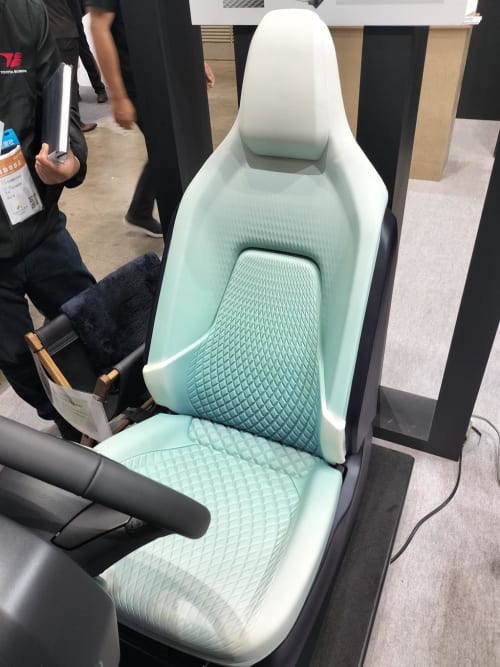
Mono-material car seat cover made of PVC developed by Toyota. Tier 1 enterprises are strengthening the development of easy-to-recycle design.
Decline in domestic plastics production and rising imports
These structural changes are occurring against the backdrop of a shrinking domestic market. According to data from the Japan Plastics Industry Federation, domestic plastics production in 2024 amounted to 8.396 million tons, representing a 4% year-on-year decrease. Compared with the level ten years earlier, production fell by 21%, and relative to twenty years ago, the decline reached 40%. This is the result of a complex combination of factors, such as an increasing share of imported products, relocation of finished goods production abroad, population decline and measures under economic transformation initiatives focused on reducing material use, down-gauging and reuse.
Plastics exports from Japan have been below 4 million tons per year for several years. At the same time, imports have been steadily increasing since 2018 and reached 3 million tons in 2024. The largest imported item is polyethylene terephthalate. In 2024, Japan imported more than 980,000 tons of this raw material, nearly half of which came from Taiwan.
In the case of polypropylene, the change has been particularly pronounced. In 2004, Japan did not import more than 10,000 tons of this polymer annually from any region. By 2014, it had exceeded the 10,000-ton threshold for imports from Thailand, South Korea and Saudi Arabia. In 2024, the United Arab Emirates, Vietnam and China joined the group of main suppliers, and the total import volume from these six regions exceeded 140,000 tons.
Against this backdrop, discussions are ongoing on the restructuring of Japan's aging and less competitive petrochemical complexes. In order to ensure security of supply, an increasing number of large plastics processors are considering using imported raw materials as a second, alternative source.
Engineering plastics and design for disassembly
Electromobility and the drive for further vehicle lightweighting are fostering the expansion of engineering plastics with enhanced properties, such as stiffness, strength, electrical insulation and flame retardancy. Along with material conversion, increasing emphasis is placed on ease of disassembly at the end-of-life stage, which is becoming a key criterion in design concepts proposed to vehicle manufacturers.
Global platform for technology exchange
In April 2026, the Chinaplas trade fair will be held in Shanghai, People's Republic of China, bringing together global plastics and rubber companies, including firms from Japan. The event will provide an opportunity to learn about the latest technologies and development directions, particularly in the areas of recycling, bioplastics and materials for electromobility.

Discussions on the reorganization of petrochemical complexes are ongoing (In the photo: Mizushima Industrial Complex).