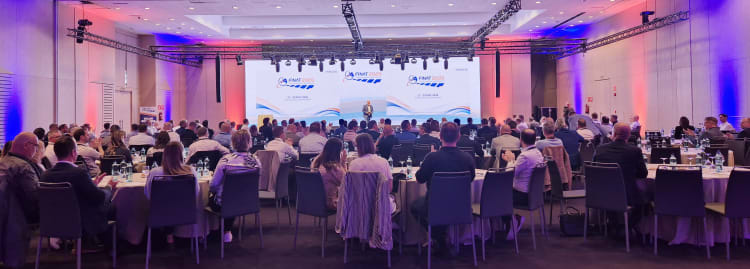
The European Label Forum 2026, held in Seville from 27–29 May, brought together 254 participants from 23 countries. The three-day programme included market presentations, strategic discussions and networking meetings. Attendance was 6% higher than a year earlier, including a 10% increase in delegates representing converting companies. The tabletop exhibition accompanying the event featured 35 suppliers representing different links in the label industry value chain. This year’s edition confirmed the forum’s position as an important strategic platform for the European label and narrow-web sector, at a time when the industry is moving from post-crisis recovery to strategic repositioning. One dominant conclusion emerged from the programme, future success will depend less on volume growth alone and more on agility, operational resilience, innovation, regulatory competence and closer collaboration across the entire value chain.
The event opened with a presentation by Dr Ilke Toygür, Director of the IE Global Policy Center and Professor of Geopolitics of Europe at IE University in Madrid, who outlined the broader geopolitical and economic context. As she indicated, Europe’s current situation is not a temporary crisis, but a period of structural transformation in which business strategy is increasingly shaped by power, security, technology, energy and trade dependencies.
Market data from Panteia, presented by FINAT, showed that consumption of self-adhesive label materials in Europe reached 7.37 billion m² in 2025, up 2% year on year, but still broadly at pre-Covid levels. Within this structure, paper rolls remained the largest segment, although they grew by only 0.9%, while non-paper rolls increased by 4.1%. Over the longer term, the material mix continues to change, the share of paper rolls has fallen over two decades from 73% to 67% of demand, the share of filmic rolls has risen from 20% to 30%, and the share of sheets has declined from 7% to 3%.
Market under pressure from costs and changing demand
FINAT also presented preliminary findings from its ongoing research on non-European imports of self-adhesive label materials, with particular focus on China. Early signals indicate a clear increase in import volumes from China since 2020, especially in selected material categories. The research points to the need for closer market monitoring and a balanced assessment of how global production capacity, pricing and supply chain dynamics may affect the competitiveness of the European label value chain.
Further preliminary market observations, presented by FINAT RADAR and AWA, pointed to a cautious business environment. Revenues of converting companies in the first quarter of 2026 were mostly stable or slightly lower than in the same period of the previous year. The most frequently indicated capital investment priority was finishing equipment, cited by 31% of respondents. Flexible packaging remained the most attractive adjacent growth market for converters, indicated by 32% of respondents. Digitalisation and automation were identified by 40% of converters as the most important success factor over the next three years. At the same time, brand owners continue to face pressure from material and energy costs, with 42% reporting increases.
The programme also highlighted a change in brand-owner expectations. Labels are no longer judged solely in terms of price, reliability and technical execution. They are increasingly part of a broader discussion on sustainability, recyclability, data, regulatory compliance, consumer engagement and design trade-offs. For converters and suppliers, this creates an opportunity to join the customer conversation earlier and act as consultative partners rather than purely transactional suppliers.
Sustainability, regulation and AI
Sustainability issues were not discussed as a separate topic, but as a business condition increasingly linked to market access, regulation and competitiveness. In discussions on PPWR, recyclability, circularity and carbon impact, it was indicated that brand owners expect practical support from the label industry value chain in balancing compliance requirements, material selection, design impact and commercial feasibility.
Artificial intelligence was another of the forum’s main topics. The discussion moved beyond general awareness and focused on practical implementation, with examples of AI agents and workflow applications related to estimating, customer service, prepress, document handling, production support and marketing. The message was clear, AI will not replace business judgement, but companies that integrate it into key processes while maintaining proper supervision, governance rules and human control will gain speed, consistency and operational insight.
Capabilities needed by 2030
The final part of the programme focused on the capabilities needed to remain competitive towards 2030. The pre-conference industry roundtables identified AI and automation as the strongest forces reshaping the sector, followed by sustainability and regulation. The discussions showed that the industry is moving from AI experimentation to operational deployment, but many companies still need stronger digital foundations, including better ERP integration, higher data quality and improved cybersecurity.
At the same time, participants stressed that people, not technology alone, will remain the decisive factor. Technological solutions are becoming increasingly available, but companies need new skills, better change management and employees capable of using digital tools effectively. Young professionals largely recognise the same forces shaping the industry, but more often see them as opportunities rather than threats. Bridging these generational perspectives will matter for companies seeking to attract talent and accelerate transformation.
The discussions also showed growing commercial tension around sustainability. Environmental data, compliance and transparency are becoming purchasing requirements, but the related costs are often pushed down the supply chain. This means that converters will need to demonstrate more clearly the value of compliance, data and technical expertise, while also working with customers and suppliers on a commercially viable model for implementing sustainable solutions.
Another important conclusion was that Europe cannot compete on cost alone. As competition from Asia intensifies in low-cost materials, finished labels and equipment, Europe’s strengths should be based on quality, agility, regulatory compliance, technical expertise and proximity to customers. "Made in Europe needs to stand for a clearly defined value proposition, supported by stronger collaboration across the broader packaging ecosystem, as labels are increasingly connecting with adjacent narrow-web applications such as shrink sleeves, pouches and flexible packaging."
As Jules Lejeune, Managing Director of FINAT, said, "ELF is much more than a conference. It is where industry leaders come together to challenge assumptions, exchange perspectives and build the relationships that drive our sector forward. This year’s discussions showed that success in our industry is no longer achieved alone. Companies need trusted relationships, shared knowledge and a strong collective voice to move forward."
FINAT also announced that the next European Label Forum will take place in Warsaw from 19–21 May 2027.