Coperion has received a Letter of No Objection from the U.S. Food and Drug Administration, FDA, for its recycling technology for high-density polyethylene, HDPE, and polypropylene, PP. The document confirms that the combination of Coperion twin screw extruders with the EcoFresh silo degassing system, used in the production of rHDPE and rPP, meets the requirements for materials intended for direct food contact. According to the company, this is the first complete decontamination solution based on twin screw extruders and EcoFresh degassing that covers capacities from small throughputs up to 6,000 kg/h. The required level of decontamination for rHDPE and rPP was confirmed in a challenge test and then verified by the FDA.
The decision opens up new possibilities for food packaging recycling. Food-grade regranulate can be produced from HDPE milk jugs or fruit juice bottles and then reused to manufacture similar bottles or related products. In turn, containers, cups, bowls and trays made of PP can be processed into new packaging intended for direct food contact. In practice, this means a broader range of applications for polyolefin recyclates in the packaging segment with high purity and safety requirements.
Producing recyclates safe for food contact is one of the greatest challenges in plastics recycling. Such regranulates must obtain confirmation of suitability for direct food contact and meet very high requirements for purity and safety. Stefan Lachenmayer, Global Commercial Director Recycling at Coperion, said: "The FDA's Letter of No Objection means that rHDPE and rPP manufactured using our technologies can be used in new food packaging at shares of up to 100 percent. As a result, we provide recyclers with confirmation that our energy-efficient mechanical recycling process makes it possible to produce high-quality recyclate for use cases A-H. These include, for example, packaging for products exposed to high temperature, heat sterilization, pasteurization or freezing."
Process steps relevant to food safety
According to the company, the high decontamination efficiency of the Coperion system results from the combination of the high degassing performance of the co-rotating twin screw extruder with the efficient EcoFresh silo degassing system. In this configuration, even short material residence times are said to be sufficient for the effective removal of low-volatility migrating substances.
The feedstock in the process for producing food-grade rHDPE consists of used HDPE beverage bottles or their caps. The material stream for rPP includes, among others, vegetable trays, packaging and yogurt cups. The material enters the extruder through Coperion K-Tron gravimetric feeders, where it is first melted, intensively mixed, homogenized and degassed using the twin screw plasticizing system. The company indicates that, when designing process parameters, it draws on many years of experience in melt and solid-state devolatilization, and that both the process itself and the screw configuration were selected to meet the requirements of a specific recycling application.
After melting, the plastic is cleaned of solid foreign matter by means of a melt filter and then pelletized. The next step is a second decontamination stage in the newly developed and standardized EcoFresh silo degassing unit.
Tests at the Coperion research center
Recyclers can verify the decontamination performance of the system with the Coperion extruder and EcoFresh at the Coperion Recycling Innovation Center, where both technologies are available for extensive trials using real material streams. Combined with Herbold Meckesheim’s Test Center, where raw material grinding and washing are carried out, the entire recycling process can be reproduced under test conditions.
Stefan Lachenmayer emphasizes: "The basis for the suitability of our HDPE and PP recycling solutions for manufacturing materials intended for food contact lies in our integrated approach as a system provider. We analyze the entire process and apply our decontamination technologies precisely at specific points in the process chain. It is their optimal interaction that makes it possible to efficiently achieve the required level of decontamination."
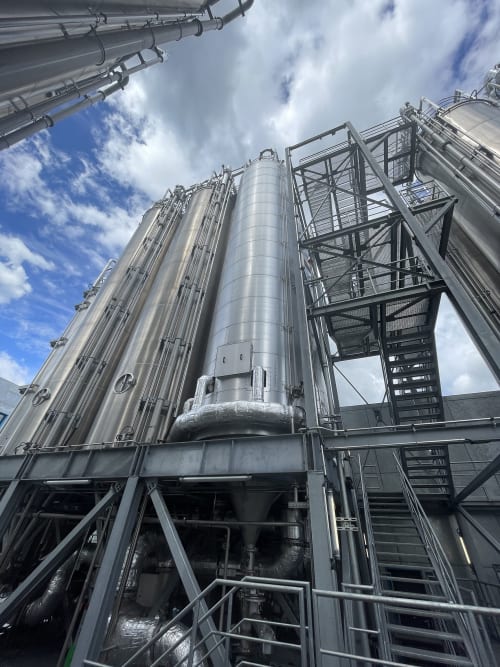
Coperion's EcoFresh silo degassing system and its twin screw extruders have received a Letter of No Objection from the FDA and are therefore suitable for the production of food-grade HDPE and PP recyclates