Under the name ENGEL Spain, the ENGEL Group is appearing at Equiplast 2026 for the first time, combining its existing local presence in the Spanish market with access to international technology expertise. The Barcelona site remains the central point of contact for sales, service, training and application engineering. For processors in Spain, this means short response times, local partners and more direct access to a broad portfolio of integrated machine solutions, automation and digital assistance systems. At Equiplast 2026, the company is presenting several exhibits showing how continuous production cells can improve component quality, output and resource efficiency, while also reducing unit costs.
The scope of the presentation includes applications for the production of decorated parts, closures for the packaging sector, thin-wall containers with in-mould labelling, and large transport mouldings. The exhibition is complemented by an area dedicated to digital process assistance systems and solutions based on artificial intelligence, aimed at stabilising production, reducing scrap and improving machine availability. In this way, the stand shows both complete production cells and tools for their optimisation in industrial conditions.
Tie-bar-less victory 120 for automated IMD production
Together with its sales and service partner Garcia Tamayo, ENGEL Spain is presenting a fully automated production solution centred around a tie-bar-less victory 120 injection moulding machine with a clamping force of 1,200 kN. In applications involving large moulds and integrated automation, ENGEL's tie-bar-less technology, with large platens and free mould installation space, is intended to provide greater freedom in production cell design. In many cases, this makes it possible to use a smaller machine, which translates into lower investment costs. Accessibility to the mould area also facilitates mould changes and shortens set-up time, increasing OEE.
In the presented application, a demo plate is produced with an IMD decorative film from Leonhard Kurz. The film is fed into the mould by a feed system from Kurz, punched out in a Schöfer mould, and then back-injected with Makrolon polycarbonate. The part weight is 48 g and the cycle time is 55 s. A film overlap initially remains on the part. The finished part is removed by a viper 20 linear robot fully integrated into the ENGEL CC300 machine control system. The film overlap is then removed fully automatically at a milling station.
The transfer head and the milling station come from Garcia Tamayo, a long-standing ENGEL partner. The company supports customers in several regions of Spain in sales and service. According to the manufacturer, the production cell shown at the trade fair demonstrates how ENGEL Spain, together with regional partners, implements compact and fully automated production solutions tailored to the needs of the Spanish market.
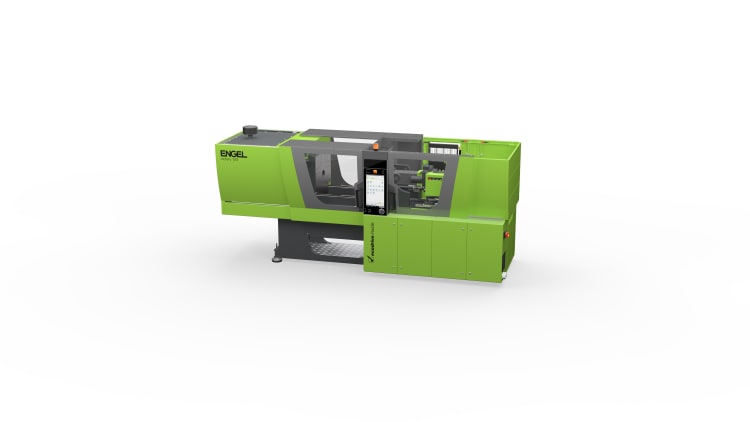
The tie-bar-less ENGEL victory 120 creates more space for mould and automation, enabling compact production cells, lower investment costs and shorter set-up times
E-mac 200 for high-output packaging production
In another production cell, the company is showing the e-mac 200 injection moulding machine with a clamping force of 2,000 kN as a solution for packaging applications requiring high output and the precision of an all-electric drive. In this application, oil closure caps made of LLDPE are produced in a 24-cavity mould, with a total shot weight of 39.6 g and a cycle time of 5.5 s. To further shorten the cycle time, the parts are freely discharged onto an automatic Z-conveyor belt from ENGEL, also fully integrated into the CC300 control system.
The manufacturer emphasises that the cell has been consistently designed for high volumes while maintaining precise and reproducible production. Especially in multi-cavity applications with short cycles, stable process control is one of the key factors affecting cost efficiency and part quality. According to ENGEL, the all-electric e-mac provides the conditions for this through precise motion sequences, high repeatability and energy-efficient operation.
An additional factor is the compact machine design, which is intended to support efficient use of the available production space and cost-effective implementation of highly automated packaging applications, even where space is limited. For this reason, the e-mac series is aimed at serial production where high output, consistent quality and low energy costs are required together.
E-motion 220 for thin-wall production with IML
In an application intended for the packaging sector, ENGEL is presenting the all-electric e-motion 220 injection moulding machine with a clamping force of 2,200 kN. The solution runs with a cycle time of 3 s and is used to produce thin-wall ice cream containers made of PP copolymer, in a 4-cavity mould, with in-mould labelling. The IML automation system in this cell is supplied by the French company Pagés.
The high-performance injection unit of the e-motion increases injection speed by almost 67 percent compared with standard solutions. The new digital assistance system iQ weight control plus analyses the injection process in real time even at such high speeds and automatically adjusts the switchover point and holding pressure within the same cycle, in either speed-controlled or pressure-controlled mode after entering only two values. According to ENGEL, shot weight fluctuations can therefore be reliably compensated even with tight tolerances, which is significant for maintaining part quality in thin-wall processing. The manufacturer states that the use of iQ weight control plus can reduce scrap by up to 50 percent.
In practice, this approach is intended to combine high output with greater process stability and reproducible quality. For processors, this means easier compliance with demanding specifications and improved cost efficiency in high-performance production.
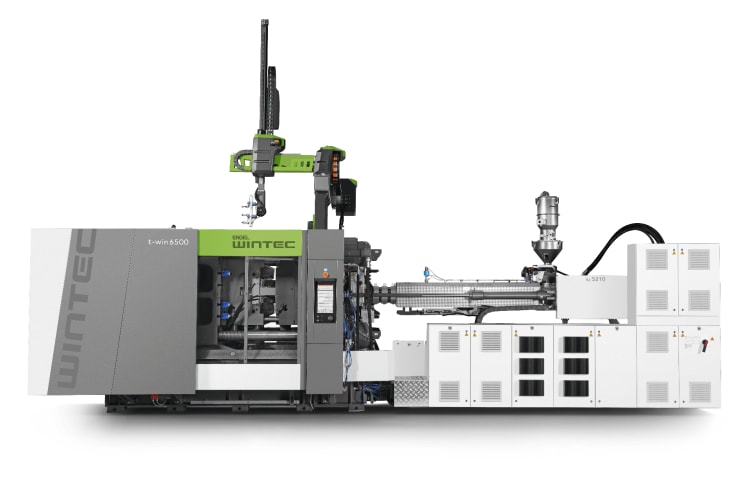
The WINTEC t-win 6500 enables the cost-efficient production of large parts with short cycle times and high process stability
Wintec t-win 6500 for cost-efficient production of large parts
The stand also features the t-win machine from Wintec, based on a robust two-platen design for applications with large moulds and high clamping forces. Short-stroke pressure cushions are intended to enable short cycle times, while synchronous locking and the servo-hydraulic drive are designed to deliver fast and energy-efficient operation. The manufacturer indicates that high energy efficiency, a compact footprint and optimised maintenance access reduce total operating costs and accelerate return on investment.
At the trade fair, fruit crates made from Borealis BH381MO polypropylene are being produced on a Wintec t-win 6500 injection moulding machine with a clamping force of 6,500 kN. The shot weight is 490 g and the cycle time is 18 s. The finished parts are removed from the mould by an ENGEL viper 20 linear robot integrated into the C3 control system and then placed on a conveyor belt. Close integration of the robot and machine within one control system is intended to relieve operators, increase production stability and shorten cycles through optimised motion sequences.
This presentation also uses the iQ weight control system, which automatically compensates for viscosity fluctuations within the same cycle. According to the manufacturer, this translates into higher component quality and reduced scrap. As a result, the solution is intended to meet the needs of processors seeking cost-efficient production of large parts while maintaining robust process control.
Digital systems and AI applications for process stabilisation
In the Expert Corner area, ENGEL is showing how production processes can be stabilised and further developed using digital assistance systems and applications based on artificial intelligence. The inject AI product family is intended to create a data-based production environment using learning mechanisms.
The solutions presented include iQ weight control, iQ clamp control, iQ flow control, iQ melt control and iQ motion control, which automatically intervene in process parameters relevant to quality and efficiency. iQ weight control compensates for viscosity fluctuations in real time and, according to the manufacturer, can reduce weight variation by up to 85 percent. iQ clamp control automatically adjusts clamping force, reducing mould stress and lowering energy consumption during clamping force build-up by up to 10 percent. iQ flow control stabilises temperature control and is intended to reduce energy costs in production by up to 18 percent, while iQ melt control automatically optimises plasticising parameters, which is intended to lead to rapid start-up of serial production.
In addition, the iQ process observer system uses AI to analyse more than 1,000 process parameters, detects abnormalities at an early stage and provides guidance for process control to prevent scrap from occurring. This is intended to increase process reliability, improve OEE and relieve operating personnel. These tools are complemented by the ENGEL Virtual Assistant, which quickly provides system-specific knowledge, and AI-based applications such as part finder, which enables spare parts to be identified from a photo.
According to ENGEL, the use of digital assistance systems means less effort for processors in process monitoring, faster responses to deviations, less scrap and higher system availability. At the same time, machine and personnel resources can be deployed in a more targeted way, which is intended to further reduce production costs.

inject AI improves process stability, reduces scrap, lowers production costs and increases system availability through AI-based process optimisation