Comexi, a global supplier of machinery for flexible packaging production, announces at Interpack (stand 8A F54) the presentation of a broad portfolio of sustainable packaging applications ready to be implemented by brand owners and converters. The company emphasizes that sustainability is no longer only a cost factor but is becoming a driver of industrial efficiency through the integration of advanced ecosystems for printing, laminating, slitting and laser converting. These solutions are intended to enable simultaneous reduction of carbon footprint and VOC emissions, while optimising costs through appropriate packaging design and energy-efficient production.
At its stand in Düsseldorf, Comexi will present, among others, applications based on recyclable monomaterials, paper-based structures and solutions with a high share of post-consumer recycled content. The company underlines that the presented examples relate directly to current and upcoming European regulations on the circular economy, recycled content and reduced solvent use. A key element of Comexi's presence at Interpack will be the fourth edition of the Sustainable Packaging Showroom seminar, focused on industrial aspects of implementing packaging with reduced environmental impact.
Fourth Sustainable Packaging Showroom at Interpack
The strategic highlight of Comexi's programme at Interpack is the 4th edition of the Sustainable Packaging Showroom, scheduled for 11 May. The event will run from 10:00 a.m. to 5:00 p.m., with a technical block from 2:00 p.m. to 5:00 p.m. in hall 10, room 10.1. The seminar is designed to go beyond general concepts and focus on specific industrial benefits, including solvent-free processes, reduction of volatile organic compound emissions and improved energy efficiency.
Experts from Comexi and industry partners will discuss how these elements, integrated both into machine design and into the structure of the packaging itself, can significantly reduce the environmental impact of the final product while increasing cost competitiveness. The agenda includes presentations on functional coatings, solvent-free lamination and solutions enabling full packaging traceability through variable data.
Four examples of efficient sustainability
Among the many solutions presented at Interpack, Comexi highlights four applications that illustrate how designing for sustainability can lead to material and economic savings.
Recyclable pet food pouch from BOPP monostructure
The first example is a pouch for pet food made from a recyclable BOPP monostructure. This structure is printed with water-based inks, enabling high-quality, solvent-free printing with high-definition graphics. The use of this system is aimed at reducing solvent consumption in the printing process.
The solution eliminates the need for costly plastic zippers by using a horseshoe-shaped opening created with Comexi Laser technology. The closing function is provided by a BOPP label with resealable properties, which additionally improves ergonomics in use. According to the company, such a design allows higher speeds on packaging lines and ensures significant material savings for the packer.
Monolayer PE monomaterial with hybrid EB flexo printing
The second application is a recyclable, monomaterial and monolayer polyethylene solution in which flexographic inks cured by electron beam radiation are used. The application of Flexo ElectronBeam technology reduces the carbon footprint by eliminating the lamination process, which at the same time lowers production costs.
The project was developed in cooperation with Coveris. As the partners point out, a change in the packaging structure makes it possible to create an "all PE" recyclable solution in a sustainable manner by reducing solvent use through EB inks and at a lower total cost arising from replacing one lamination step with an OPV coating applied directly on the central impression cylinder.
EB inks provide strong visual properties, including intense colours and high-resolution details, while the EB varnish ensures surface protection of the print. The required barrier properties are delivered by the coextruded PE structure. The packaging features an easy-open system that demonstrates the capabilities of Comexi's laser, which operates efficiently in both extrusion-based applications and monomaterial lamination without the need for separate equipment.
Paper-based packaging with FREEcure technology
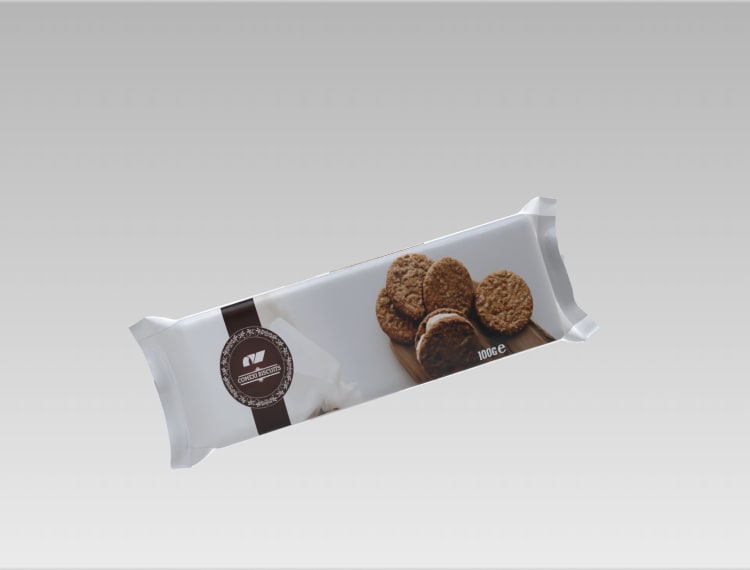
For brands transitioning to paper packaging, Comexi presents a surface printing solution using EB and FREEcure technology, implemented in offset technology on a central impression cylinder. The system uses inks and varnishes free of photoinitiators, which is important for food packaging applications.
According to Comexi, this technology offers a high-opacity white and a wide colour gamut at high production speeds, without trapping issues between ink layers. Offset in this configuration is compatible with both paper substrates and film. The project was developed in cooperation with Lecta, IST and Sunchemical.
Circular detergent pouches with 40% PCR
The fourth example is detergent pouches made from a monomaterial MDOPE + PE structure designed for material recyclability. The construction includes more than 40% post-consumer recycled resin originating from household waste. The aim of the project is to demonstrate that such a high share of recycled feedstock does not have to mean compromising the shelf appearance of the packaging.
The packaging is printed using offset technology on a central impression cylinder and is intended to be a solution aligned with forthcoming European standards, while maintaining competitive cost levels and high visual quality. The pouches are presented in two variants: as reverse-printed and laminated, and as surface-printed on the same material structure. The project was developed in cooperation with Dow, Mespack and Reifenhauser.
Holistic approach to circularity
The described applications represent only a segment of the broader range of sustainable solutions that Comexi is presenting at Interpack. This offering includes, among others, functional coatings, solvent-free lamination and variable data coding systems enabling full packaging traceability throughout the value chain. Of particular interest to brand owners focusing on high recycled content may be the latest solution in the area of slitting and rewinding.
Comexi integrates EB technology from ESI directly into slitters, enabling crosslinking and improved surface resistance of PE materials. This solution addresses the growing requirements for processing films with high recycled content, which often exhibit inferior mechanical and surface properties.
Comexi technology is designed to minimise waste and energy consumption. For brand owners, this means the ability to achieve sustainability targets without sacrificing packaging performance or the visual identity that determines product recognition on international markets. Visitors can explore the presented solutions at Comexi's stand 8A F54 and during the fourth Sustainable Packaging Showroom in hall 10, room 10.1.