Carlsberg has begun rolling out a new cardboard multipack for bottles with rounded edges, developed jointly with DS Smith and KHS based on SCA’s patented Arcwise technology. The new premium packaging was launched first on the Polish market, and further projects are being prepared. From the beverage producer’s perspective, the starting point for work on the new format was the consumer experience and product visibility on the shelf. As Marine Andre, Director of Packaging Innovation at Carlsberg, indicates, packaging must attract attention, meet functional requirements and remain cost-rational at the same time. According to market research cited by the company, the sustainable nature of packaging is expected by consumers, but in itself usually does not constitute a basis for paying a higher price. For this reason, the new format was intended to combine the environmental aspect with visual impact and the possibility of using existing packaging infrastructure. Carlsberg emphasizes that solutions that do not meet at least two of the three criteria - sustainability, cost optimization and appropriate consumer experience - have little chance of success.
One example of this approach is DS Smith Round Wrap, a cardboard multipack for beer bottles with rounded edges. According to the project participants, the solution is expected to deliver benefits in three areas. First, it strengthens brand presence and increases packaging appeal on the shelf. In this context, Carlsberg refers to scientific research, including from Harvard Medical School, which is said to show that objects with rounded shapes are perceived as more attractive than those with angular corners. Second, the new type of secondary packaging uses less material, has a lower carbon footprint and better withstands damage during transport. Third, it can be produced on existing packaging machines, without the need for major capital expenditure and without increasing the price for the end customer.
A lengthy development process
Before the new multipack reached the market, the concept underwent a multi-year process of trials and refinement. As Bogdan Volkotrub, Senior Manager for Packaging Implementation and Optimization at Carlsberg headquarters, recalls, the first tests began in Sweden in 2020. Initially, the aim was to confirm on a small scale that the solution could be implemented at all. However, the first trials did not bring the expected result, as consistent production quality could not be achieved.
The breakthrough came in 2022, when partners with the appropriate competencies were brought into the project. DS Smith, as the packaging manufacturer, provided the material and carried out a demanding process of testing, learning and validation. At the same time, KHS, the Dortmund-based systems supplier, analyzed which of the packaging machines operated within the Carlsberg Group could handle the new packaging without significant modifications. Bogdan Volkotrub compares this process to assembling building blocks: “one element is the material, the second is the machine, and the third is teamwork. If even one element does not fit, it is impossible to build anything meaningful.”
Poland as a test market
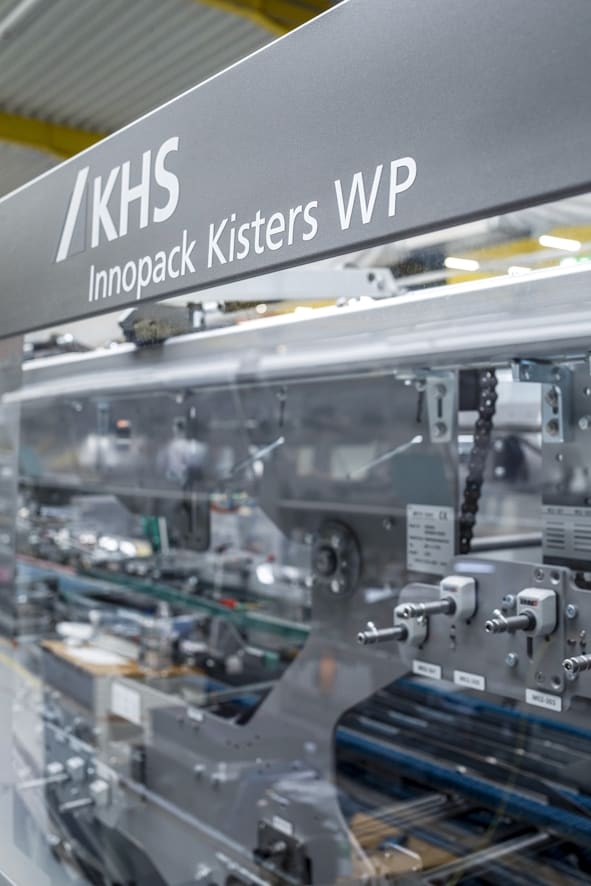
The next step was to find a suitable market for launching the project under commercial conditions. The choice fell on Poland, served by Carlsberg’s Polish subsidiary. In this market, bottled products of the Carlsberg, Garage and Somersby brands are packaged mainly in large bundles containing 20 or 24 primary packs. In this segment, wrap-around cartons are used instead of plastic crates. In addition, the production plant had a machine capable of producing the new multipack, namely a KHS Innopack Kisters WP Advanced packer. In 2024, the first packs with rounded corners appeared on the shelves of Polish supermarkets.
Material selection and process parameters
Rounded edges place high demands both on the material itself and on the way it is processed. Jonathan Carter, Head of Innovation Product Management at DS Smith, explains that the outer layer must be strong enough to stabilize the curvature, while the inner layer should be significantly lighter so as to enable proper flute formation. Only this combination makes it possible to achieve a smooth rounded shape without wrinkling or cracking of the material.
To achieve the required quality, DS Smith tested numerous combinations of paper, flute types, adhesive and machine parameters. This was an iterative process, carried out before the material was sent to the customer. Jonathan Carter describes the result achieved as the “golden ratio” of the material composition.
Minor machine modifications
In the final phase of the project, DS Smith delivered thirteen pallets with a limited pool of material variants to the KHS plant in Kleve. There they underwent intensive machine testing. Tobias Kersten of KHS admits that at first there were questions as to how wrap-around packaging with rounded edges would function on existing systems. However, the final solution proved relatively simple. “We simply had to use different guides and folding tools in the folding area,” says Kersten. “In practice, this means only minor adjustments. Our specialists set the system very precisely, thanks to which the new format can be integrated seamlessly with modern wrap-around packers. This makes it possible to maintain high process stability and produce the new type of packaging without any noticeable drop in performance.” As he adds, this aspect underlines the flexibility of the wrap-around packer and its high level of market acceptance.
The finished secondary packaging has been well received by both retailers and consumers. The rounded corners are said to be less susceptible to damage during transport, storage and in-store display. According to the project participants, the curved form may also support sales, although no specific numerical data have yet been provided. DS Smith cites the results of a consumer study showing that, on average, 77% of respondents would be more inclined to buy a product in the improved wrap-around pack with a rounded design than in another type of packaging. One reason may be the larger surface area available for brand communication. In addition, the box lid with a printed promotional motif can be opened and positioned vertically for the sale of individual bottles, similarly to a miniature display unit.
Less material and lower emissions
The new multipack is also expected to deliver measurable environmental effects. Thanks to the lighter inner layer and the optimized die-cut, material consumption can be reduced by up to 20%. “Depending on the comparison basis applied, we use up to around 24% less CO2e,” says Jonathan Carter. Carlsberg’s Polish subsidiary therefore estimates annual savings at around 224 tonnes. Additional benefits are expected to arise from logistics, including greater pallet stability and lower stretch film consumption.
DS Smith states that the Round Wrap solution has already been fully developed and is ready for implementation in additional markets. Jonathan Carter indicates that conditions are favorable for this, as production has already been successfully tested in many key locations across the EMEA region. “We have the know-how; now we must scale up together,” he emphasizes. Carlsberg takes a similar position, counting on interest from its subsidiaries and planning to selectively develop the new format where the appropriate market volume, brand strategy, material availability and machine capabilities coincide.
Innovation across the value chain
The project for the new multipack with rounded corners shows that packaging innovation with declared environmental benefits requires cooperation across the entire value chain. In the view of the project participants, this is not the result of a single idea, but of joint action by the brand owner, the packaging supplier and the machine manufacturer. Marine Andre summarizes it as follows: “We cannot change anything in the packaging area on our own. Only by working with strong partners can we develop systems and solutions that are better for our customers, the environment and our companies.”