Accurate determination of water content in materials is one of the most important pillars of quality control in many industrial sectors. In particular, in the wood, agricultural and plastics industries, the efficiency of production processes and the quality of end products depend directly on the precision of moisture measurement. Different material groups, such as wood chips, animal feed or plastic granules, have completely different physical properties, which places high demands on the flexibility and accuracy of the measuring equipment used.
In the wood industry, determining the moisture content of biomass is crucial for calculating its calorific value. Wood chips with excessively high water content reduce energy yield and can also lead to damage to combustion plants due to slagging. Similar challenges occur in the agricultural sector in the production of animal feed. In this case, storage stability is the primary concern, as even small deviations from the target value can result in microbial growth or mould formation, which in extreme cases may require the entire batch of product to be discarded.
The plastics industry presents a clear technological contrast in this respect. When processing granules, extremely low moisture contents, in the range of a few hundredths of a percent, are often required. Hygroscopic plastics such as polyamide or polycarbonate must be intensively dried before extrusion or injection moulding. Excessive residual moisture in the granulate leads to hydrolytic degradation during processing, which manifests itself in blistering, surface defects and a marked reduction in the mechanical strength of finished parts.
Modern moisture analyzers operate on the thermogravimetric principle, also known as the drying oven method, but in a much accelerated form. The device functions both as a precision balance and as a drying chamber. During measurement, the sample is continuously weighed while a heating element drives off the moisture. Automated recording of mass loss in real time makes it possible to define the end point of the measurement precisely, either after a specified time or when mass stability is reached. This eliminates manual calculation errors and shortens the total analysis time from hours to a few minutes.
To meet the diverse requirements of measurements in different industries, the PCE-UX 3081 moisture analyzer has been developed as a solution for industrial environments. This device is distinguished by its capability to measure materials with very low moisture content, which makes it particularly suitable for high quality demands in plastics processing. High resolution of readings is essential in this application in order to reliably detect even minimal amounts of water remaining in granules or other polymer feedstocks.
A key design advantage of the PCE-UX 3081 from the perspective of the wood and agricultural industries is the integrated large sample tray. It enables uniform distribution of a sufficiently large amount of material, including bulk materials with low bulk density such as wood chips and animal feed. Wide distribution of the sample is crucial for measurement quality, as only under such conditions can homogeneous heating be ensured without local overheating of the material and without leaving an undried core inside the sample.
In combination with highly sensitive sensors that enable reliable measurement of minimal moisture contents and the possibility of using relatively large sample portions, the PCE-UX 3081 provides a high level of repeatability and stability of the measurement process. In many industrial applications, this translates into greater certainty in assessing the quality of raw materials and semi-finished products compared to conventional laboratory methods, which often require longer analysis times and more intensive manual handling.
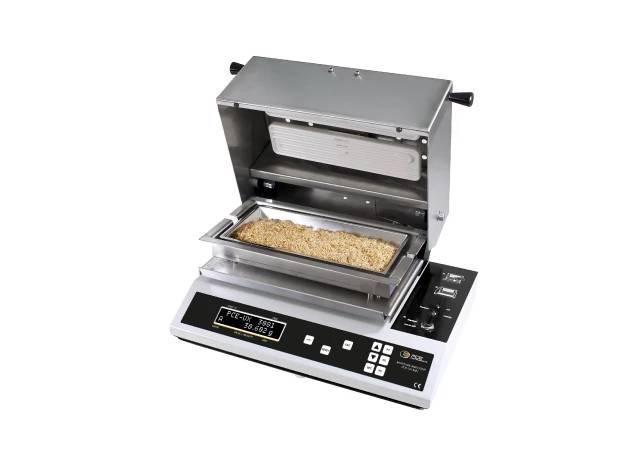
In the wood, agricultural and plastics industries, process efficiency depends on the accuracy of moisture measurement.