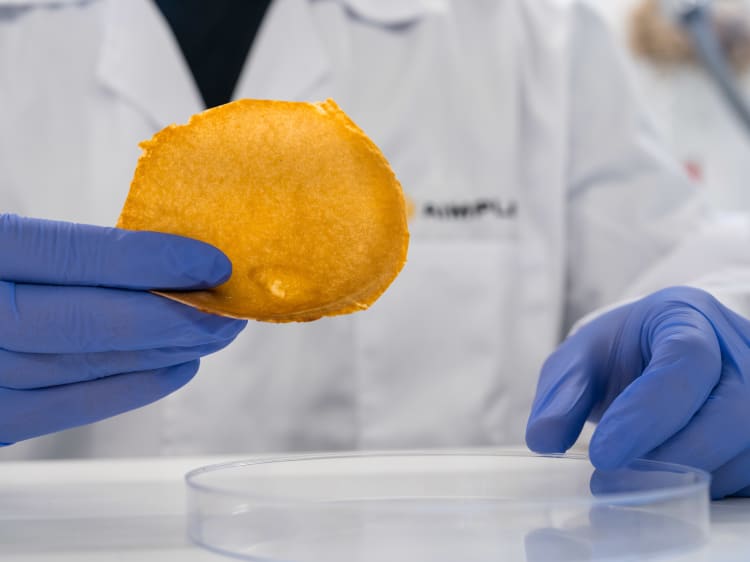
Organic waste accounts for around 50 per cent of municipal waste in Spain. Current treatment methods, such as composting or biogas production, do not make it possible to generate products with sufficient economic value to offset processing costs. In response to this environmental and economic challenge, Aimplas is leading the Vegancelio project. This initiative is aligned with the principles of the circular economy and the bioeconomy and focuses on recovering value from organic waste by converting it into two products, vegan leather intended for the textile sector and chitosan microcapsules for cosmetic applications.
The project is funded by the Valencian Institute of Competitiveness and Innovation, IVACE+i, through ERDF funds. It aims to develop advanced technologies enabling the use of organic waste as a feedstock for higher value-added materials. The vegan leather is to be made from fungal mycelium, while the chitosan microcapsules are designed for the encapsulation of active ingredients with antioxidant effects and their controlled release.
The scope of work includes the production of fungal mycelium from organic waste, the sustainable extraction of chitosan from fungal biomass using chemical and enzymatic methods, the manufacture of vegan leather through the optimisation of plasticisers and processes such as extrusion, as well as the development of chitosan and hybrid microcapsules for dermocosmetic applications. The project also provides for knowledge transfer to the plastics, textile and cosmetics sectors in the Valencian Community. This model also has the potential to be replicated in other industries and for other types of waste with a similar composition.
Cooperation with industry
The project involves Tejidos Royo S.L., which specialises in the manufacture of textile materials, and Dermopartners S.L., which focuses on the formulation of dermocosmetic products. Both companies contribute industrial and market knowledge and participate in defining technical parameters, providing specialist advice and validating the materials being developed. Their involvement is intended to support the practical and commercial feasibility of the processes and increase the potential for implementation of the project results.
As Pablo Ferrero, lead researcher in biotechnology at Aimplas, explains, "The products developed in the Vegancelio project respond to real market demand, which makes it possible to economically leverage the applied technologies. The project represents an opportunity for companies implementing these solutions to position themselves as leaders in sustainability and innovation."
According to Aimplas, the comprehensive approach adopted in the project can contribute not only to reducing the volume of organic waste and greenhouse gas emissions, but also to the development of materials free from harmful substances and processes intended to be sustainable, profitable and scalable. The project is also intended to reduce dependence on imported raw materials and strengthen the position of the Valencian Community in sustainable innovation.
Vegancelio joins other initiatives led by Aimplas that focus on waste recovery and the development of sustainable materials.