Wittmann to present automation and granulator at Kuteno 2026
At Kuteno 2026, Wittmann will present the compact FlexCell plus automation cell and the S-Max granulator for in-line recycling. Both solutions are intended to support savings in space, material, energy and time in injection molding processing.
At Kuteno 2026 in Bad Salzuflen, Wittmann Group intends to present two solutions for plastics processors working in injection molding, the FlexCell plus automation cell and an S-Max series granulator for efficient in-line recycling. The manufacturer indicates that combining compact automation with the grinding of production waste directly beside the machine is intended to address growing requirements for saving space, material, energy and time. The presentation will focus in particular on the concept of flexible automation with a very small footprint. According to the company, the FlexCell automation cells feature a standardized, compact design while maintaining high application flexibility. The concept includes three variants, Basis, Primus and Plus, which allows it to be used both for simple pick-and-place operations and for integrating downstream process steps, including the packaging of finished parts.
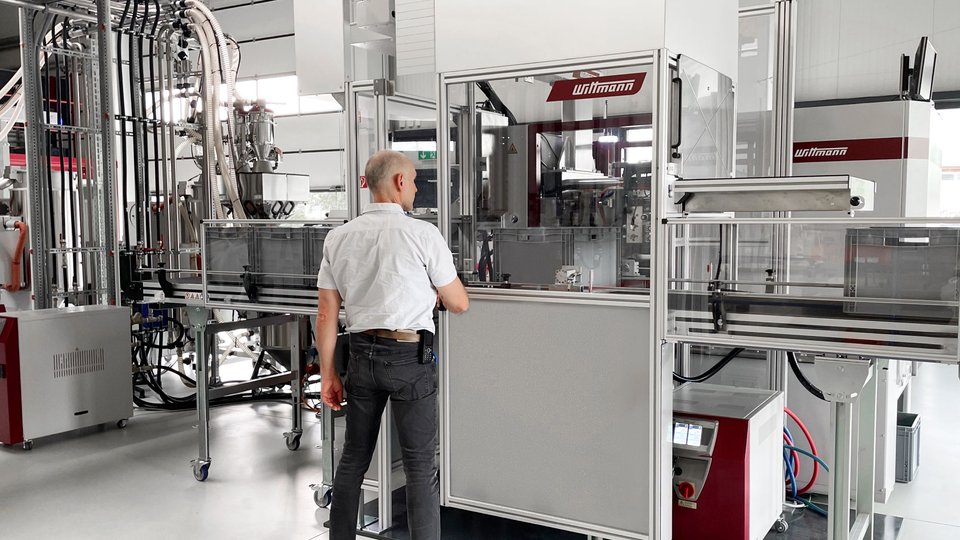
In the FlexCell plus version to be shown at Kuteno 2026, the possibility of maintaining autonomous production for a certain period of time has been provided. For this purpose, a fully automatic box transfer system has been installed for the direct packaging of molded parts into crates, KLT containers or cartons. The parts can be deposited either unsorted or stacked according to a predefined pattern. As stated by the manufacturer, a key design feature is that the box transfer system is integrated with the protective housing into one unit that can be easily moved sideways. This is intended to ensure free access to the mold space both for manual intervention and for cleaning and servicing work.
Compact automation at the injection molding machine
When developing the FlexCell automation cells, the main focus was on saving space. Because the cells are directly connected to the injection molding machine and enable production with the machine guard door open, the automation system can operate very close to the clamping unit. According to Wittmann, this translates into shorter handling times and lower investment costs, among other things because the robot can operate with a shorter Z axis.
The system's key features include minimal space requirements, modular flexibility and good accessibility. All three models of the automation cells are compatible with injection molding machines from various brands, can be retrofitted to existing production lines and can be expanded easily. All automation components have a fixed place inside the FlexCell and remain safely enclosed. According to the manufacturer, this solution supports improved occupational safety and more efficient setup processes. Temperature controllers can also be integrated in a space-saving manner while remaining easily accessible.
The company also emphasizes the advantages resulting from the standardized design. All models in the FlexCell family are intended to offer short delivery times and a favorable price-to-performance ratio.
In-line recycling beside the machine
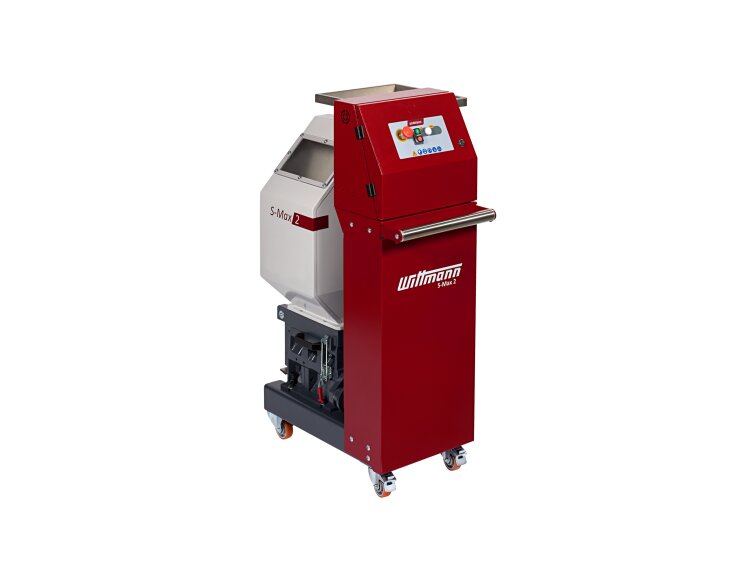
The second exhibit at the booth will be a screenless granulator from the S-Max series, intended for in-line recycling. As Wittmann indicates, rising raw material prices and new regulations are causing processors to pay increasing attention to the reuse of sprues and reject parts directly after production. If this type of waste is reground on site immediately after production, a high-quality recyclate of single-material origin is obtained, which in many applications can be added back to virgin material.
The S-Max screenless granulators are intended to enable energy- and material-saving recycling. Thanks to their compact design, they can often be placed directly beside the injection molding machine and efficiently integrated into the production cell layout. With a low motor speed of 27 rpm at 50 Hz, these units are designed to process all engineering plastics, including styrenic, acrylic and glass-fiber-reinforced materials. The low motor speed is also intended to reduce noise emissions, energy consumption and dust formation. According to the manufacturer, in combination with a very homogeneous regrind, this makes it possible to obtain granulate of consistently high quality, which supports a high share of good molded parts when the material is reprocessed by injection molding.
In developing the S-Max series, long service life of the cutting tools was also taken into account. All units in this series are intended to stand out for their low maintenance requirements. In addition to the low motor speed, this is mainly due to screenless operation. The grinding chamber can be fully opened in just a few steps and cleaned easily, which is intended to enable fast and simple material changes.
Testing facilities and trade fair presence
Wittmann also reports advisory support in selecting a granulator and in the efficient integration of in-line recycling into the production process. At the company's technical centers in Meinerzhagen and Nuremberg, infrastructure is available for grinding trials and injection molding tests. For visitors, Kuteno is intended to provide an opportunity for direct contact with the company's experts. Wittmann's booth will be located in hall 20, booth D36.