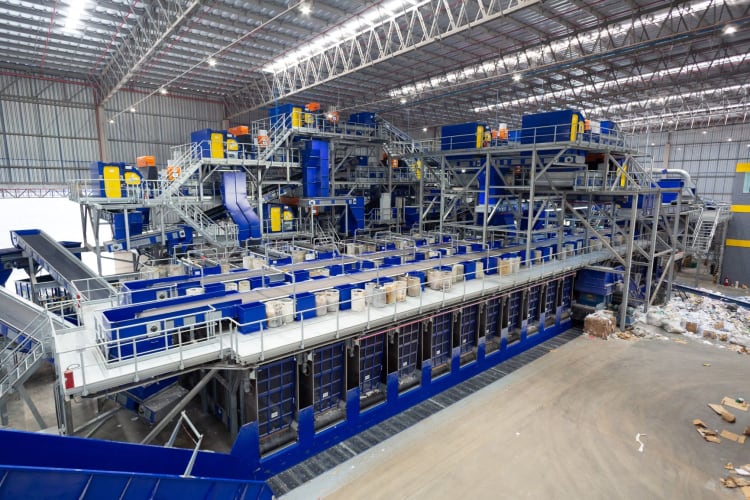
The dry recyclables sorting plant built by Stadler Anlagenbau for Flacipel Comércio de Aparas e Sucatas, part of the Multilixo Group, in Guarulhos in the state of São Paulo was commissioned at the end of 2019 and officially inaugurated in February 2020. The facility, with a capacity of up to 200 tonnes of dry recyclables per day, was designed as a highly flexible installation, capable of processing heterogeneous input streams while maximising material recovery and minimising rejects. The sorting plant has become one of the pillars of Flacipel's development strategy and an important element of the recycling infrastructure in the region, supporting efforts to reduce landfilling and increase the share of material recycling.
The investment has had an impact that goes beyond a simple increase in processing capacity for the Multilixo Group. As emphasised by Rubens Prinet, operations manager at Flacipel, the Guarulhos facility was seen from the outset as a structurally important tool in the company's development within the group. The installation was conceived as a value-creating platform in many dimensions, combining the function of a sorting plant with the role of a stable environmental services base for customers requiring high recovery rates and full traceability of waste streams. These assumptions translated into specific requirements for the configuration of the process line, including the number of output fractions, the level of automation and the ability to operate with varying input streams.
Design assumptions and process configuration
One of Flacipel's main objectives was to minimise the amount of residual waste and to sort material into 21 fractions, while maintaining the ability to process different types of input streams such as selectively collected waste and office and commercial waste. Combining high process efficiency with the required flexibility posed a significant technical and design challenge.
Henrique Filgueiras, sales director at Stadler do Brasil, notes that the ability to switch between types of input material required a particularly well thought-out plant layout and appropriate selection of equipment. Stadler's task was to design a facility that would maintain stable, high-performance operation in different scenarios without limiting operational flexibility. A modular approach to line construction was adopted, based on the company's experience in processing complex, heterogeneous secondary raw material streams.
The line includes a pre-sorting station where material is separated, among other criteria, by bag colour, which makes it possible to split off specific fractions at the very beginning of the process. This is followed by a Stadler ballistic separator to extract cardboard as a separate stream. Pre-classified material streams are stored and then fed separately into the main sorting line.
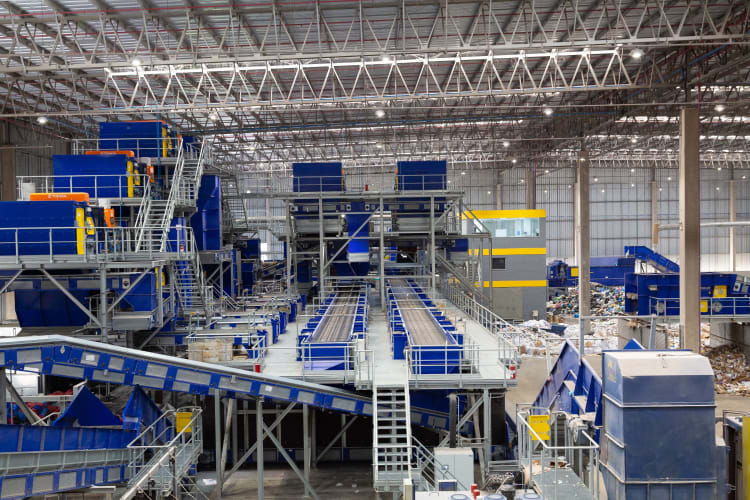
The main line is equipped with dosing units, bag openers and two additional Stadler ballistic separators. The configuration is complemented by optical sorting systems, windshifter air separators, magnetic separators and eddy-current separators. The use of these technologies enables the recovery of a wide range of fractions, including different types of plastics, films and colours, various paper grades, cartons, metals and streams destined for the production of refuse-derived fuel (RDF).
This line layout makes it possible to adapt process parameters and equipment settings to the characteristics of the specific input stream, which helps to maintain stable quality of output fractions despite variations in the composition of the waste delivered to the plant. At the same time, the reduction of residual waste translates into better utilisation of the material potential of the dry recyclables entering the installation.
Building on previous experience and cooperation
Flacipel's decision to select Stadler as its technology partner was preceded by several years of cooperation and practical operation of the company's equipment. Even before the Guarulhos project, the Multilixo Group had operated a Stadler sorting line for around seven years, equipped with a ballistic separator, bag opener and optical sorters. Experience with this installation served as a reference point for validating the technology under Brazilian conditions and was an important source of data for designing the new plant.
Silvio Urias, owner and managing director of the Multilixo Group, points out that the choice of Stadler was not only a technical decision but also a strategic one. In his view, it was part of the positioning of the group and Flacipel in the market for secondary raw material recovery and waste management services, which he compared to moving up to a higher competitive division. Practical knowledge of the operation of the ballistic separator and other equipment helped to reduce investment risks and ensure high operational performance of the new installation from the start-up stage.
The Guarulhos sorting project was developed through close cooperation between the Flacipel and Stadler teams, based on real operational experience, testing and joint development of the process scheme and plant layout. Installation was completed within four months, followed by commissioning carried out by the Stadler do Brasil team. This implementation model supported rapid transfer of operational know-how to the operator's team and a smooth transition to full‑scale operation.

Impact on capacity, operational resilience and market position
Since its start-up, the Guarulhos sorting plant has significantly changed the scale of Flacipel's operations. Monthly throughput has increased from around 4,800 tonnes to 8,000 tonnes, enabling economies of scale, improved margins and a stronger position for the company in the market for secondary raw materials and waste management services.
According to Silvio Urias, the facility has become a benchmark both in terms of the volume of material processed and the quality of the recovered fractions. Higher process stability has translated into greater operational resilience for the company. From the customers' perspective, this means access to a partner offering consistent service parameters, lower environmental risk, reliable data on waste flows and continuity of service.
The increase in capacity and quality consistency has opened up new business opportunities for Flacipel. By being able to guarantee high recovery rates and full traceability of waste, the company has acquired new customers, particularly those seeking solutions that enable the reduction or elimination of landfilling. For them, Flacipel acts as a partner to whom environmental targets can be delegated and who can provide predictable services, security and documented confirmation of the results achieved.
Stadler's involvement did not end at the commissioning stage. The plant is covered by a contract for regular inspections and preventive maintenance, under which Stadler technicians visit the site once a month. This makes it possible to plan service work more effectively and reduce downtime. Commercial and technical visits also serve to further develop the cooperation and to strengthen the position of the Guarulhos facility as a reference point for technologically advanced sorting plants in Brazil.
Role in the circular economy and development directions
At regional level, the Flacipel sorting plant in Guarulhos plays an important role in achieving sustainability and circular economy objectives. Efficient sorting and a broad range of separated fractions mean that materials entering the facility do not go to landfill but are directed to defined, as far as possible sustainable uses, such as material recycling or energy recovery from combustible fractions.
Rubens Prinet considers the installation to be a key tool for reducing the amount of waste sent to landfill and for ensuring environmental traceability of the processed streams. At the same time, the project is evolving and is subject to continuous modification, including through the integration of new equipment and gradual increases in capacity. This means going beyond the original plant concept towards a dynamic industrial platform that can be adapted to changing market requirements and regulations.
Further upgrades are currently being prepared, including the expansion of the 3D line to enable automatic separation of additional material fractions. The direction of these changes indicates a continued increase in the level of automation and sorting accuracy, which is important both in terms of the quality of secondary raw materials and in meeting the requirements of end customers along the plastics, paper and metal recycling value chain.
For Stadler, the Guarulhos project is an example of the importance of long‑term cooperation and a flexible approach to the design of sorting installations. From the technology supplier's perspective, the facility shows how a well‑designed sorting plant can become a growth tool, combining high efficiency, the ability to adapt to changing waste streams and close cooperation with the operator. Such a configuration makes it possible to build an installation that is prepared not only for current market needs but also for future challenges related to the development of recycling systems and the achievement of climate targets.